


What Does an EICR Check For? The 2026 Guide to Electrical Safety Inspections
- oliverroberts100
- Aug 3
- 12 min read
Did you know that a simple oversight in your consumer unit could lead to a £40,000 fine or, worse, a hidden fire hazard? It's a common worry for landlords and homeowners alike, especially with the "EICR time bomb" hitting in 2026 as thousands of five-year certificates expire at once. If you're wondering what does an EICR check for, you're likely trying to navigate the confusion between fixed wiring and portable appliances while avoiding unexpected repair costs. We understand that you need clarity, not jargon, to keep your property legal and your family safe.
You likely already recognise that regular testing is the only way to catch silent wear and tear before it becomes a crisis. This guide breaks down the entire inspection process into plain English. We'll explain exactly what happens when the power goes off, how the new BS 7671 Amendment 4 standards affect your home, and how to interpret the pass or fail codes on your final report. By the end, you'll know precisely how to prepare for your visit and ensure your electrical system remains fully compliant with the latest UK safety laws.
Table of Contents
What is an EICR and Why is it Essential for Your Home?
Think of an Electrical Installation Condition Report (EICR) as an MOT for your property’s electrical system. Just as you wouldn't drive a car for a decade without checking the brakes, you shouldn't live in a house without verifying the safety of its hidden wiring. An EICR is a formal document issued after a comprehensive assessment of your electrical infrastructure. It ensures everything is up to the latest safety standards, specifically the BS 7671 Amendment 4 regulations that became mandatory on 15 October 2026.
When asking what does an EICR check for, many people assume it's a quick glance at their light switches. In reality, it focuses on the "fixed wiring" of your home. This is the invisible network of cables, conduits, and connections that run behind your walls and under your floors. Over time, these components can degrade due to heat, age, or even rodent damage. A professional inspection identifies these silent hazards whilst they are still manageable, preventing them from escalating into dangerous situations.
Safety is the primary driver behind these reports. By identifying overloads and defective work, an EICR helps prevent house fires and lethal electric shocks. Organisations like Electrical Safety First work tirelessly to raise awareness about these risks. Unlike a basic visual check, a professional EICR involves rigorous dead and live testing. This means we use specialised equipment to send signals through your circuits. This process uncovers faults that the human eye simply cannot see.
Fixed Wiring vs. Portable Appliances
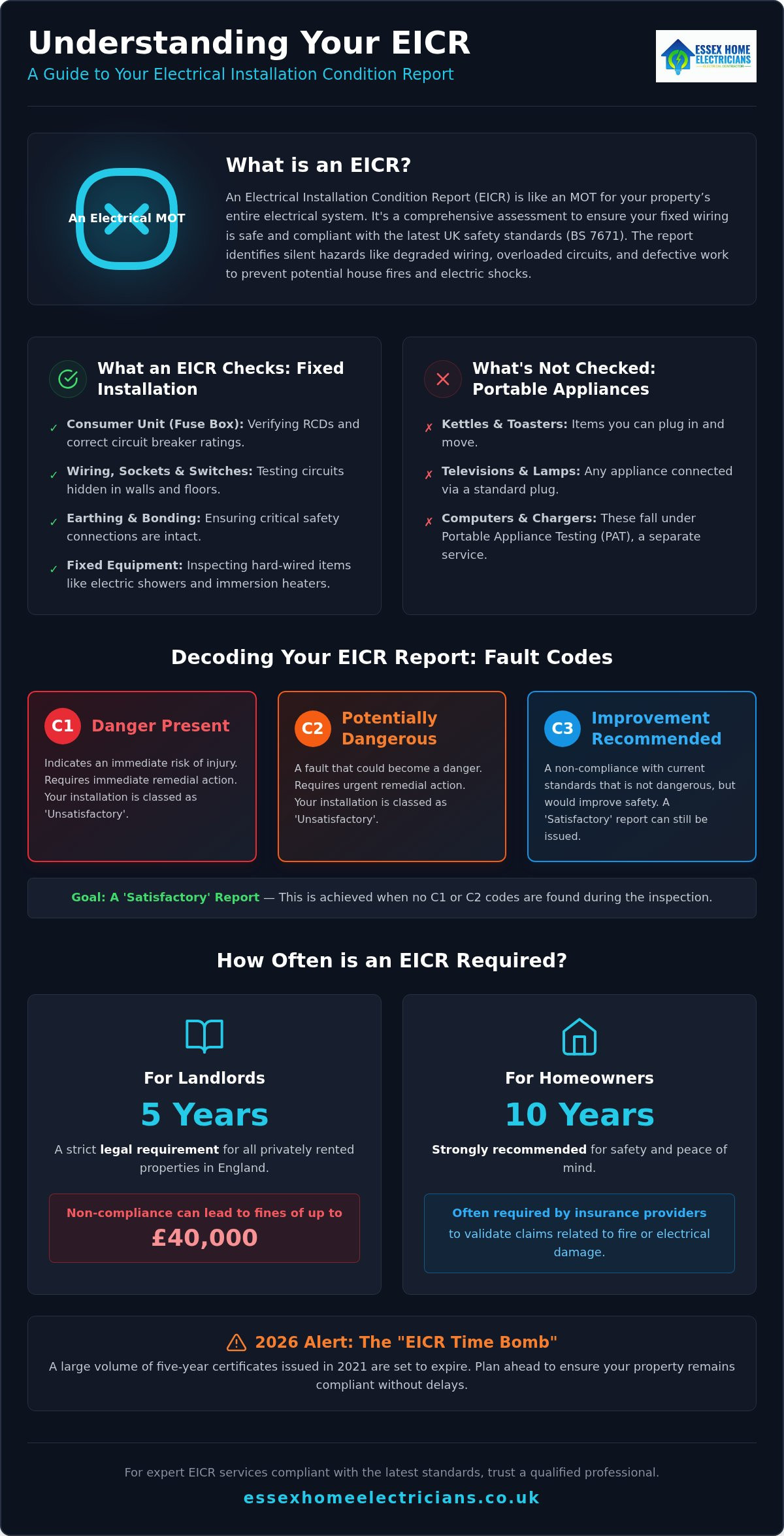
It's vital to understand the boundary of an EICR. This report covers the permanent parts of your system, including your consumer unit, sockets, and switches. It does not include your kettle, toaster, or television. Those items fall under Portable Appliance Testing (PAT), which is a separate but complementary service often required for Essex businesses. We also inspect "fixed electrical equipment" during an EICR. This includes hard-wired items that you can't simply unplug, such as electric showers, immersion heaters, and storage heaters.
The Legal Landscape for Essex Property Owners in 2026
The rules regarding electrical safety have tightened significantly. For landlords in England, having a satisfactory EICR is a strict legal requirement under the Landlord and Tenant Act. You must have your property inspected at least every five years to avoid civil penalties that can reach £40,000. If you are managing a rental property, our landlord EICR Essex guide provides a deeper look at these specific compliance needs. Understanding what does an EICR check for helps you prepare for this essential visit.
Homeowners aren't legally forced to have an EICR in the same way, but it's strongly encouraged every 10 years. Many insurance providers now request proof of a recent inspection before they will settle a claim related to fire or electrical damage. Staying proactive protects your investment and, more importantly, your family's safety.
The Core Inspection: What Does an EICR Check For Specifically?
An EICR is a two-stage process that combines a detailed visual survey with rigorous electrical testing. We start by looking for obvious hazards that the untrained eye might miss. This includes identifying DIY "botch jobs", damaged cables, or signs of overheating at socket outlets. We also verify that your earthing and bonding are sufficient. This is a critical safety feature that ensures, if a fault occurs, the electricity is safely diverted to the ground rather than through a person. Understanding what does an EICR check for helps you prepare your property for a smooth inspection day.
The Consumer Unit and Protective Devices
The consumer unit, or fuse box, is the brain of your home's electrical system. We perform a deep dive into its condition to ensure it can handle modern demands. We specifically check for Residual Current Devices (RCDs). These are lifesavers that trip the power in a fraction of a second if a fault is detected. We also verify that Miniature Circuit Breakers (MCBs) are correctly rated for each circuit to prevent overloading. Our experts look for physical signs of distress, such as heat damage or loose connections, which are common causes of domestic fires.
Wiring, Sockets, and Lighting Circuits
Beyond the fuse box, the core of what does an EICR check for involves deep circuit testing. We measure "continuity" to ensure the electrical path is unbroken and "insulation resistance" to confirm that the wires aren't leaking current. This is particularly important for older Essex properties where cable insulation can become brittle. We pay close attention to "special locations" like bathrooms. In coastal areas like Southend, high humidity can accelerate the degradation of electrical fittings, so we ensure all equipment meets the required safety zones and IP ratings.
Practicalities: What to Expect on Testing Day
Testing is a thorough process that requires the power to be turned off for significant periods. We cannot test a "live" circuit safely, so please plan for a lack of electricity whilst we work. You'll need to provide clear access to your consumer unit and all accessible sockets and switches. For a standard three-bedroom home in Essex, the inspection typically takes between two and four hours. We follow the official GOV.UK guidance to ensure every report is legally robust and accurate. If you're ready to secure your property, you can book your fixed-price inspection with our local team today.
Decoding Your EICR Report: Understanding C1, C2, and C3 Codes
The final document you receive isn't just a simple tick-box list. It is a detailed assessment that concludes with an overall status of either "Satisfactory" or "Unsatisfactory". To reach this verdict, the electrician uses a standardised coding system to rank every observation found during the inspection. When considering what does an EICR check for, it is helpful to view these codes as a prioritised to-do list for your property's safety. A single high-priority fault will result in an automatic fail, requiring immediate attention to keep the premises legal and safe.
The classification codes are defined by strict industry criteria supported by Electrical Safety First. These rankings ensure that both homeowners and landlords understand the severity of any issues discovered. The codes are broken down as follows:
C1 (Danger Present): This is the most critical ranking. It indicates an immediate risk to life, such as exposed live wires. The electrician will usually fix these issues or make them safe whilst on-site.
C2 (Potentially Dangerous): Whilst not an immediate threat, a C2 fault could become dangerous if a second fault occurs. This is still an "Unsatisfactory" result that requires urgent remedial work.
C3 (Improvement Recommended): This indicates that your system is safe but does not meet the latest 2026 wiring standards. You aren't legally required to fix these, but doing so improves the long-term reliability of your home.
When an 'Unsatisfactory' Result Occurs
If your report contains any C1 or C2 codes, it is legally deemed "Unsatisfactory". For Essex landlords, this triggers a strict legal obligation under the 2026 regulations to complete remedial works within 28 days. You must also provide written confirmation to your tenants and the local authority that the hazards have been resolved. We understand the stress of a failed report, which is why we provide itemised, transparent quotes for all necessary repairs immediately after the inspection. Our goal is to move your property from a fail to a "Satisfactory" status with minimal disruption.
FI (Further Investigation) Codes
Sometimes, an electrician might record an FI code. This happens when they identify a potential issue that cannot be fully diagnosed within the scope of the standard test. In older properties across Billericay or Leigh-on-Sea, complex wiring layouts from previous decades can often hide the source of a fault. You cannot ignore an FI code; it is treated as an "Unsatisfactory" result until the investigation is complete. Understanding what does an EICR check for means recognising that sometimes we need to dig a little deeper to guarantee your absolute peace of mind.
EICR Frequency: How Often is an EICR Required for Your Property?
The intervals between electrical inspections aren't just suggestions; they are vital safety boundaries. For standard domestic homeowners, the general rule is to have an inspection every 10 years. If you are moving house, we always recommend a fresh report upon change of occupancy to ensure you aren't inheriting someone else's DIY mistakes. For UK landlords, the law is much stricter. You must have a valid certificate every five years to remain compliant. Commercial properties typically follow this same five-year cycle, though high-risk sites like petrol stations or industrial units often require more frequent testing. It's vital to remember that these are maximum intervals. Safety doesn't follow a calendar, and your system can degrade long before your certificate expires.
When considering what does an EICR check for, you must account for the environment your property sits in. A house in a sheltered inland town won't face the same stresses as one on the coast. These guidelines provide a legal baseline, but they don't always reflect the reality of wear and tear in specific Essex locations. Waiting for the absolute deadline can sometimes lead to more expensive remedial works down the line.
Essex Specifics: Coastal Corrosion and Property Age
Living in Southend or on Canvey Island brings unique challenges for your electrical system. The salt-heavy air in these coastal areas is incredibly abrasive. It accelerates the corrosion of outdoor electrics, security lighting, and even the internal components of your consumer unit. For properties with high exposure to sea spray, we strongly recommend a safety check every three years rather than five. We also see many properties in Basildon with original 1960s wiring. These older systems weren't designed for the heavy load of modern heat pumps or EV chargers. They require a more vigilant approach to testing to ensure the insulation remains intact.
Trigger Events for an Early EICR
Specific events should prompt an inspection regardless of when your last one was completed. If you've just bought a property where the previous owners carried out significant renovations, an EICR is essential to verify the work was done to code. Physical damage from storms, floods, or even a minor fire also makes an immediate test mandatory. You should also watch for "nuisance tripping" or flickering lights. These are often the first signs of a loose connection or a failing circuit. If you notice these symptoms, you may need a rapid response from an emergency electrician Basildon to identify the fault before it escalates. Understanding what does an EICR check for allows you to spot these red flags early and take action. If your certificate is approaching its expiry date, you can book your fixed-price EICR with our local Essex team today.
Next Steps: Booking Your EICR in Essex
Booking an inspection shouldn't be a gamble. You need a NAPIT-accredited professional to ensure your certificate is legally valid under the strict 2026 rules. We focus on individual competence, ensuring every electrician on our team possesses the required Level 3 qualifications and years of documented experience. We provide a clear, fixed-price promise for all Essex homeowners and landlords. This means you won't face unexpected surcharges or "hidden fees" once we arrive at your door. Our process is designed for speed and efficiency. We handle all the paperwork digitally, sending your final report directly to your inbox as soon as it's signed off. This makes sharing the document with tenants, insurers, or local authorities completely seamless.
Our team brings deep local expertise to every property we visit. We understand the specific challenges faced by different housing stocks across the county. Whether you own a modern apartment or a coastal bungalow, we know exactly what does an EICR check for to keep your specific installation safe. We don't just provide a list of faults; we offer practical advice on how to maintain your system for the long term. This proactive approach helps you avoid the "renewal cliff" and keeps your property compliant with the latest BS 7671 Amendment 4 standards.
EICRs for Home Buyers in Basildon and Southend
Moving into a new home is stressful enough without discovering a faulty consumer unit on your first night. Never buy an older property in Basildon or Southend without requesting a recent safety report first. If the seller cannot provide one, booking your own inspection is a smart investment. When asking what does an EICR check for in a pre-purchase context, you're looking for financial leverage. An "Unsatisfactory" result allows you to negotiate the purchase price down based on the estimated cost of remedial works. You can also request that the current owner completes all C1 and C2 repairs as a condition of the sale. If the inspection reveals that the system is beyond simple repair, our house rewiring Essex guide can help you budget for a full renovation project.
The Essex Home Electricians Difference
We've spent over 20 years building a reputation as the trusted local experts for Rayleigh, Wickford, and Billericay. Our team doesn't just tick boxes; we provide a consultative service that puts your safety first. If we discover a critical C1 fault whilst on-site, we don't leave your family at risk. We offer a 1-hour emergency response to isolate or repair dangerous issues immediately. This rapid action is part of our commitment to the Essex community. We combine high-level technical standards with the friendly approach of a helpful neighbour. Don't leave your safety to chance or wait for a system failure to occur. Book your EICR safety check today and ensure your property meets the 2026 standards.
Protect Your Essex Home with a Modern Safety Inspection
Understanding exactly what does an EICR check for is the first step toward a safer, more compliant property. We've explored how these reports prioritise your fixed wiring, from the consumer unit to the furthest socket in your home. Whether you are a landlord avoiding heavy fines or a homeowner protecting your investment, staying ahead of the 2026 standards is essential. Regular testing doesn't just satisfy legal requirements. It provides the ultimate peace of mind for you and your family.
Our team brings over 20 years of local experience to every job across Southend, Basildon, and the wider Essex area. As NAPIT-accredited experts, we ensure your certificate is legally robust and accurate. If we discover any urgent safety issues during your test, we provide 24/7 emergency support to resolve them quickly. Don't leave your electrical safety to chance or wait for a silent fault to become a crisis.
Book Your Fixed-Price EICR in Essex Now and let our local experts keep your property safe and compliant for years to come.
Frequently Asked Questions
Is an EICR a legal requirement for all homeowners in 2026?
No, an EICR is not currently a legal requirement for private homeowners in the UK. It is, however, highly recommended every 10 years to ensure your property remains safe and your home insurance stays valid. Without a recent report, you may find it difficult to settle a claim if an electrical fire occurs.
How long does an EICR certificate remain valid for a rental property in Essex?
For rental properties, the legal maximum validity is five years. In coastal Essex locations such as Southend or Canvey Island, we often recommend more frequent checks for outdoor installations. Salt air can accelerate the corrosion of components, so a three-year interval is sometimes safer for properties with high exposure.
Can I sell my house in Basildon without a valid EICR?
Yes, you can legally sell a house in Basildon without one. However, most modern buyers and mortgage lenders now insist on seeing a "Satisfactory" report before the exchange of contracts. If you don't have a valid certificate, a buyer may use the uncertainty to negotiate a lower purchase price to cover potential rewiring costs.
What happens if my EICR comes back as 'Unsatisfactory'?
An "Unsatisfactory" result means the electrician found C1, C2, or FI codes during the inspection. You must carry out remedial work to fix these faults before a "Satisfactory" certificate can be issued. Landlords are legally required to complete these repairs within 28 days to remain compliant with UK safety laws.
Do I need a new EICR if I get a new tenant within the 5-year period?
No, you don't need a full new report every time a tenant moves in, provided your current certificate is less than five years old. The report covers the installation itself, not the occupants. We still suggest a simple visual check between tenancies to ensure no physical damage has been done to sockets or switches.
How much does an EICR typically cost for a 3-bedroom house in Essex?
The cost of an inspection is usually determined by the size of the property and the number of circuits. Whilst standard UK industry rates for a three-bedroom home often fall between £100 and £250, we offer a fixed-price structure for Essex residents. This ensures you know the total cost upfront without any hidden circuit fees.
Does a new-build property need an EICR immediately?
No, a new-build home doesn't require an EICR straight away. It should be supplied with an Electrical Installation Certificate (EIC) that confirms the initial work meets all safety standards. This document typically covers the property for the first five years if rented, or ten years if it's your own home.
Can any electrician carry out an EICR inspection?
No, only electricians with specific qualifications and experience should perform these tests. When asking what does an EICR check for, it's clear that the process requires advanced technical knowledge. As of 2026, inspectors must hold a Level 3 Award in Periodic Inspection and Testing to ensure the report is legally recognised.


Comments