


Essex Homebuyer EICR Check: Safety Guide (2026)
Your RICS homebuyer survey won't tell you if the property's wiring is safe or on the verge of complete failure. Most buyers believe a standard survey inspects the electrical circuits, but surveyors only glance at visible fittings before adding an urgent disclaimer to protect their own liability. That leaves you facing the stressful risk of inheriting dangerous DIY work or an unexpected bill for a full rewire. Arranging an independent EICR check for home buyers Essex wide cuts straight through that uncertainty, turning hidden electrical faults into hard facts before you commit.
You deserve total clarity before exchanging contracts on a new home. In this guide, you'll discover how a pre-purchase inspection uncovers concealed wiring defects, translates complex safety codes, and provides your conveyancer with the leverage needed to renegotiate the purchase price. We'll walk you through typical electrical issues across local housing stock, inspection timescales, and how an authoritative condition report protects both your family and your financial investment.
Table of Contents
What Is an EICR and Why Do Essex Homebuyers Need One?
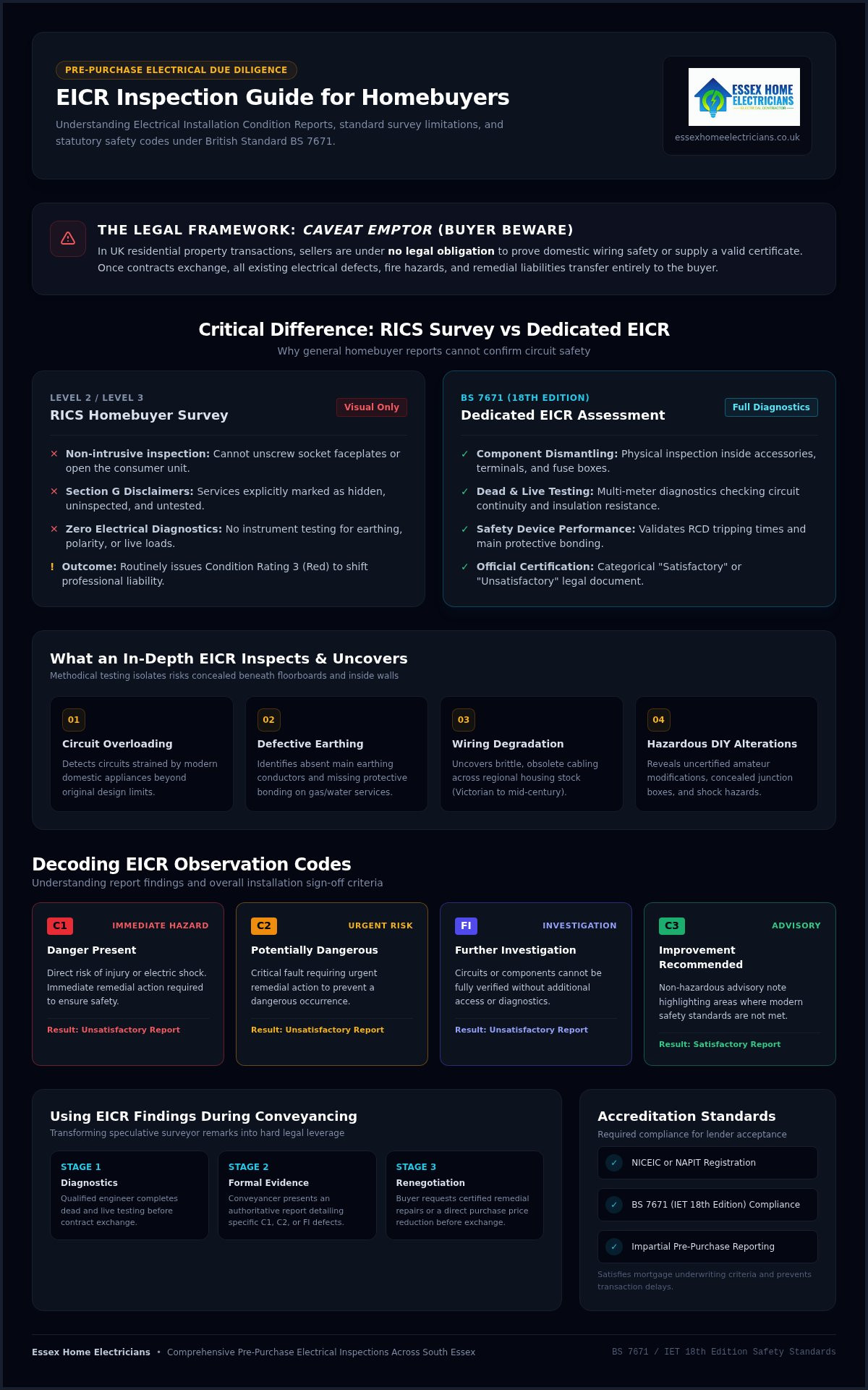
An Electrical Installation Condition Report (EICR) is an in-depth assessment of a property's fixed wiring, incoming supply, fuse box, and connected accessories. While estate agent brochures showcase freshly painted walls and modern kitchen worktops, they reveal nothing about the cables buried underneath. Mortgage valuation surveys don't assess safety either; they simply check whether the property represents adequate financial security for the loan. Booking an independent EICR check for home buyers Essex wide ensures you aren't blindsided by hidden fire risks, failing insulation, or ungrounded circuits after completing your purchase.
During an inspection, a qualified electrician methodically tests the entire installation to identify:
Overloaded circuits feeding modern domestic appliances
Absence of critical earthing and protective bonding
Degraded, brittle, or obsolete wiring types
Hidden fire and electrical shock hazards created by unqualified amateur DIY work
The Legal Reality: Caveat Emptor in UK Property Purchases
Residential property transactions in England operate strictly under the legal principle of caveat emptor, or "buyer beware". Current owners are under no legal obligation to provide a recent safety certificate or prove the domestic wiring is safe before selling. The moment you exchange contracts, all existing defects, fire risks, and maintenance liabilities transfer directly to you. Arranging an independent inspection before exchanging contracts protects your bank balance, preventing sudden out-of-pocket expenses for emergency repairs the week you collect the keys.
BS 7671 Requirements and Domestic Safety Standards
Domestic electrical testing benchmarks an installation directly against the national standard, known as the BS 7671 wiring regulations (the IET Wiring Regulations 18th Edition). Qualified engineers conduct specialized dead and live tests to evaluate how circuit breakers, main earthing terminals, and Residual Current Devices (RCDs) perform under realistic electrical fault conditions.
Once testing finishes, the engineer formally signs off the installation as either "Satisfactory" or "Unsatisfactory". If hazardous defects are flagged, you gain clear, authoritative documentation. This official report gives your conveyancing solicitor hard evidence to request repairs or negotiate a price reduction before completion. For professional guidance on domestic safety inspections across south Essex, Essex Home Electricians provides comprehensive pre-purchase assessments designed to keep your purchase secure.
Standard RICS Survey vs Dedicated EICR: Understanding the Critical Difference
Many property buyers assume a Level 2 or Level 3 building survey includes electrical testing. It doesn't. Chartered surveyors provide exceptional insight into roofing timbers, structural movement, and damp proofing, but they aren't qualified electricians. In section G of their paperwork, surveyors routinely insert standard disclaimers stating that services remain hidden, uninspected, and untested. Booking a dedicated EICR check for home buyers Essex wide fills this critical gap, replacing speculative surveyor assumptions with conclusive diagnostic testing.
Limitations of General Homebuyer Survey Reports
General surveyors work under the strict framework of RICS Home Survey standards. These guidelines restrict surveyors to non-intrusive, visual inspections. They cannot unscrew socket faceplates, open consumer units, or test circuit continuous paths. If a seller cannot present an up-to-date safety certificate or Part P building compliance document, surveyors routinely issue a Condition Rating 3 (Red). This rating flags an urgent defect requiring professional investigation, often prompting nervous mortgage lenders to threaten retention clauses before exchange.
What an Accredited Electrician Physically Inspects and Tests
A dedicated pre-purchase inspection involves multi-meter instrument diagnostics alongside physical component dismantling. Rather than guessing whether hidden circuits are safe, an electrician conducts dead and live tests across every individual circuit in the building.
Key inspection procedures include:
Insulation resistance testing: Delivers test voltages down cables to check for damaged, chewed, or thermally degraded insulation behind walls.
Earth fault loop impedance: Measures whether circuit breakers will trip quickly enough during a dead short to prevent fatal shocks.
RCD trip-time testing: Verifies safety switches cut the power supply in milliseconds under simulated shock conditions.
Consumer unit safety audit: Evaluates circuit capacity, metal enclosure fire ratings, and surge suppression. If you're assessing an older setup, review our guide on fuse box upgrade Basildon requirements to see modern board standards.
Visual assessments alone cannot reveal whether circuits will overload under daily family use or spark inside wall cavities. If your survey flagged electrical disclaimers, you can easily contact our local team to book an independent pre-purchase inspection before committing to contracts.
Decoding Observation Codes and Common Defects in Essex Housing
Receiving a multi-page electrical report can feel overwhelming if you don't know how to interpret the technical jargon. An inspector records any non-compliant issues as observation codes. These ratings reflect risk severity, directly determining whether a property passes or fails. Booking a focused EICR check for home buyers Essex wide gives you the exact terminology needed to discuss repairs rationally with the vendor before completion day.
Understanding C1, C2, C3, and FI Defect Classifications
Inspectors categorise safety findings into four distinct codes outlined in official GOV.UK electrical safety guidance:
Code C1 (Danger Present): Immediate risk of injury or electric shock. Examples include exposed live terminals, damaged consumer unit casings, or completely missing earthing. The inspector will usually isolate the circuit immediately to make it safe.
Code C2 (Potentially Dangerous): Urgent remedial action required. Typical defects include missing 30mA RCD protection for socket circuits, absent supplementary bonding to incoming metallic gas or water pipes, or undersized conductors that overheat under normal load.
Code FI (Further Investigation Required): Unidentified circuits or concealed junction boxes that cannot be confirmed safe without destructive access.
Code C3 (Improvement Recommended): Highlights non-compliance with the newest wiring updates that are not currently dangerous, such as older colour-coded sleeving or minor wear to cosmetic plates.
The pass-fail threshold is absolute. A single C1, C2, or FI observation makes the report "Unsatisfactory". Only reports containing exclusively C3 codes or zero defects receive a "Satisfactory" outcome.
Typical Electrical Faults Uncovered Across Essex Properties
Different eras of Essex construction present recurring safety challenges:
Post-war developments (Basildon, Harlow): 1960s builds often retain wooden-backed Wylex fuse boards with rewireable fuse wire. These boards lack modern shock protection and struggle to cope with induction hobs, heat pumps, and electric vehicle chargers.
Period homes (Southend, Leigh-on-Sea, Colchester): Victorian and Edwardian terraces frequently hide degrading vulcanised Indian rubber (VIR) or lead-sheathed cables behind fresh plaster. These crumbling insulations present genuine fire hazards. For properties requiring comprehensive updates, explore our complete guide to house rewiring Essex costs and procedures.
Suburban extensions (Rayleigh, Billericay, Wickford): Uncertified DIY wiring in garages, garden offices, and outbuildings frequently reveals absent earthing paths, undersized twin-and-earth cables, and loose connections.
Spotting these era-specific defects before exchanging contracts lets you separate minor, non-critical improvements from genuine safety liabilities.
How to Organise an EICR and Use Results During Conveyancing
Organising a pre-purchase electrical survey is straightforward when you integrate it early into your conveyancing timeline. Rather than treating the report as a simple tick-box exercise, view it as an objective valuation tool. An EICR check for home buyers Essex wide delivers concrete evidence you can use to safeguard your capital before signing binding legal agreements.
The inspection and negotiation process follows five practical steps:
Step 1: Seek written permission from the vendor via the selling estate agent.
Step 2: Appoint an independent, qualified registered electrician.
Step 3: Agree clear access parameters across all circuits, including lofts and outbuildings.
Step 4: Review the formal condition report alongside an itemised remedial estimate.
Step 5: Instruct your conveyancing solicitor to raise official pre-contract enquiries and negotiate.
Arranging Inspection Access Through Estate Agents
Timing matters during conveyancing. Contact the selling agent as soon as your offer is accepted or immediately after your RICS survey flags electrical disclaimers. Testing requires physical access across the property, so confirm ahead of time that the mains electricity supply is fully energised. Ask the vendor to clear storage away from consumer units, under-stair cupboards, and loft hatches. An unhindered inspector can complete testing efficiently within two to four hours without disrupting the sellers.
Renegotiating Purchase Prices or Requesting Vendor Remedials
If your report returns an "Unsatisfactory" outcome due to C1 or C2 defects, you have substantial leverage. Your conveyancing solicitor can submit the official report along with an itemised contractor's quote directly to the vendor's legal team. You generally have two paths forward:
Price reduction or retention: Deduct the exact cost of the remedial repairs directly from the agreed purchase price, retaining your cash to instruct your own contractor after completion.
Vendor rectification: Require the seller to complete all urgent C1 and C2 rectifications before contracts are exchanged. Always insist on receiving a registered competent person certificate and updated report before completing.
Conveyancing deadlines move fast. If you need a thorough assessment to protect your upcoming property purchase, book your pre-purchase EICR with our Basildon team today for a rapid turnaround.
Choosing an Accredited Essex Electrician for Pre-Purchase Inspections
Estate agents frequently recommend in-house contractors when buyers raise questions about wiring. While convenient, this practice can introduce an unwelcome conflict of interest. An agent's primary goal is to complete the transaction smoothly, which may disincentivise their preferred contacts from flagging difficult defects. Commissioning an independent EICR check for home buyers Essex ensures you receive an impartial appraisal with zero commercial ties to the sale.
Essential Qualifications and Accreditations to Verify
Not every tradesperson possesses the specialist credentials or diagnostic equipment required to evaluate domestic installations formally. Before hiring an inspector, check these core credentials:
Competent Person registration: Verify the contractor holds active registration with a recognised scheme operator such as NAPIT or NICEIC.
Specialist testing qualifications: Check that the attending engineer holds dedicated inspection credentials, such as City & Guilds 2391 or its equivalent.
Insurance coverage: Confirm the business carries valid public liability and professional indemnity insurance to cover testing procedures.
Report quality: Ask whether their reports include clear photographic evidence alongside straightforward, non-technical defect summaries.
Book Your Home Buyer EICR Across South Essex
Essex Home Electricians provides rigorous pre-purchase assessments tailored to buyers throughout south Essex. Based in Basildon, our NAPIT-accredited engineers bring over 20 years of domestic testing experience to local communities, including Benfleet, Rayleigh, Wickford, Billericay, and Southend. We understand the specific wiring quirks found across the county's varied housing stock, from coastal Victorian villas to post-war suburban estates.
Conveyancing schedules leave very little margin for delay. When you need clear, objective advice to protect your prospective purchase, book your survey via our pre-purchase inspection team today. We will supply the technical evidence required to help you exchange contracts with confidence.
Secure Your Essex Property Investment Before Exchanging Contracts
Buying a home is one of the largest financial commitments you'll ever make. Relying solely on visual building surveys leaves you vulnerable to dangerous hidden wiring hazards and sudden repair liabilities under the UK's caveat emptor principle. Arranging a professional EICR check for home buyers Essex wide transforms unknown risks into clear, documented evidence. It gives you the leverage to renegotiate purchase prices, demand vendor repairs, and avoid unbudgeted bills after completion day.
You shouldn't let electrical uncertainty delay your move. Backed by over 20 years of domestic inspection experience, Essex Home Electricians delivers prompt reporting tailored to strict conveyancing deadlines. As a NAPIT-accredited contractor based in Basildon, our engineers combine thorough testing with full-service capability, readily handling any subsequent consumer unit upgrades or complete rewiring if required. Book your pre-purchase EICR check with our accredited Essex electricians today to step into your new home with total confidence.
Frequently Asked Questions
Is an EICR legally required when buying a house in Essex?
No, there is no statutory legal requirement forcing a residential buyer or seller to commission an EICR under UK law. Domestic purchases operate strictly under buyer beware principles. However, while owner-occupiers aren't legally mandated like private landlords, mortgage lenders frequently make an EICR check for home buyers Essex wide a formal lending condition if the property surveyor notes outdated components or issues a red warning rating on electrical services.
How much disruption does a pre-purchase EICR cause during viewings?
Disruption is minimal and completely non-destructive. Our engineers do not lift floorboards or channel into plaster. The main requirement is turning the electrical supply off in stages for short intervals to complete dead instrument tests. Sellers can comfortably remain in the home during testing, provided work areas around the fuse board, accessible sockets, and loft hatches are kept clear before the engineer arrives.
Can a seller refuse to allow an EICR check before exchange?
Yes, a vendor has the legal right to decline access because they still own the property. However, outright refusal is an immediate red flag for buyers and conveyancing solicitors. It usually suggests the seller suspects severe wiring faults or uncertified DIY modifications. If a seller refuses access, you should discuss this hesitation with your solicitor, as proceeding blindly risks inheriting thousands of pounds in urgent rewiring liabilities.
What happens if the home buyer EICR reveals an Unsatisfactory rating?
An Unsatisfactory rating simply means the inspector identified at least one C1, C2, or FI observation code. You don't need to pull out of the purchase immediately. Instead, share the report with your conveyancer. You can instruct them to request that the vendor remedies the urgent defects via an accredited electrician before exchange, or negotiate a clear price reduction based on our written repair quote.
Can I use an EICR report to reduce my property purchase price?
Yes, an itemised condition report is one of the most effective renegotiation tools available during conveyancing. When serious safety risks emerge, buyers across south Essex routinely present the inspector's itemised remedial quote to the selling agent. Sellers often prefer reducing the agreed purchase price or establishing a formal financial retention rather than risking a broken property chain or losing their onward purchase.
How long does a pre-purchase electrical inspection take to complete?
A standard pre-purchase electrical inspection takes between two and four hours for a typical two-to-three-bedroom domestic property. Larger homes, older period properties in places like Leigh-on-Sea, or houses with complex extensions require slightly longer. During this visit, the engineer methodically tests every individual circuit, verifies earthing paths, and photographs any non-compliant issues, before compiling the final technical certificate off-site for rapid delivery.
Will a standard RICS Level 2 survey uncover dangerous house wiring?
No, a standard RICS Level 2 survey will never uncover concealed electrical faults. Chartered surveyors only perform a basic visual review from standing height. They don't remove consumer unit covers, test socket polarities, or inspect hidden cabling inside wall cavities. Surveyors explicitly state this limitation in their disclaimers, making a dedicated EICR check for home buyers Essex essential to identify fire hazards and earthing failures before you complete.


Comments