


Electrical Test Certificates: 2026 Essex Homeowner Guide
- oliverroberts100
- Aug 5
- 13 min read
Could a single missing document really cost you £30,000 or stall your house sale indefinitely? In 2026, electrical safety isn't just about avoiding a tripped switch; it's a strict legal landscape that every Essex homeowner needs to navigate. You might be worried about confusing terminology like EICR versus EIC, or perhaps you're anxious that a routine outdoor socket installation Essex project might uncover expensive hidden faults. It's completely normal to feel a bit uneasy when technical standards change, especially with the recent Amendment 4 to the wiring regulations now in full effect.
We understand that you want to keep your family safe and your paperwork in order without facing unexpected repair bills. This guide promises to strip away the jargon. You'll discover exactly what an electrical test certificate is, why you legally need one, and how the inspection process works in your Essex home. We'll preview the latest 2026 standards and explain how a valid certificate provides the peace of mind you need for a successful property sale or a safe rental.
Table of Contents
Understanding the Electrical Test Certificate and Why Your Home Needs One
Navigating Different Types of Electrical Safety Certificates
The EICR Inspection Process: Steps to Securing Your Certificate
Legal Obligations: When is an Electrical Certificate Mandatory in Essex?
Professional Electrical Testing Services Across Basildon and Essex
Understanding the Electrical Test Certificate and Why Your Home Needs One
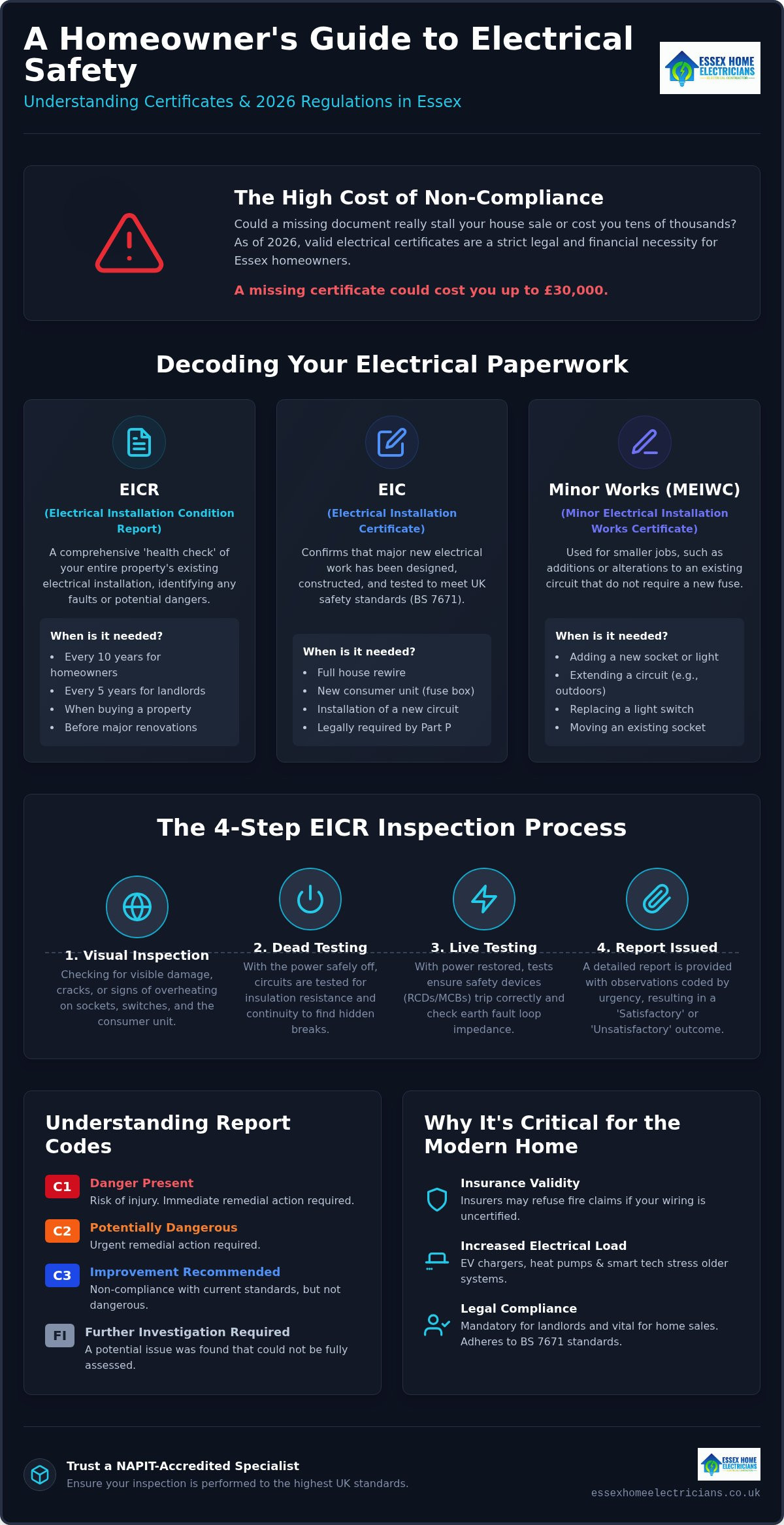
An electrical test certificate is a formal document issued by a qualified electrician to confirm that your home's wiring is safe for continued use. Most homeowners recognise this as an Electrical Installation Condition Report (EICR). It's a comprehensive health check for your property's electrical system. The primary goal is protecting your life and property from the risks of fire or electric shock. All testing follows the strict UK electrical wiring standards, specifically BS 7671. As of 2026, these regulations include Amendment 4, which addresses modern challenges like solar PV and battery storage. Every circuit, from your fuse box to a recent outdoor socket installation Essex, must meet these rigorous safety benchmarks to pass.
The Difference Between an EICR and a Minor Works Certificate
It's easy to get confused by the paperwork. An EICR is a comprehensive assessment of your entire home. It involves testing every circuit to find hidden faults, such as degraded insulation or poor earthing. In contrast, a Minor Works Certificate is used for smaller, specific tasks. If you've just added a single light switch or completed an outdoor socket installation Essex, this smaller certificate is usually sufficient. It confirms that the specific addition doesn't compromise the safety of the existing system. You'll need the full EICR for a total property sign-off, whilst minor works cover the small, documented tweaks. Knowing which one you need saves time and prevents unnecessary costs during a house sale.
Why an Electrical Test Certificate is Essential in 2026
Homes in 2026 look very different from those built even a decade ago. We're asking our wiring to do more than ever before. With the surge in EV chargers, heat pumps, and smart home hubs, the electrical load on older Essex properties has skyrocketed. This increased demand can stress aging cables, leading to overheating. Beyond immediate safety, these certificates are now a non-negotiable for home insurance validity. Most providers won't pay out for fire damage if they find your wiring wasn't certified. For families in older homes in Basildon or Southend, this report is the only way to prove your house isn't a hidden risk.
At Essex Home Electricians, we view these reports as vital preventative measures. They help you avoid the stress of a 24/7 emergency call-out by catching minor issues before they become dangerous. It's about documented peace of mind. By identifying a loose connection or a faulty circuit early, you ensure your home remains a safe environment for your family.
Navigating Different Types of Electrical Safety Certificates
Understanding which document you need can be a minefield for homeowners. You don't always require a full property report for every small job. In the UK, domestic electrical work is typically covered by three main types of certification. Each serves a specific purpose, ranging from signing off a brand-new circuit to verifying the safety of an existing system that hasn't been checked in years. Holding the correct paperwork isn't just about following rules; it's about having a documented trail of safety that protects your home's value and your family's wellbeing.
The Electrical Installation Certificate (EIC)
An EIC is the most comprehensive document issued after new work is completed. You'll receive this for major projects such as a full house rewire, a new consumer unit upgrade, or the installation of entirely new circuits. It is a legal requirement under Part P of the Building Regulations. This certificate confirms that the new installation was designed, constructed, and tested to the highest safety standards from day one. If you're considering a significant project, our Essex Home Electricians rewiring services always include this vital sign-off as standard.
For smaller additions, we use the Minor Electrical Installation Works Certificate (MEIWC). This is typically reserved for modifications to an existing circuit that don't involve a new fuse in the consumer unit. For example, if we're extending a kitchen circuit to facilitate an outdoor socket installation Essex, an MEIWC is often the appropriate document. It provides the same level of safety assurance but focuses specifically on the small change rather than the entire house. It's a punchy, efficient way to keep your home's "health record" updated without unnecessary complexity.
The Periodic Inspection: When an EICR is Required
Whilst an EIC or MEIWC covers new work, an Electrical Installation Condition Report (EICR) is used to assess what's already there. Think of this as a periodic MOT for your home. It doesn't certify that work was done; it certifies that the current state of your wiring is safe. In the rental sector, this is a strict legal obligation. Landlords in Essex must have an EICR performed at least every five years to remain compliant with the 2020 Private Rented Sector Regulations. Failing to do so can result in fines of up to £30,000.
For owner-occupiers, the rules are slightly different. There is no law forcing you to test your own home every five years, but industry standards strongly recommend a professional inspection every ten years. If your property is older or you've recently moved into a new place in Basildon or Southend, getting an EICR is the only way to uncover hidden dangers. If you're unsure which document your recent outdoor socket installation Essex or home upgrade requires, speak with our local team today for clear, expert advice.
The EICR Inspection Process: Steps to Securing Your Certificate
Securing your certificate involves a disciplined, multi-stage inspection of your home's entire electrical infrastructure. Before our team arrives, you'll need to clear access to your consumer unit (fuse box) and ensure all sockets are easily reachable. We will need to turn off the power temporarily to perform 'dead' testing safely. This allows us to measure resistance and insulation without any risk. Regular home electrical safety checks are the only way to catch hidden faults that a quick visual glance might miss. We then move to 'live' testing once the power is restored to verify that your RCDs and circuit breakers trip as they should in an emergency.
Our engineers conduct a thorough visual check of every switch, light fitting, and socket. This includes checking the integrity of any outdoor socket installation Essex to ensure weatherproofing hasn't degraded over time. We look for signs of overheating, loose connections, or DIY work that doesn't meet current standards. By the time we finish, we'll have a complete map of your home's electrical health. This methodical approach ensures that your outdoor socket installation Essex and indoor circuits are fully compliant with the 2026 BS 7671 standards.
Understanding the Coding System: C1, C2, C3, and FI
Every fault found during the inspection is assigned a specific code that determines the final result of your report. These codes are designed to help you prioritise repairs based on risk levels. Understanding them is key to managing your home's safety effectively.
C1: Immediate danger. This is a "stop work" situation where a risk of injury is present and immediate action is required.
C2: Potentially dangerous. These faults are not yet an immediate threat but require urgent remedial action to make the property safe.
C3: Improvement recommended. This is not a failure; it is a safety suggestion to bring the home closer to modern standards.
FI: Further Investigation required. This is used when a circuit cannot be fully tested; notably, under 2026 regulations, this code no longer automatically triggers an "unsatisfactory" result.
What Happens if Your Property Fails the Test?
If your property receives even a single C1 or C2 code, the overall report will be marked as "Unsatisfactory". You cannot obtain a valid certificate until these issues are resolved. We will provide a detailed quote for the necessary remedial works to bring your home up to code. Once the repairs are completed, we issue a separate document that confirms the property has reached a "Satisfactory" status. This transition is essential for insurance purposes and legal compliance. For a deeper dive into the specific items we examine, see our EICR safety inspection guide.
Legal Obligations: When is an Electrical Certificate Mandatory in Essex?
Legal obligations surrounding electrical safety have tightened significantly over the last few years. It is no longer a matter of personal choice; holding a valid certificate is a legal shield that protects you from liability and financial loss. Whether you are a landlord, a seller, or a long-term homeowner, you have a documented 'Duty of Care' to ensure your property's electrical system is safe. Failing to meet these standards can lead to invalidated insurance policies and, in the most severe cases, criminal prosecution if a fire or injury occurs due to negligence.
Solicitors and mortgage lenders in towns like Basildon and Southend now treat electrical certificates with the same level of scrutiny as gas safety records. If you've recently upgraded your garden with an outdoor socket installation Essex, ensuring that specific work is documented is vital. Without the correct paperwork, a house sale can stall for weeks whilst buyers demand expensive, last-minute inspections. Having your documentation ready proves that you have maintained the property responsibly and according to current UK standards.
Landlord EICR Requirements in Essex
For landlords, the rules are uncompromising. Under the 2020 Private Rented Sector Regulations, you must have a valid EICR for every tenancy. You are legally required to provide a copy of this report to your existing tenants within 28 days of the inspection. If a local authority in Essex requests a copy, you must produce it within seven days. The financial risks of ignoring these rules are high; local councils can issue civil penalties and fines of up to £30,000 for non-compliance. To ensure you are fully protected, follow our detailed Landlord EICR Essex guide.
Buying or Selling a Home in Essex: The Role of the Certificate
If you are selling a property in Rayleigh or Wickford, a 'Satisfactory' EICR is a powerful negotiating tool. It removes the 'fear factor' for buyers, showing them that they won't be hit with a £5,000 rewiring bill the moment they move in. Conversely, if you are the buyer, you should never exchange contracts without seeing a recent electrical test certificate. If the seller cannot provide one, you are well within your rights to ask for the cost of an inspection to be knocked off the asking price.
Older properties, particularly those with original wiring from the 1970s or 80s, are often the ones that struggle most during surveys. A proactive inspection catches issues like degraded cable insulation or lack of RCD protection before the sale hits a roadblock. If you are preparing your home for the market or have concerns about a recent outdoor socket installation Essex, book your professional safety inspection today to keep your property transaction on track.
Professional Electrical Testing Services Across Basildon and Essex
Choosing the right contractor for your electrical testing is a decision that impacts your home's long-term safety and legal standing. At Essex Home Electricians, we combine over 20 years of local experience with a deep understanding of the unique electrical challenges found in Basildon, Southend, and the wider Essex area. We aren't a national call centre; we are your neighbours. This local presence allows us to offer rapid response times and seamless follow-up work if your report identifies any necessary repairs. Whether we are signing off a complex rewire or a simple outdoor socket installation Essex, our commitment to transparent pricing and no-obligation quotes remains the same.
Our team takes pride in being a calm and capable problem-solver for our community. We understand that finding a fault in your wiring can be stressful. Our engineers are trained to explain technical issues in plain English, ensuring you understand exactly what is required to make your home safe. We provide a methodical breakdown of our findings, moving quickly from identifying a problem to delivering a definitive solution. This disciplined approach is why homeowners across the county trust us to act as the vigilant protectors of their property's electrical health.
Why NAPIT Accreditation Matters for Your Certificate
Not all electricians are authorised to issue a valid EICR. Our NAPIT accreditation is your guarantee that our team is fully qualified, insured, and regularly audited to meet the highest industry standards. This body ensures we stay updated on the very latest 2026 safety regulations, including the specific changes introduced in Amendment 4. Using an accredited professional is vital because it provides an insurance-backed guarantee for the work performed. If you're using a certificate for a house sale or to satisfy a landlord's legal duty, the document must come from a registered expert. It's the only way to ensure the paperwork is legally binding and recognised by local authorities and mortgage lenders.
Booking Your Electrical Safety Check in Essex
We've made the process of securing your home's safety as straightforward as possible. Our team covers a wide range of locations, including Benfleet, Canvey Island, and Leigh-on-Sea, providing the same high standard of service across the county. We provide no-obligation quotes that are clear and easy to understand, with no hidden costs for the initial inspection. Our energetic and responsive team is ready to guide you through the process with minimal friction.
If you're preparing for a visit, we recommend reviewing our Home Electrical Safety Certificate Basildon checklist. This guide helps you prepare your property, ensuring we can access your consumer unit and test every circuit efficiently. From checking your main fuse box to verifying the earthing on an outdoor socket installation Essex, we handle every detail with professional discipline. Our goal is to move you from an 'unsatisfactory' status to complete peace of mind without any unnecessary preamble or distraction.
Protect Your Essex Home with a 2026 Safety Sign-Off
Electrical safety isn't just about ticking a box; it's about protecting your family and your investment. By now, you understand that a valid electrical certificate is a vital health record for your property. Whether you're a landlord meeting the strict 2020 regulations or a homeowner preparing for a sale in Basildon, having the right paperwork is essential. Every modification, including a recent outdoor socket installation Essex, must be safe and documented to meet the latest Amendment 4 standards. Proactive testing catches minor faults before they escalate into dangerous and expensive emergencies.
Our team of NAPIT-accredited experts brings over 20 years of local Essex experience to every inspection. We pride ourselves on being the trusted local experts who keep your home running safely. While we offer a 1-hour emergency response for urgent issues, a planned safety check is the best way to avoid those stressful situations entirely. Don't leave your property's compliance to chance. Book your professional electrical test certificate with our Basildon team today. We're here to ensure your home stays safe, legal, and ready for whatever the future holds.
Frequently Asked Questions
How much does an electrical test certificate cost in Essex?
Market rates for a residential EICR in the South East typically range between £100 and £350 depending on the size of your property. For a standard three-bedroom house in Essex, you can generally expect to see industry averages between £180 and £280. These figures represent the inspection fee only; any remedial work required to achieve a "Satisfactory" result will be quoted separately based on the faults found.
How long is an electrical test certificate valid for?
The validity depends on your property type and its use. For rental properties in England, a certificate is a legal requirement and must be renewed at least every five years. For owner-occupied homes, the industry recommendation is typically every ten years. However, if your home is older or you have recently completed a significant project like an outdoor socket installation Essex, more frequent checks are advisable to ensure continued safety.
Can I sell my house without an electrical test certificate?
You can technically sell a house without one as it isn't a legal requirement for homeowners, but it is highly discouraged. Most solicitors and mortgage lenders now insist on seeing a valid EICR before they allow a sale to proceed. Providing a "Satisfactory" report early in the process prevents delays and stops buyers from trying to negotiate a lower price based on perceived electrical risks.
How long does an EICR inspection usually take for a 3-bedroom house?
A thorough inspection for a typical three-bedroom home usually takes between three and four hours. The exact time depends on the complexity of your wiring and the number of circuits in your consumer unit. If you have extensive external electrics or a recent outdoor socket installation Essex, the engineer will need extra time to test these additional points. We always recommend clearing access to all sockets and switches beforehand to keep the process efficient.
What is the difference between an EICR and a PIR?
An EICR and a PIR are essentially the same thing, but EICR is the modern, official term. PIR stands for Periodic Inspection Report, which was the standard name used in previous versions of the wiring regulations. If a solicitor or insurer asks for a PIR, they are looking for the current Electrical Installation Condition Report. The updated EICR format provides more detailed information about the safety of your installation.
Is an electrical test certificate a legal requirement for homeowners?
No, there is currently no law forcing homeowners to have an EICR for their own residence. Whilst it isn't mandatory, it is a vital safety measure that many insurance companies look for in the event of a claim. Maintaining a valid certificate proves you have exercised your duty of care to keep the property safe. It also helps identify aging components before they become a fire hazard.
Do I need a new certificate if I only change a light fitting?
You don't need a full EICR for simple "like-for-like" replacements such as changing a light fitting or a socket faceplate. However, if you add a completely new circuit or make significant alterations to existing wiring, you must receive a Minor Electrical Installation Works Certificate. This smaller document confirms that the specific work meets safety standards without requiring a full inspection of the entire house.
What happens if a landlord does not have a valid EICR?
Landlords who fail to provide a valid certificate face severe legal and financial consequences. Local authorities in Essex have the power to issue civil penalties and fines of up to £30,000 for non-compliance. Beyond the fines, a landlord without a valid report may find their property insurance is void. This leaves them personally liable for any damages or injuries caused by electrical faults within the rental property.


Comments