


10 Vital Signs You Need Rewiring: An Essex Homeowner’s Safety Checklist
- oliverroberts100
- Jul 29
- 12 min read
Updated: Aug 1
Could the faint smell of burning plastic or a flickering lamp in your Basildon lounge be more than just a minor house quirk? You likely worry that investigating these issues will lead to a massive bill or weeks of floorboards being ripped up. It's a common concern for homeowners across Essex, especially as the latest April 2026 electrical regulations highlight how much pressure modern EV chargers and smart devices put on our older properties.
We understand that the thought of a full rewire feels overwhelming, but ignoring the warning signs can put your home at risk of electrical fires. This guide will help you identify the critical signs you need rewiring so you can gain total peace of mind and ensure your system meets current UK safety standards. We'll walk through a ten point checklist to help you self-diagnose your wiring and determine if you need a full upgrade or a simple repair from a trusted local NAPIT electrician.
Table of Contents
Why Your Home’s Wiring Age Matters in 2026
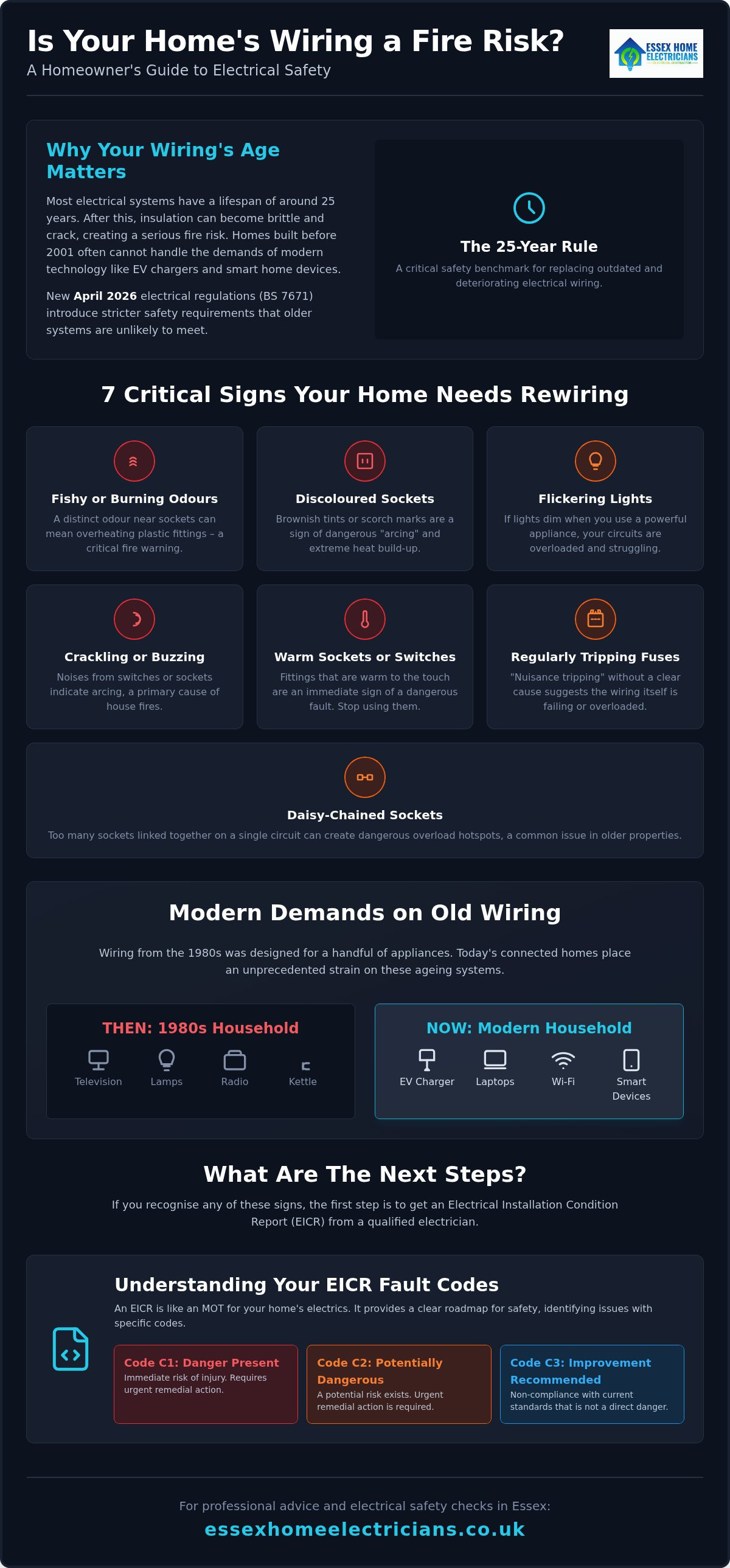
Your home's electrical system is much like a car; it requires regular maintenance and eventually reaches a point where critical components need replacing. The industry standard "25-year rule" isn't just a suggestion. It's a safety benchmark. Most electrical installations have a finite shelf life. Whilst your sockets might still provide power, the hidden infrastructure behind your walls could be deteriorating. Understanding the signs you need rewiring starts with knowing the age of your property and the technology it was built to support.
In Essex, particularly in areas like Basildon, many properties built before 2001 are now entering a high-priority zone for inspection. These homes were wired to different Electrical wiring standards than those required today. Amendment 4 to BS 7671, published in April 2026, introduced rigorous new safety requirements that older systems simply cannot meet. There's a vast difference between "functional" wiring that still works and "safe" wiring that protects your family from fire risks. Modern life demands more from our cables than ever before.
The 25-Year Threshold Explained
PVC insulation protects your cables, but it doesn't last forever. Over two decades, this material becomes brittle and prone to cracking. Heat generated by modern appliances accelerates this breakdown. Homes from the 1970s and 80s were designed for a few lamps and a television, not the simultaneous load of high-speed Wi-Fi, multiple laptops, and kitchen gadgets. A domestic rewire is the total replacement of all circuits and cables. This process ensures every inch of your home's "circulatory system" is brand new and up to code, preventing faults before they start.
Building Regulations and Compliance
Major electrical work must comply with Part P of the Building Regulations. This isn't just a red-tape exercise; it's a legal requirement that ensures the work is safe and documented. Attempting to ignore these standards can lead to serious issues with your home insurance or even devalue your property during a sale. Investing in a house rewiring Essex project provides the certification needed to prove your home is modern and safe. Spotting the signs you need rewiring early allows you to plan this investment before a minor fault turns into an expensive emergency.
The Homeowner’s Checklist: 7 Physical Signs You Need Rewiring
Identifying physical signs you need rewiring is the first step toward securing your home. Whilst some electrical issues are hidden behind plasterboard, many manifest as clear warnings you can spot during a quick walk-through. If you've noticed a strange, fishy odour in your hallway or near a specific socket, don't dismiss it as a plumbing issue. This distinct smell often indicates that plastic insulation or old Bakelite fittings are overheating and melting. It's a critical warning that a fire could be imminent.
Another obvious red flag is discolouration on your plug faces. Scorch marks or brownish tints around the pin holes aren't just surface dirt; they're evidence of "arcing" or extreme heat build-up. Similarly, if your lights flicker or dim when you turn on a high-power appliance like a vacuum or a kettle, your current circuits are likely struggling to cope with the demand. This instability suggests your wiring is no longer fit for purpose.
Red Flags in Your Sockets and Switches
Listen closely to your switches when you turn them on. A buzzing or crackling sound, known as arcing, happens when electricity jumps across gaps in loose or damaged connections. This is a primary cause of house fires. Switches that feel warm to the touch are another immediate emergency. In older Essex homes, we often find "daisy-chained" circuits where too many sockets are linked together, creating dangerous hotspots. Using a Home Electrical Safety Checklist can help you methodically check every room for these subtle but high-risk dangers.
Unstable Power and Nuisance Tripping
If your consumer unit trips regularly, it's a cry for help from your electrical system. Whilst a single faulty toaster might trip a circuit once, "nuisance tripping" that occurs without a clear cause suggests the wiring itself is failing. It's important to distinguish between a broken appliance and a circuit that's simply overloaded or compromised by age. Frequent fuse "pops" are a sign that your home's safety mechanisms are working hard to prevent a disaster, but they shouldn't be ignored. If your power cuts out every time you use more than two appliances, you may need an emergency electrician Basildon to investigate the fault immediately.
Spotting these issues early can save you from the stress of a sudden power failure or a dangerous electrical event. If you're unsure about the state of your sockets or the sounds coming from your walls, you can speak with our local team for professional advice and a safety assessment.
Identifying "Invisible" Dangers: Cables and Fuse Boxes
Beyond the visible scorch marks and flickering lights, the most serious signs you need rewiring often lurk out of sight. In many older Essex properties, the infrastructure itself is the hazard. Whilst the UK strictly adheres to the IET Wiring Regulations, looking at international safety benchmarks such as the National Electrical Code (NEC) highlights a universal truth: old insulation is the leading cause of residential electrical fires. If your home hasn't been upgraded in the last few decades, your cables might be hiding a dangerous secret.
We frequently encounter the "Big Three" of dangerous cabling in Basildon homes: lead-sheathed, black rubber (VIR), and fabric-coated wires. These materials are well past their safe operating life. Another invisible threat is the presence of "green goo" or surfactant. This sticky substance leaches out of the plasticiser in older PVC cables. It's a chemical reaction that can cause high resistance and eventually lead to a fire if it reaches the socket terminals. Furthermore, properties built in Essex during the 1960s often lack earthing on lighting circuits. This means if a metal light fitting develops a fault, the entire fixture can become live and dangerous to touch.
How to Check Your Own Cable Insulation
A quick trip to the loft or a look under the stairs can reveal a lot about your home's health. Modern cables are typically grey or white PVC. These are designed to be resilient and safe. However, if you see black, crumbly rubber (VIR) or wires wrapped in what looks like old-fashioned braided string, you're looking at a severe fire risk. These materials degrade over time, leaving bare copper exposed behind your walls. If you spot these, it is a definitive sign that your home requires professional attention from Essex Home Electricians.
Is Your Fuse Box a Relic?
Your fuse box is the brain of your home's electrical system. Old boards with wooden backs or heavy cast iron switches are obsolete and lack the sensitivity to protect you from modern electrical faults. A modern RCD-protected consumer unit is designed to cut power in milliseconds if it detects a leak. If your current board lacks a "Test" button, it cannot provide this life-saving protection. Older systems are also prone to "over-fusing," where a fuse is replaced with a higher-rated wire than the circuit can actually handle. This creates a massive fire risk as the cables will melt before the fuse ever "pops."
Lead-sheathed cables: Highly likely to be over 60 years old and dangerous.
Black rubber (VIR): Becomes brittle and flakes off, exposing live wires.
Wooden-backed fuse boards: A fire hazard in themselves and a sign of an ancient system.
Green surfactant: A chemical leaching process that requires urgent cable replacement.
Modern Strains: Why 2026 Tech Demands Newer Wiring
Many Essex homes were wired when a colour TV was the peak of technology. Today, your electrical system manages a constant stream of data and power. This shift in consumer behaviour is one of the most common signs you need rewiring that homeowners overlook. Your cables aren't just old; they're exhausted. They were designed for a different era of energy consumption. If your system is over 25 years old, it was never meant to support the "always-on" lifestyle of a 2026 household.
Smart devices, heat pumps, and induction hobs have replaced traditional gas appliances in many Basildon households. This transition significantly increases the electrical demand on your property. Old, thin copper cables weren't designed for this continuous draw. They often struggle to dissipate the heat generated by these modern, high-load systems. This leads to the insulation becoming brittle much faster than intended. Over time, this degradation can cause short circuits or even hidden fires within your wall cavities. This shift is a global phenomenon; for instance, inlightec.com.au assists homeowners in Western Australia with upgrading their systems to handle these increased modern demands safely.
The Impact of High-Load Appliances
Power-hungry appliances cause significant heat stress in outdated wiring. If you find yourself relying on multi-way adapters because you don't have enough sockets, you're likely overloading your circuits. This is a major fire risk that an EICR would quickly flag. Modern kitchens are the heart of the home but also the most power-intensive room. They usually require a dedicated circuit rewire to handle the simultaneous use of ovens, dishwashers, and air fryers safely. A partial rewire for a kitchen extension is often the most pragmatic way to bridge the gap between old infrastructure and new demands.
Preparing for an EV Future
As of April 2026, all new electric vehicle charger installations must be "smart" by law. You cannot safely install a high-speed EV charger on a 30-year-old system. These chargers pull a massive, continuous load for several hours. Older cabling simply isn't thick enough to handle that without a dangerous rise in temperature. A modern consumer unit with integrated surge protection is now a necessity rather than an optional upgrade. Rewiring your home now future-proofs your property for the next 25 years of technological advancement. It provides the capacity you need for solar batteries and smart home automation without the constant fear of a tripped fuse. If you are considering solar panels as part of this upgrade, ensuring your roof is in top condition is vital, and experts such as I R. Wilson Roofing can assess whether your current structure is suitable for such installations.
If you're planning an extension or considering an EV charger, it's the perfect time to assess your current capacity. You can contact our expert team today to discuss a partial or full rewire tailored to your home's needs.
Next Steps: From EICR to a Safer Home
If you've identified several signs you need rewiring from our checklist, your next move shouldn't be guesswork. Suspecting a fault is stressful, but living with uncertainty is dangerous. The only way to move from suspicion to certainty is through professional verification. An Electrical Installation Condition Report (EICR) acts as an MOT for your property. It provides a legal document that details the exact health of your circuits, sockets, and consumer unit.
When you receive your report, it will contain specific codes that dictate your next steps. A 'C1' code means danger is present and there is an immediate risk of injury. In these cases, we often have to make the installation safe before we leave the site. A 'C2' indicates a potentially dangerous fault that requires urgent attention. Finally, 'C3' suggests that whilst the system is safe for now, improvements are recommended to meet modern standards. Understanding these codes helps you prioritise repairs and decide whether a full or partial rewire is the most pragmatic solution for your budget.
The EICR: Your Electrical MOT
During a safety inspection, an electrician performs a series of "dead" and "live" tests. We check the continuity of your earthing, the insulation resistance of your cables, and the trip times of your RCDs. This process uncovers the hidden signs you need rewiring that a visual check simply cannot find. Homeowners in Southend and Basildon trust Essex Home Electricians for honest, transparent assessments. We don't look for problems that aren't there; we provide the facts you need to keep your family safe.
Choosing the Right Essex Electrician
Rewiring is one of the most significant maintenance projects a homeowner can undertake. It is vital to choose a NAPIT or NICEIC accredited contractor. These bodies ensure that your electrician is regularly assessed and works to the latest April 2026 standards. Beware of "cheap" quotes that seem too good to be true. A proper rewire requires quality materials and significant labour. Low prices often lead to dangerous shortcuts, such as using undersized cables or failing to notify Building Control. Always ensure your contractor provides insurance-backed guarantees and a Part P certificate upon completion.
Preparing for a rewire doesn't have to be a nightmare. We recommend clearing furniture from the walls and identifying any specific areas where you'd like extra sockets or smart home controls. Most projects can be organised in stages to minimise disruption to your daily life. If you're ready to secure your home's future, you can contact Essex Home Electricians for a free, no-obligation rewire quote today. Our local team is here to provide the expert guidance and high-quality workmanship your Essex home deserves.
Secure Your Home’s Future Today
Your home should be a place of safety, not a source of worry. We've explored how outdated cabling and the heavy demands of 2026 technology can strain your electrical system. Identifying the physical signs you need rewiring is a vital first step; however, professional certainty is the only way to protect your family and property. Whether it's an obsolete fuse box or deteriorating rubber insulation, these issues require a methodical and expert approach to resolve safely.
As NAPIT-accredited contractors with over 20 years of local Essex experience, we specialise in bringing older homes up to modern safety standards. We provide a rapid 1-hour emergency response across Basildon and Southend for urgent faults, but we prefer helping you catch problems before they reach that stage. It's much better to plan an upgrade than to react to an emergency. Don't wait for a minor flicker to become a major fire risk.
Book your expert Electrical Safety Check in Essex today. Our team is ready to provide the clarity and technical expertise you need for total peace of mind in your home.
Frequently Asked Questions
How long does a full house rewire take for a standard Essex semi-detached?
A full house rewire for a standard semi-detached property typically takes between 5 and 10 working days to complete. This timeframe depends on whether the house is empty or occupied, as moving furniture and protecting carpets adds extra labour time. We usually work in two stages, starting with the hidden cabling before moving on to the final fittings and testing.
Can I stay in my house whilst the rewiring work is being carried out?
You can stay in your property, but we usually recommend vacating if possible due to the level of disruption. The process is inherently noisy and creates a significant amount of dust as we lift floorboards and chase into walls. Since we must disconnect the power for long periods during the day, living in the home whilst the work is ongoing is quite challenging.
Is it possible to rewire a house without removing the plaster or chasing walls?
It is difficult to hide new cables without chasing into the plasterwork or lifting floorboards. The only alternative is using surface-mounted plastic trunking, which remains visible on your walls. Whilst trunking is faster and less messy, most Essex homeowners prefer the traditional method to maintain the aesthetic finish and property value of their homes during a full upgrade.
What is the average cost of rewiring a 3-bedroom house in Essex in 2026?
The cost of rewiring a 3-bedroom house in Essex depends on several factors, including the age of the property and the complexity of the installation. Property size, the number of sockets required, and ease of access all influence the final investment. We recommend booking a survey to receive a detailed, no-obligation quote tailored to your specific home and electrical needs.
What happens if I ignore the signs that my house needs rewiring?
Ignoring the physical signs you need rewiring significantly increases the risk of electrical fires and dangerous shocks. Faulty wiring remains a leading cause of domestic fires in the UK. Beyond the safety risks, your home insurance may be invalidated if a fire is caused by a known electrical fault that you failed to address with professional, certified repairs.
Does a house rewire include a new consumer unit and all new sockets?
A comprehensive house rewire involves replacing every single component of your electrical system. This includes all the internal cabling, a modern RCD-protected consumer unit, and all new socket and switch faceplates throughout the property. We also ensure that your earthing and bonding are up to the latest 2026 standards to provide maximum protection for your appliances and your family.
Will a rewire increase the value of my property in the Essex market?
A full rewire is a major selling point and can certainly increase the appeal and value of your property. Surveyors and buyers in the Essex market look for the safety certificates provided after a rewire. It gives them peace of mind that they won't face immediate, expensive repair bills or safety issues after they move into their new home.
How often should I have my home’s electrical wiring professionally inspected?
Homeowners should have an Electrical Installation Condition Report (EICR) performed every 10 years to ensure everything is safe. If you are a landlord, the law requires an inspection every 5 years or at each change of tenancy. Regular checks help identify early signs you need rewiring before they develop into dangerous and costly emergencies that require urgent attention.


Comments