


EV Charger Installation Southend: The Complete 2026 Homeowner Guide
A safe EV charger installation in Southend requires more than just mounting a box on your garage wall; it requires a total assessment of your home's electrical infrastructure. You've likely spent weeks researching the perfect vehicle, yet the technical reality of 7kW versus 22kW chargers and fuse box capacities can feel like a sudden roadblock. It's frustrating to wait for your new car only to worry if your property can actually support it. We understand that anxiety. Ensuring your home is ready for the future of transport shouldn't be a source of stress.
This guide provides everything you need to know about securing a reliable EV charger installation Southend homeowners can trust for years to come. We'll demystify the latest 2026 UK smart charging regulations and explain the mandatory UK Power Networks approval process. You'll learn how to identify if your consumer unit needs an upgrade and how to access current OZEV grants for renters and landlords. From NAPIT-certified safety standards to achieving the fastest possible home charging speeds, we've mapped out the path to a powered-up home.
Table of Contents
Switching to Electric: EV Charger Installation in Southend
The streets of Southend-on-Sea look different in 2026. From the seafront to the residential avenues of Thorpe Bay, electric vehicles are now the standard choice for families and commuters alike. An EV charger installation Southend property owners invest in is no longer a luxury; it's a fundamental part of modern home infrastructure. While public charging points have expanded, the trend has shifted heavily toward domestic units. Homeowners want the certainty of a dedicated spot rather than searching for an available electric vehicle charging station in a busy car park or waiting at a supermarket hub.
Switching to home charging also offers long-term financial relief. While public networks often apply premium rates, charging at home allows you to take advantage of off-peak electricity tariffs. This significantly reduces the cost per mile for your daily travel. For those used to the rising prices at the pumps along the A127, the savings are immediate and substantial.
Why Southend is the Perfect Place for an EV
Southend's geography makes it ideal for the electric transition. For those commuting from Leigh-on-Sea to London, the daily round trip is well within the range of modern EVs. Waking up to a full battery means you can bypass the petrol stations entirely. Beyond convenience, there's a collective effort to protect the Essex coast. Reducing tailpipe emissions helps preserve the air quality along our beaches and busy high streets. Local infrastructure has improved, but nothing beats the reliability of your own driveway. At Essex Home Electricians, we've seen a surge in requests as residents realise that home charging is the most efficient way to power their commute.
The Problem with 3-Pin "Granny" Chargers
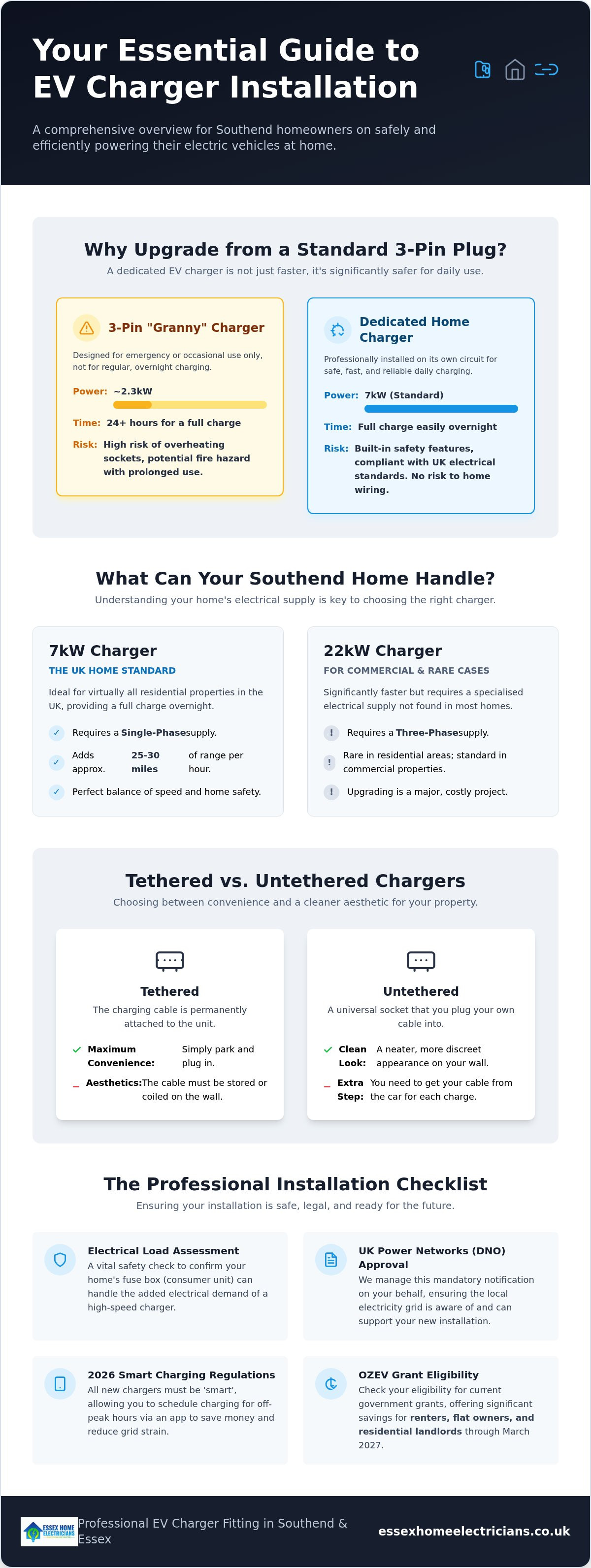
Many new EV owners start by using a standard 3-pin portable cable, often called a "granny" charger. These are designed for occasional or emergency use, not daily charging. Drawing a constant high load from a domestic socket for 12 hours or more creates significant heat. This can lead to scorched sockets or, in worse cases, electrical fires. By 2026, safety standards have become much stricter regarding these portable units, discouraging their use for primary charging.
Speed is the other major factor. A standard socket only provides about 2.3kW of power. A dedicated EV charger installation Southend professional setup provides 7kW. This difference is massive. A full charge that takes 24 hours on a 3-pin plug can be completed overnight with a dedicated unit. It's the difference between a car that's always ready and one that's constantly tethered to the house. Professional installation ensures your home's wiring is protected from the stress of these high-power demands.
Choosing the Right Home Charging Point for Your Vehicle
Selecting the right hardware is a balance between your vehicle's requirements and your home's electrical capacity. Most modern units are now "smart" by law. This allows you to schedule charging via an app to take advantage of cheaper night-time rates. You should also look for solar matching if you have panels on your Southend roof. This ensures your car charges using green energy whenever the sun is out. When exploring your options, check the latest UK government grants to see which smart models currently qualify for financial support.
7KW vs 22kW: What Can Your Southend Home Handle?
Most residential streets in Southend and Westcliff are served by a single-phase electricity supply. This means your EV charger installation Southend will typically be a 7kW unit. A 7kW charger is the standard for home use. It adds roughly 25 to 30 miles of range per hour, which is perfect for an overnight top-up. While 22kW chargers are faster, they require a three-phase supply. Upgrading a standard Essex home to three-phase is a major project that often involves digging up the driveway to reach the main supply. You can check your supply by looking at your meter; a single large fuse indicates single-phase, while three fuses suggest three-phase.
Tethered vs Untethered: Which Suits Your Driveway?
The choice between a tethered or untethered unit often depends on your daily routine. A tethered charger has the cable permanently attached. You simply pull up and plug in. It's the ultimate convenience for a busy household. However, an untethered unit provides a cleaner look on your brickwork because it's just a socket. You'll need to use your own cable, which you likely keep in the boot. For properties in Southend with limited driveway space or those close to the pavement, untethered units are often preferred. They prevent cables from being a trip hazard or a target for theft when you aren't charging.
Compatibility is rarely an issue in 2026, as almost all new EVs use the Type 2 plug standard. However, it's always worth double-checking your vehicle's specific intake rate. If you're unsure which unit fits your car or your home's current supply, chat with our local team for a quick assessment. We can help you choose a model that matches your car's plug type and your home's aesthetic perfectly.
Navigating UK Regulations, DNO Approvals, and Grants
Legal compliance is the backbone of any safe EV charger installation Southend project. By 2026, UK regulations have evolved to ensure that every domestic chargepoint is not only smart but also fully integrated with the national grid's stability. These rules aren't just red tape; they protect your home and your neighbours from electrical overloads. Central to this is Building Regulations Part P, which mandates that all domestic electrical work is carried out by a competent person. Without the correct certification, you may find your home insurance is void in the event of an electrical fault. Every installation we perform is fully certified and registered to ensure total peace of mind.
The DNO Notification Process Explained
UK Power Networks (UKPN) manages the local electricity grid across Southend. They're the Distribution Network Operator (DNO). They must be informed whenever a high-load device is added to a home. Most 7kW setups fall under a process called "Connect and Notify." In these cases, we install the unit and inform UKPN within 28 days. However, if your property has an older 60-amp fuse, or if the local substation in your part of Essex is near capacity, we must "Apply to Connect" before any work begins. This prevents power cuts in your street. We handle all these technical applications for you, ensuring your home remains compliant with grid safety standards.
OZEV Grants and Incentives in 2026
Financial support for going electric remains available through several UK government grants for EV chargers. As of 2026, the OZEV (Office for Zero Emission Vehicles) grant provides up to £500, or 75% of the total cost, for renters and flat owners with dedicated off-street parking. This was increased from the previous £350 cap in April 2026 and is confirmed to run until March 31, 2027. Residential landlords in Southend can also claim £500 per socket for up to 200 sockets per year.
To access these funds, you must use a NAPIT-accredited and OZEV-authorised installer. This ensures the work meets the high standards required for public funding. We manage the paperwork on your behalf to make the process as simple as possible. By choosing a local expert for your EV charger installation Southend, you ensure that every regulatory box is ticked, from the initial UKPN notification to the final grant application. Our 20 years of experience in the Essex area means we know exactly how to navigate these local and national requirements without delay.
The Installation Process: What Southend Homeowners Should Expect
A standard EV charger installation Southend project typically takes between 2 to 4 hours to complete. However, the work begins with a detailed assessment of your home's unique electrical layout. Our team follows a rigorous four-step process to ensure your charging point is safe, efficient, and fully compliant with 2026 standards. We don't just fit a box; we integrate it into your home's infrastructure.
Step 1: Site Survey and Load Assessment. We examine your consumer unit to ensure it can handle the additional 32-amp draw. In many older Southend properties, this is the moment we identify if a fuse box upgrade is necessary for safety.
Step 2: Cable Routing. We plan the most efficient path from your meter or consumer unit to the charging location. We prioritise discreet routing to maintain your home's kerb appeal and avoid unnecessary disruption to your decor.
Step 3: Mounting and Connection. The unit is securely fixed to your exterior wall or a dedicated pedestal. We then complete the high-voltage connections and install necessary safety earthing to protect against electrical faults.
Step 4: Commissioning and App Setup. We test the unit with diagnostic equipment to simulate a vehicle connection. Finally, we help you pair the charger with your smartphone to manage your 2026 smart charging schedules and monitor energy usage.
Preparing Your Home for the Installer
You can help the day run smoothly by clearing access to your fuse box and the chosen installation wall. Think about the mounting height; most homeowners find that waist height offers the best balance of ease of use and cable management. Since 2026 regulations focus heavily on smart connectivity, ensure your home Wi-Fi signal reaches your driveway. If the signal is weak, we may need to discuss a hardwired data cable or a signal booster to ensure your smart features function correctly.
Common Challenges in Southend Properties
Southend's diverse architecture presents specific challenges that national call-centre installers often overlook. In the larger detached homes of Thorpe Bay, we often encounter very long cable runs where the meter is at the opposite end of the property from the driveway. This requires careful planning to prevent voltage drop. Conversely, in Southend centre, flats and maisonettes often require complex routing through shared spaces. If your meter is located far from your parking space, we have the expertise to design a solution that meets all safety codes. Book your site survey today to get a custom installation plan for your property.
Professional EV Charger Fitting with Essex Home Electricians
Choosing a local specialist for your EV charger installation Southend means you get more than just a functional plug. You gain the expertise of a team that has served the Essex community for 20 years. National companies often use sub-contractors who prioritise speed over long-term safety. We take a different approach. Every fitting includes a total home safety check to ensure your entire electrical system remains stable under the new load. As NAPIT-accredited contractors, we strictly adhere to the latest wiring regulations. This protects your property and your investment for the long term.
Our commitment to Southend residents doesn't end when the charger is mounted. We provide 24/7 emergency support with a 1-hour response time in the local area. If a fault occurs or a breaker trips in the middle of the night, you won't be left waiting for a national call centre to find a technician. We are rooted in the community and remain unfazed by complex technical challenges. Our goal is to provide a composed, consultative service that gives you total peace of mind.
Beyond the Charger: Upgrading Your Home Infrastructure
Many older properties in the area weren't built with high-power EV charging in mind. Before we install your unit, we assess your consumer unit's health. Does your Southend home need a fuse box upgrade? If your current board lacks modern RCD protection, it could pose a risk when drawing 32 amps for hours on end. We ensure your consumer unit has the correct Type A RCD protection required for EV circuits. For those moving into a fixer-upper, we often integrate charging points into full house rewiring projects. This ensures your home infrastructure is future-proof and safe from day one.
Booking Your Southend Installation
We make the transition to electric driving simple and transparent. Our Basildon-based team provides free, no-obligation quotes tailored to your property's specific needs. We don't believe in hidden fees or technical jargon. You'll receive a clear breakdown of the work required, from the cable routing to the UK Power Networks notification. Our local guarantee means you're working with fully insured and qualified electricians who take pride in their work. We handle every detail so you don't have to.
Secure your EV charger installation in Southend today and join the hundreds of local homeowners who trust us with their home's electrical safety. Our team is ready to provide the fast, reliable, and professional service you deserve.
Ready to Future-Proof Your Southend Home?
Transitioning to an electric vehicle is a significant step toward a more efficient lifestyle along the Essex coast. A successful EV charger installation Southend residents can rely on depends on professional infrastructure assessment and strict regulatory compliance. Ensuring your consumer unit meets 2026 safety standards and managing the UK Power Networks notification process are essential tasks that require expert handling.
Choosing a local partner means you aren't just getting a charger; you're gaining a long-term safety advocate. We bring over 20 years of local Essex experience to every project, ensuring your home is ready for the demands of modern transport. As a NAPIT accredited installer, we provide the technical precision required for a safe and smart setup. Our 1-hour emergency response guarantee means we're always here if you need us most.
Don't leave your home's electrical safety to chance. Take the first step toward faster, more reliable charging today. Book Your Southend EV Charger Survey Today and enjoy the convenience of a fully powered home.
Frequently Asked Questions
Do I need a new fuse box to install an EV charger in Southend?
You don't always need a new fuse box, but your existing system must meet current safety standards. A dedicated 32-amp circuit is required for a 7kW EV charger installation Southend homeowners usually choose. If your current consumer unit is full or lacks the necessary RCD protection, we will recommend an upgrade. We specialise in these infrastructure improvements to ensure your home remains safe under the increased electrical demand.
How long does a typical home EV charger installation take?
A standard installation typically takes between 2 and 4 hours to complete. This timeframe covers the physical mounting of the unit, cable routing, and the final commissioning. If your property requires a consumer unit upgrade or involves complex cable runs through multiple walls, the process might take slightly longer. We always provide a clear time estimate after our initial site survey so you can plan your day accordingly.
Can I install my own electric car charger if I am a DIY enthusiast?
No, you cannot legally install your own EV charger. This work falls under Building Regulations Part P and must be carried out by a qualified professional. A certified installer ensures the unit is correctly earthed and that all UK Power Networks notifications are handled. Attempting a DIY installation is dangerous and will void your vehicle's warranty and your home insurance policy while failing to meet 2026 safety standards.
What happens if my Southend home does not have a driveway?
Private home chargers require dedicated off-street parking to be legally installed. If you rely on on-street parking in the centre of Southend, you cannot run cables across the pavement as this creates a significant trip hazard. You should instead look for local public charging hubs or check if Southend-on-Sea City Council has plans for lamppost charging in your street. Off-street parking is a mandatory requirement for most current OZEV grants.
Will an EV charger increase my electricity bill significantly?
Your total electricity consumption will rise, but your overall transport costs will fall compared to petrol or diesel. By 2026, most Southend residents use smart chargers to schedule charging during off-peak windows when rates are significantly lower. This managed approach ensures you get the most value from your home unit whilst protecting the local grid. Many modern energy tariffs are designed specifically to support electric vehicle owners with cheaper overnight pricing.
Do I need permission from the council to install a charger in Southend?
Most domestic installations fall under "permitted development" and do not require formal planning permission from the council. However, exceptions apply if your property is a listed building or located within a conservation area in Leigh-on-Sea or Thorpe Bay. You should always check with your local planning department if your home has specific heritage protections. Regardless of planning, our team must always notify UK Power Networks of the new installation.
Is my old consumer unit safe enough for a 7kW charger?
An old consumer unit, particularly one with a plastic casing or outdated fuses, is often unsuitable for the sustained high load of a 7kW charger. These devices draw 32 amps for several hours, which can cause older components to overheat. We perform a full load assessment during our EV charger installation Southend survey to determine if your existing board has the capacity and modern RCD protection needed for safe operation.
What is the difference between Type 1 and Type 2 charging cables?
Type 2 is the current UK standard for home charging, featuring a 7-pin design that supports both single and three-phase power. Type 1 is an older 5-pin standard primarily found on older Japanese or American models. Almost all new vehicles sold in 2026 use Type 2 connectors. If you have an older vehicle, you can usually buy an adapter or a specific cable to ensure it works perfectly with a modern Type 2 home charging unit.


header.all-comments