

An EICR for a mortgage application isn’t a standard requirement for every UK home loan. A lender may request one if the property’s age, survey findings or other electrical concerns raise questions about the installation’s safety. For a standard remortgage without a structural survey, lenders rarely ask for an EICR, so an older report won’t automatically delay your application.
It’s understandable to want a clear answer before a purchase or remortgage moves forward. This guide explains when a lender may request an inspection, what an unsatisfactory report could mean for lending, and whether an existing EICR may still be useful. You’ll also learn how a lender’s request differs from a landlord’s legal electrical checks, what an EICR covers, and why the findings and the property’s condition matter as well as the report date. This should help you understand what the lender needs and what to do next.
Table of Contents
EICR, landlord checks and mortgage requests: what is the difference?
Does an EICR certificate form part of every mortgage application?
Whether an older EICR can be used for a mortgage application
Who can confirm whether your lender needs an EICR?
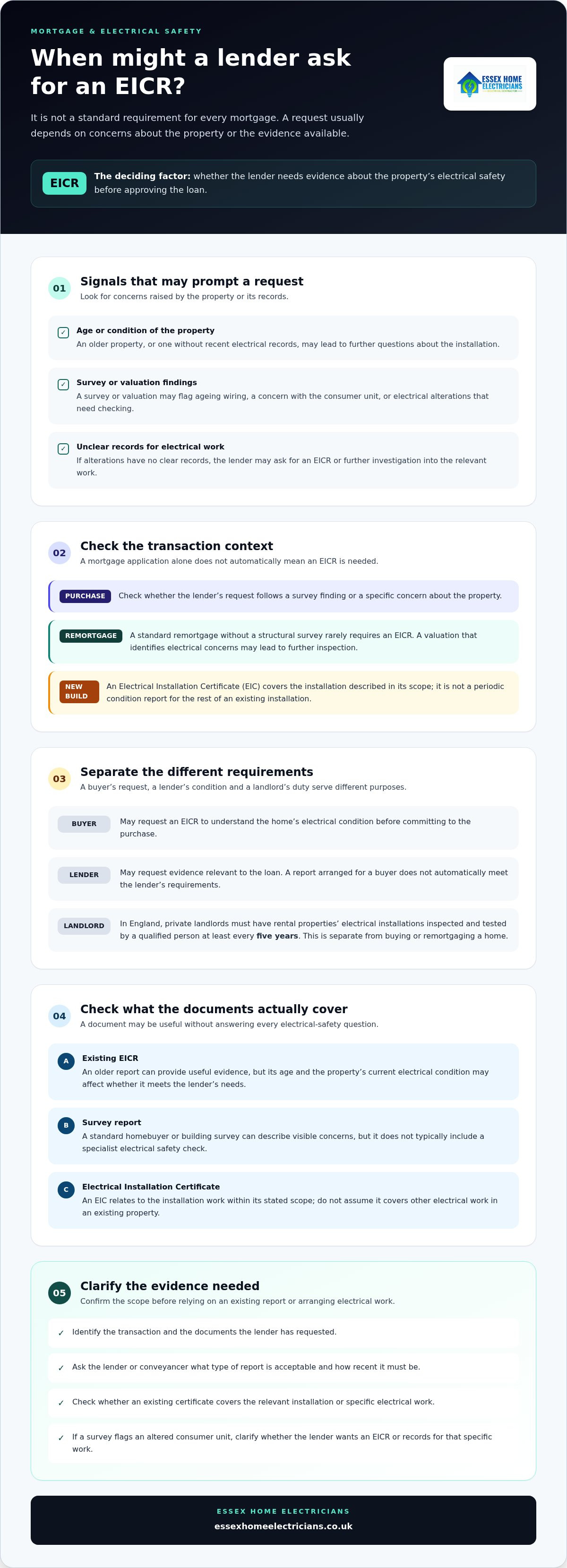
For a standard residential mortgage, an EICR isn’t automatically required across the UK. Lenders may request one if the property’s age, valuation or survey raises electrical concerns. A standard remortgage rarely requires an EICR when no structural survey is needed. The deciding factor is whether the lender needs evidence about the property’s electrical safety before approving the loan.
Selling a private home in England or Wales does not legally require the seller to provide an EICR. The Energy Performance Certificate (EPC) is the only certificate legally required when selling a UK home. However, a buyer, surveyor or lender may request electrical evidence for a particular transaction. The legal requirements for selling and a lender’s conditions for lending are separate matters.
An EICR may become relevant when a survey identifies concerns about wiring, the consumer unit or electrical alterations. Older properties can also prompt questions about the installation’s condition, particularly if there are no recent records. A lender may request an EICR or further investigation to assess whether the installation meets acceptable safety standards. The request depends on the property and the issues raised during assessment, not simply on the fact that a mortgage application exists.
A new-build home should come with an Electrical Installation Certificate (EIC), which covers the installation described in its scope. That document may provide relevant evidence for the work it certifies, but it isn’t a periodic condition report for the rest of an existing installation. A survey report can describe visible concerns, but a standard homebuyer or building survey doesn’t typically include a specialist electrical safety check. These documents therefore don’t automatically replace an EICR in every case.
To establish what the lender needs, identify the transaction and the documents requested. Ask the lender or conveyancer to clarify the required report, its acceptable age and whether an existing certificate covers the relevant installation. For example, if a survey flags an altered consumer unit, find out whether the lender wants an EICR or records for that specific work. This helps avoid treating a general survey or limited certificate as evidence of the whole electrical installation.
For a purchase, check whether the lender’s request follows a survey finding or property concern.
For a remortgage, distinguish a routine valuation from a survey that identifies electrical issues.
For a new build, check the scope of the EIC before treating it as evidence for other electrical work.
EICR, landlord checks and mortgage requests: what is the difference?
A landlord inspection duty, a buyer’s request and a lender’s condition serve different purposes. Knowing which applies helps you understand why an electrical installation condition report was requested and what it needs to cover.
When lenders may request an EICR
A lender may request an EICR when information about the property raises questions about electrical safety. Examples include a survey flagging ageing wiring, a consumer unit concern or alterations without clear records. The property’s age can also prompt further assessment, particularly when the lender needs evidence about the installation’s condition before making a lending decision.
This is a transaction-specific request, not a routine condition of every mortgage. A standard remortgage without a structural survey rarely involves an EICR, but a valuation that identifies electrical concerns may lead to further inspection. A lender may also request an EICR during a purchase if the surveyor recommends checking the electrics. The request should identify the evidence needed and any issue the report must address.
Requests from buyers and lenders
A buyer can request an EICR to understand the home’s electrical condition before committing to the purchase. A lender’s request serves a different purpose: it assesses information relevant to the loan and may form part of the lending conditions. One report may help both parties, but commissioning it for the buyer doesn’t automatically satisfy the lender’s requirements.
For example, a buyer may want an independent inspection after seeing dated wiring, while the lender may request evidence only after a survey raises a specific concern. The seller can provide existing electrical records, but the lender decides whether they meet its requirements. Clarifying the purpose matters: a general survey describes visible concerns, while an EICR assesses the fixed installation.
Landlord checks are separate again. In England, private landlords must have rental properties’ electrical installations inspected and tested by a qualified person at least every five years, according to the UK legislation register. That duty concerns a rented property, not every home purchase or residential mortgage. Buying a property doesn’t, by itself, create the private-rented inspection duty.
An EICR isn’t automatically required because a property is being bought, sold or remortgaged. A lender may request one when the property’s age, survey findings or electrical records raise concerns. Buyers and sellers should distinguish this request from a landlord’s legal inspection duty, then clarify what evidence the lender expects and which parts of the installation it needs assessed.
Does an EICR certificate form part of every mortgage application?
No. A property purchase alone doesn’t create an electrical inspection duty for a private buyer, and an EICR isn’t mandatory for every mortgage application. The position differs for landlords: in England, private landlords must have rental properties’ electrical installations inspected at least every five years. Buying a home to live in doesn’t make you subject to that landlord duty.
An EICR checks fixed electrical installations for compliance with BS 7671 wiring regulations, according to British Standards Institution (BSI). It records the condition of the installation on the inspection day and identifies faults, safety concerns and recommended work. It isn’t a general survey of the building, and it doesn’t replace a homebuyer survey. A surveyor may inspect visible services, but a standard homebuyer or building survey doesn’t typically include a specialist electrical safety check.
An EICR concerns fixed electrics such as wiring, sockets, switches and the consumer unit. It doesn’t assess every electrical appliance or provide a complete property survey. An Electrical Installation Certificate covers the new installation, addition or alteration named in its scope. It isn’t a periodic condition report for the rest of an existing electrical installation. For a new-build property, the EIC can provide evidence for the installation it covers.
If a lender requests an EICR, start by identifying its deadline and the evidence it expects. Share the request with the electrician before booking, including any survey findings or concerns about specific circuits. Arrange access to the relevant areas, including the consumer unit and rooms with electrical fittings. A standard residential inspection typically takes two to four hours. An EICR is usually ready within 24 hours of completing the inspection.
Timing matters if the inspection identifies work that needs attention. The report may recommend remedial work or further investigation, so allow time for the lender to review its findings and decide what evidence it needs. Booking close to a mortgage deadline can leave little room to address issues or provide additional documents. The inspection itself doesn’t guarantee that the lender will accept the report as meeting its requirements.
Inspection costs depend on the property and the work involved, including its size, installation complexity and access to electrical fittings. The cost is set out in a quote. Clarifying the scope before booking helps avoid confusion between an EICR, an installation certificate and a general property survey. Each document covers a different aspect of the property’s condition or electrical history.
How failed EICRs may affect mortgage approval
An unsatisfactory electrical installation condition report can affect a mortgage decision if it identifies safety concerns that need attention. It doesn’t automatically mean the lender will refuse the application. The lender may consider the seriousness of the findings, the work required and whether the electrical risks are resolved before lending proceeds.
Pay close attention to the observation codes. A C1 finding means danger is present and requires immediate attention, whilst C2 means the installation is potentially dangerous. An FI code means further investigation is needed. These findings have different implications, so the report’s detailed observations matter more than the word “unsatisfactory” alone.
C1: Danger is present, requiring immediate attention.
C2: The installation is potentially dangerous and needs urgent attention.
FI: Further investigation is required to establish the electrical condition.
A lender may require remedial work before proceeding, retain part of the loan until work is complete, or decline lending if significant safety issues remain. For example, a C2 finding involving exposed wiring could lead to a request for repairs and evidence that the concern has been addressed. An FI code may prompt investigation before the lender can assess the risk.
An electrician’s report gives the lender specific findings to assess, rather than a general impression of the property. It should identify affected circuits or equipment, explain the concern and recommend action. A qualified electrician can investigate the issue and carry out remedial electrical work. Keep the original report and follow-up records together so the lender can see what was identified and what changed.
Start by reading each observation and its code. Separate immediate dangers from items requiring further investigation, then identify the work or assessment the report recommends. If the report identifies a C1 concern, treat it as urgent and address the immediate danger. For an FI observation, the next step is investigation that clarifies the installation’s condition. A broad description such as “old wiring” needs the report’s specific findings to guide decisions.
After the work is complete, provide the lender with clear evidence addressing the original observations. Depending on the findings, this may include records of remedial work or further investigation. The lender can then assess whether the concern has been resolved or whether more evidence is needed. A repaired fault doesn’t erase the original report, but clear records help show what action was taken and the resulting safety position.
Mortgage approval depends on how the lender responds to the report and any remaining risks. An unsatisfactory EICR signals that identified concerns need attention; it isn’t a verdict on every part of the property or an automatic refusal of finance.
Whether an older EICR can be used for a mortgage application
An older EICR can provide useful evidence, but its date alone doesn’t determine whether a mortgage lender will accept it. The report describes the fixed electrical installation’s condition on the day of inspection. As electrical systems can deteriorate and lenders have different document requirements, they may consider both the report’s age and any changes made since it was issued.
Start by comparing the report date with the property’s electrical history. Check whether rewiring, consumer unit replacement, additions or alterations took place afterwards. An older report may not describe later work, while an installation certificate covers only the new installation, addition or alteration within its scope. Keep relevant certificates and records with the EICR so the lender can assess what each document covers.
The report’s findings matter too. Check whether it records remedial work, further investigation or safety concerns, then look for records showing what action followed. For example, if an older EICR identified a fault near the consumer unit, a repair record helps explain what changed. If the report contains unresolved concerns or doesn’t cover later electrical work, the lender may seek current evidence about the installation.
There isn’t a single age threshold that guarantees acceptance by every lender. Requirements vary between transactions, and the property’s current condition matters alongside the report date. Older wiring may be outdated or no longer reflect current safety standards. If you’re relying on a past inspection, consider whether the report still reflects the installation being assessed, especially after alterations or a change in occupancy.
For homeowners, Electrical Safety First recommends an EICR at least every 10 years or when occupancy changes. That recommendation is a useful context for an older report, but it doesn’t set a universal mortgage acceptance period. A lender can still request a more recent inspection because of a survey finding, property age or electrical concern. Conversely, an existing report can help explain the installation’s history and any action already taken.
To prepare an existing report for the lender’s review, gather the complete document and supporting records. Check that the address and inspection scope match the property, then identify any electrical work completed since. Include installation certificates for later alterations and evidence of completed remedial work. This gives the lender a clearer timeline than a certificate that may pre-date important changes.
If the lender requests a current report, or an older EICR leaves electrical concerns unresolved, arrange an updated inspection. Arrange an EICR inspection to assess the installation’s present condition and document its findings.
Essex Home Electricians: Full & Partial House Rewiring
Essex Home Electricians can help with wiring concerns identified in an EICR. If the report points to widespread deterioration, full or partial house rewiring may address the affected circuits. Where the findings concern the consumer unit, fuse box repairs or upgrades may be relevant. The right work depends on the inspection findings and the installation’s condition.
Share the report’s findings when discussing the next step. This helps match the recommended work to the specific concerns raised, rather than assuming every unsatisfactory report requires a full rewire. Once the electrical work is complete, keep the records with the EICR for the lender’s review.
For help with electrical concerns identified in your report, contact Essex Home Electricians.
Move your mortgage application forward with a clear plan
Before arranging electrical work, keep the lender’s request and the report’s findings together. This gives you a practical starting point: identify the evidence needed, note any outstanding action and ensure the next step addresses the property’s actual electrical concerns. For an EICR for a mortgage application, a clear record of completed work can help explain how reported issues have been dealt with.
Where the findings point to outdated wiring, Essex Home Electricians offers full and partial house rewiring. For concerns centred on the fuse box, it also provides fuse box repairs and upgrades. If an electrical fault needs urgent attention, its 24-Hour Emergency Electrician service may be relevant. The appropriate work depends on the report’s findings, not simply on the fact that the report is unsatisfactory.
The lender’s requirements and the report’s recommendations shape the next step, so keep your documents organised as the application progresses. For help addressing electrical issues identified in an inspection, contact Essex Home Electricians. A clear plan can help you approach the next stage with confidence.
Frequently Asked Questions
Is an EICR Required for Remortgaging?
Usually, a standard remortgage doesn’t require an EICR if no structural survey is needed. This may change if a valuation report or other assessment highlights electrical concerns. For example, an outdated consumer unit or signs of unauthorised electrical alterations may prompt the lender to request further evidence. Check the specific document request for your remortgage rather than assuming an old report will meet it.
Are the Electrics Usually Checked as Part of a House Survey?
A standard UK homebuyer or building survey doesn’t typically include a specialist electrical safety check. A surveyor may comment on visible features such as an ageing consumer unit, but can’t inspect wiring hidden behind walls or beneath floors. Treat a survey observation as a prompt to investigate the concern, not as a full assessment of the installation. An EICR focuses on fixed electrical systems.
Do I Need An EICR When I Buy A New Build?
A new-build property should come with an Electrical Installation Certificate (EIC), covering the installation within its scope. This may mean a separate EICR isn’t needed for the new installation. Keep the EIC with the property documents and check that it relates to the completed electrical work. If further alterations have been made since certification, the original document won’t cover those changes.
Do I Need an EICR If I’m Buying a House?
Buying a home doesn’t itself create the electrical inspection duty that applies to private rented properties. You can still choose an independent EICR, especially for an older property without recent electrical records. For example, an inspection before exchange may identify faults or upgrades to consider in your purchase planning. It won’t replace a homebuyer survey, as the two assessments examine different aspects of the property.
How should you read the report findings?
Read each observation code alongside the electrician’s description. C1 means danger is present, C2 means the installation is potentially dangerous, and FI means further investigation is required. Don’t rely on the overall “satisfactory” or “unsatisfactory” label alone. For example, an FI observation needs further assessment to establish the issue, whilst a C1 finding signals an immediate danger that requires prompt attention.
Need an EICR for a Property Transaction?
Whether you need an EICR depends on the transaction and the property’s use. A private home sale doesn’t generally require the seller to provide one, but a buyer or lender may request it. A different rule applies when a property is sold as a rental with tenants in place: a valid EICR is legally required. Keep the transaction type clear when organising electrical records.
Is an EICR required for a mortgage application in the UK?
An EICR for a mortgage application isn’t a standard requirement for every UK mortgage. A lender may request one if the property’s age, survey findings or electrical concerns need further assessment. For example, a survey that flags wiring or alterations could lead to a request before the lender reaches a decision. The request depends on the property and the information raised during assessment.
Do UK mortgage lenders ask for an EICR before approving a mortgage?
Some lenders may request an EICR before making or finalising a mortgage offer, particularly if electrical safety concerns arise. The report can help them assess identified risks and decide whether further work or investigation is needed. A buyer’s own inspection can provide useful information, but it doesn’t automatically meet the lender’s requirements. Read the lender’s request carefully and make sure the report addresses its stated concerns.