

Your fuse box isn't trying to ruin your evening when the lights suddenly fail; it's actually performing a critical, life-saving intervention. While a sudden blackout is frustrating, that clicking sound from your consumer unit is the first line of defence against electrical fires and dangerous shocks. Understanding what to do if your fuse box keeps tripping is essential for every homeowner in Essex. It's completely natural to feel a sense of dread when the power cuts out, especially if you're worried about the safety of your family or the potential for faulty wiring.
We understand that staring at a bank of switches in the dark is confusing, especially when you aren't sure of the difference between an RCD and an MCB. You want your home back to normal quickly and safely without the guesswork. This guide provides a clear, step-by-step process to help you identify why your electricity keeps cutting out. We'll walk you through safe fault-finding techniques, explain the common culprits behind a tripped switch, and help you decide if you can restore power yourself or if it's time to call a professional emergency electrician to investigate the fault.
Table of Contents
Understanding Why Your Fuse Box Keeps Tripping
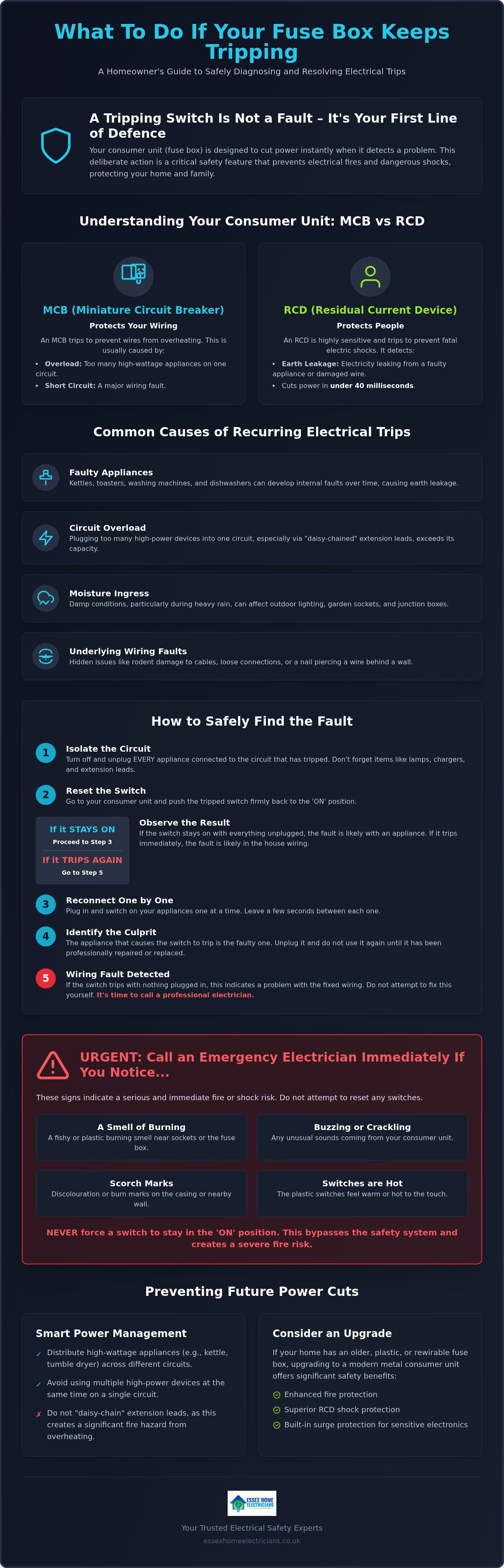
Your consumer unit, commonly known as a fuse box, acts as the safety hub for your entire property. It's a sophisticated distribution centre that monitors every circuit in your home. When homeowners ask what to do if your fuse box keeps tripping, the first step is understanding that this 'trip' is a deliberate safety action. It isn't a malfunction; it's your system working exactly as designed to prevent electrical fires and keep your family safe.
A trip occurs when the system detects an abnormality in the electrical flow. In modern Essex homes, this is usually managed by an RCD (Residual Current Device). This device is so sensitive it can cut the power in less than 40 milliseconds if it detects electricity leaking where it shouldn't. Whether it's a single circuit for your kitchen sockets or the main switch cutting off the entire house, the goal is the same: total protection.
The Difference Between MCBs and RCDs
Most modern boards contain two types of protection. A Miniature Circuit breaker (MCB) is designed to protect your house's wiring. If you plug in too many high-wattage appliances at once, the MCB detects an overload and shuts down that specific circuit. An RCD, however, is there to protect people. It detects 'earth leakage' and prevents fatal electric shocks. You can usually identify the RCD because it's wider than the standard MCBs and features a small 'Test' or 'T' button. If the RCD has tripped, it often takes out several circuits at once.
Is a Tripping Fuse Box Dangerous?
While a tripping switch is a safety feature, the underlying cause can be hazardous. If you find yourself wondering what to do if your fuse box keeps tripping even after you've unplugged common culprits, it might be an internal wiring fault. You should look for these immediate red flags:
A faint smell of burning or ozone near the consumer unit.
Visible discolouration or scorch marks on the plastic casing.
Persistent buzzing or crackling sounds coming from the board.
The switches feel hot to the touch.
One rule is absolute: never force a tripped switch to stay in the 'on' position. If it won't stay up, there's a live fault present. Forcing it manually bypasses the safety mechanism and significantly increases the risk of an electrical fire. If you're unsure about the safety of your installation, our team at Essex Home Electricians can provide expert fault finding to pinpoint the danger and restore your peace of mind.
Common Causes of Recurring Electrical Trips
When your power cuts out once, it's a nuisance. When it happens repeatedly, it's a pattern that requires attention. Knowing what to do if your fuse box keeps tripping starts with identifying whether the stress is coming from a faulty appliance or the house's internal infrastructure. Most recurring trips are not random; they are specific responses to electrical 'noise' or safety risks.
Kitchens are the most frequent trouble zones. High-wattage items like kettles, toasters, and dishwashers often develop internal faults over time. The "kettle test" is a simple way to diagnose this: unplug every appliance on the affected circuit, reset the switch, and reconnect them one by one. If the power fails the moment a specific device is turned on, you've found the source. If you're still unsure, following these circuit breaker safety tips can help you safely manage the situation.
Appliance Faults vs Wiring Issues
It's vital to distinguish between a broken toaster and a deeper wiring fault. Nuisance tripping is often weather-dependent. In Essex, damp conditions frequently affect outdoor security lighting or poorly sealed garden sockets. If your electrics only trip during heavy rain, moisture ingress is likely causing earth leakage. Older properties still using rewirable fuse boxes are particularly prone to these issues, as they lack the precision of modern consumer units. If you can't find a faulty appliance, the issue might be hidden, such as rodent damage to cables in the loft or a DIY accident where a nail has pierced a wire behind a wall.
Overloading Your Circuits
Modern homes demand more power than ever. Home offices with multiple monitors, heaters, and high-spec PCs can easily exceed the capacity of a single circuit. The danger increases significantly when homeowners start "daisy-chaining" extension leads. This practice creates excessive heat that the circuit breaker detects as a fire risk. If your home's layout no longer supports your electrical needs, a house rewiring Essex specialist can install dedicated circuits to handle the load safely.
Finding the root cause of a trip can be frustrating, especially when it's intermittent. If you've tried the basics and the power still won't stay on, you can contact our local Essex team for an expert fault-finding inspection.
Step-by-Step Guide: How to Safely Reset Your Fuse Box
When the lights go out, your first instinct might be to rush to the consumer unit and flip every switch you see. Stop for a moment. Safety must be your absolute priority. Before you touch the board, ensure your hands are completely dry. Use a battery-powered torch or your phone light rather than fumbling in the dark; you need a clear view of the switches to avoid mistakes. Identifying the problem is usually straightforward, as the tripped switch will be in the 'off' or 'down' position, looking out of alignment with the others.
If you're wondering what to do if your fuse box keeps tripping, the most effective approach is a methodical reset. Don't just flip the switch back up immediately. If there's a live fault, it'll just snap back down, which can damage the internal mechanisms over time. Instead, unplug the appliances on that specific circuit first. Understanding the Function and operation of circuit breakers helps you realise that they require a firm, clear action to reset correctly. Once the circuit is clear, push the switch fully down before clicking it back into the 'on' position.
The Isolation Procedure for Fault Finding
The isolation method is the standard DIY diagnostic tool for identifying electrical faults. If a reset doesn't work, turn off all the individual MCBs (the smaller switches) and the main RCD. Flip the main RCD back on first. Then, switch the individual MCBs back on one by one. When the power trips again, the last switch you touched identifies the "problem" circuit. This allows you to keep the rest of the house powered whilst you investigate that specific area. It's a simple way to narrow down the search without needing specialist equipment.
What to Do if the Main Switch Won’t Stay Up
Sometimes, the fault is more significant than a single broken toaster. If the main switch or the RCD won't stay in the 'on' position even when all individual circuits are off, you're likely facing a serious internal fault. Before assuming the worst, check your neighbours' houses. If the whole street is dark, it's a grid power cut. However, if it's only your home, you have a critical failure that requires professional intervention.
Attempting to force a main switch to stay up is incredibly dangerous and can lead to electrical fires. If your power won't restore after a basic isolation test, it's time to call for help. You can contact a 24-hour emergency electrician Basildon for an immediate response. Our team can typically arrive within one hour across Essex to diagnose the fault and get your home safe and powered again.
When to Call a Professional Essex Electrician
There comes a point where DIY isolation tests reach their limit. If you have unplugged every appliance and the power still won't stay on, the fault lies within your home's permanent wiring or the consumer unit itself. Understanding what to do if your fuse box keeps tripping involves knowing when to step back for your own safety. Electricity is unforgiving; persistent tripping is a clear signal that a safety mechanism is struggling to contain a fault.
Immediate intervention is required if you notice physical warning signs from the fuse box. If the unit is warm to the touch, emitting a faint buzzing sound, or showing any signs of smoke or discolouration, you must turn off the main power switch immediately and call for help. These symptoms often indicate loose connections or internal component failure, both of which are high fire risks. We also frequently see issues triggered by heavy rain amongst other weather events, where moisture enters external lighting or weathered junction boxes. Because we are NAPIT-accredited, our work meets the highest safety standards required for both your peace of mind and your home insurance compliance.
The Value of Professional Fault Finding
Electricians use specialised testing equipment that goes far beyond what a homeowner can see. We utilise insulation resistance testers to find "invisible" leaks in cables hidden behind walls or under floorboards. DIY electrical work is not only dangerous but can be illegal in the UK under Part P of the Building Regulations for significant tasks like consumer unit repairs. During a professional safety inspection, we don't just reset the switch; we identify the root cause, whether it is a degraded cable or a failing RCD, and provide a permanent fix.
Emergency Response in Basildon and Beyond
When you are facing a total power failure, every minute counts. We are based in Basildon and maintain a strict one-hour emergency response target for residents in Rayleigh, Southend, and Benfleet. Local proximity is vital during an electrical crisis; it ensures that a qualified professional can be on-site before your home becomes uncomfortably cold or your food begins to spoil. Before we arrive, please ensure the area around your fuse box is clear of clutter to allow us immediate access to the system. If you're currently in the dark and need help, you can book an emergency electrician now for a rapid response.
Preventing Future Trips: Upgrades and Maintenance
Once you've managed the immediate stress of a power cut, your focus should shift toward long-term reliability. Understanding what to do if your fuse box keeps tripping involves more than just resetting switches; it requires a proactive approach to your home's electrical health. A system that frequently fails is often a system that is struggling to keep up with modern energy demands. By investing in contemporary safety technology, you can significantly reduce the risk of nuisance trips and protect your expensive electronics from damage. For homeowners in other regions looking to future-proof their properties, Innovative Electrical Contractors offers expert solar and battery installations alongside traditional electrical services.
Modern electrical standards, specifically the BS 7671 Amendment 4:2026, emphasise the need for robust protection. One of the most effective upgrades is the installation of Surge Protection Devices (SPDs). These components guard your home against voltage spikes, which are common across Essex during stormy weather or grid switching. Without an SPD, a power spike can fry the delicate circuitry in your smart TV, computer, or EV charger. Additionally, you should perform a simple manual check every six months by pressing the "Test" or "T" button on your RCD. This ensures the internal mechanism is moving freely and remains ready to cut the power in a genuine emergency.
If your home still uses an old-style fuse box with rewirable fuses or a black plastic casing, it is time to consider an upgrade. Under current safety regulations, black plastic consumer units are considered a fire risk because they cannot contain a fire if a component fails internally. A modern fuse box upgrade Basildon specialist can replace these with a non-combustible metal unit. These 18th Edition boards feature individual RCD protection for different circuits, meaning a fault in the garden won't plunge your entire house into darkness. This compartmentalised approach is the best way to resolve issues if your fuse box keeps tripping without a clear cause.
Electrical Safety Inspections (EICR)
Hidden faults are the most common cause of recurring electrical issues. Cables hidden in walls or under floorboards degrade over time, leading to "nuisance" trips that are difficult to diagnose. We recommend booking an Electrical Installation Condition Report (EICR) every ten years for homeowners, or every five years for landlords. This comprehensive "MOT" for your electrics identifies loose connections and thermal damage before they escalate into a total power failure. Obtaining an EICR certificate Chelmsford ensures your property meets the latest safety standards and provides essential documentation for insurance purposes.
Taking care of your electrical system now prevents the frustration of an emergency later. If you are worried about the age of your installation or want to improve your home's resilience, get a free no-obligation quote for your upgrade today and let our local experts provide the peace of mind you deserve.
Restoring Your Home's Electrical Safety
A tripping fuse box is your property's first line of defence against electrical fires and dangerous shocks. By following a methodical isolation test, you can often identify a faulty appliance and restore power without unnecessary stress. However, if the switches won't stay up or you notice red flags like buzzing sounds, it's vital to prioritise safety over convenience. Knowing exactly what to do if your fuse box keeps tripping keeps your family safe and prevents minor faults from becoming expensive disasters.
Our NAPIT-accredited team has over 20 years of local Essex experience specialising in rapid fault finding and consumer unit upgrades. We understand how disruptive a total power loss can be for your household. Whether you need a routine safety inspection or an urgent repair, we are here to provide professional, dependable support. Need an emergency electrician? Call our 24/7 Basildon team now for a 1-hour response. You don't have to face electrical issues in the dark; expert help is always just a phone call away.
Frequently Asked Questions
Why does my fuse box trip even when nothing is turned on?
This usually indicates a fault in the permanent wiring or an issue with "earth leakage." Moisture ingress in outdoor security lights or garden sockets across Essex is a frequent culprit. Even when appliances are switched off, they remain connected to the circuit. A professional insulation resistance test can pinpoint whether a cable behind a wall has degraded or if moisture is bridging a connection in your external electrics.
Can a faulty lightbulb cause the whole house to lose power?
Yes, it is possible. When a bulb blows, it can occasionally create a small power surge that trips the Miniature Circuit Breaker (MCB). In many older properties in Basildon or Southend, this surge might also trigger the Residual Current Device (RCD). Because the RCD often protects multiple circuits, a single failing bulb can unfortunately plunge several rooms, or even the entire house, into total darkness.
Is it safe to reset a tripped fuse box myself?
It is safe to attempt a reset once, provided your hands are dry and you use the isolation method to unplug appliances first. However, if the switch immediately snaps back to the "off" position, you must stop. Forcing a switch to stay up is incredibly dangerous and can cause an electrical fire. If a basic reset fails, you should contact a NAPIT-accredited electrician to investigate the fault.
How much does an emergency electrician cost in Essex?
Emergency call-out fees in areas like Rayleigh and Wickford typically cover the rapid response and the first hour of fault finding. Rates vary depending on the time of day and whether parts are required for a repair. Whilst we don't list specific prices here, we provide transparent quotes for all work. Our 24/7 service ensures a qualified expert can reach your property within one hour during a crisis.
What is the most common reason for a consumer unit to trip?
The most frequent cause is a faulty domestic appliance, particularly those that use water and heat like kettles or dishwashers. Overloaded circuits are also a major factor in modern homes. Knowing what to do if your fuse box keeps tripping starts with checking if you have too many high-wattage devices running on one circuit. This is especially common in home offices or kitchens with multiple extension leads.
Should I be worried if my fuse box makes a buzzing sound?
A buzzing or crackling noise is a serious red flag that requires immediate attention. This sound often indicates "arcing," where electricity jumps between loose or damaged connections. This process generates extreme heat and is a leading cause of electrical fires. If you hear your consumer unit buzzing, turn off the main power switch immediately and call for an emergency inspection to prevent further damage to your home.
Does a tripping fuse box mean I need a full house rewire?
Not always. Many issues are resolved with a simple circuit repair or a consumer unit upgrade to a modern 18th Edition board. However, if your property in Billericay or Canvey Island has wiring that is over 30 years old, persistent tripping might be a sign of perished insulation. We recommend booking an EICR to assess the condition of your cables before deciding if a full rewire is necessary.
How often should I test the RCD button on my fuse board?
You should press the "Test" or "T" button on your RCD every six months. This simple check ensures the internal safety mechanism hasn't seized up and is still capable of cutting the power during a fault. If the switch doesn't trip when pressed, your home is not protected against fatal electric shocks. Regular testing is a vital habit for maintaining electrical safety in any Essex household.