
Just because your lights flick on every evening doesn't mean your home is protected from a catastrophic electrical failure. In fact, the most dangerous fuse boxes are often the ones that seem to be working perfectly right up until the moment they overheat. If you are asking "is my fuse box safe" in 2026, you are not alone. Many Essex homeowners feel a lingering sense of unease about their ageing electrical systems but aren't sure if an upgrade is truly necessary or just an unwanted expense.
It's natural to feel confused by technical talk of RCDs or the latest BS 7671:2018+A4:2026 regulations. You want a home that's secure, not a lecture on wiring. This article cuts through the jargon to reveal why "still working" is no longer the benchmark for safety in a modern household. You will discover how to spot five critical warning signs of an outdated unit and learn how modern consumer units with surge protection prevent many of the 20,000 electrical fires recorded annually in the UK. We'll provide a straightforward path to ensure your property is fully protected and meets the highest safety standards.
Table of Contents
What is a Fuse Box and How Does it Differ from a Consumer Unit?
Myth vs. Reality: 'My Electricians Say It Still Works, So It Must Be Safe'
5 Red Flags: How to Spot an Unsafe Fuse Box in Your Essex Home
What is a Fuse Box and How Does it Differ from a Consumer Unit?
Think of your fuse box as the heart of your home's electrical system. It pumps power to every socket, light, and appliance you own. If this heart is weak or outdated, the entire property is at risk of fire or electrical failure. Most Essex homeowners use the term 'fuse box' out of habit, but professionals refer to it as a Consumer Unit or a Distribution board. Its role is simple but critical: it distributes electricity throughout your home whilst protecting your circuits from dangerous overloads. If you're currently asking "is my fuse box safe", you're likely noticing that your old setup struggles with the demands of modern living.
Whilst they might look similar on the outside, the technology inside these boxes has evolved massively over the last forty years. Older systems were designed for a time when a home only had a few lights and a radio. Today, we plug in everything from high-powered EV chargers to sophisticated smart home hubs. This shift in demand means the internal components must be far more sensitive and responsive than they used to be.
The Anatomy of an Outdated Fuse Box
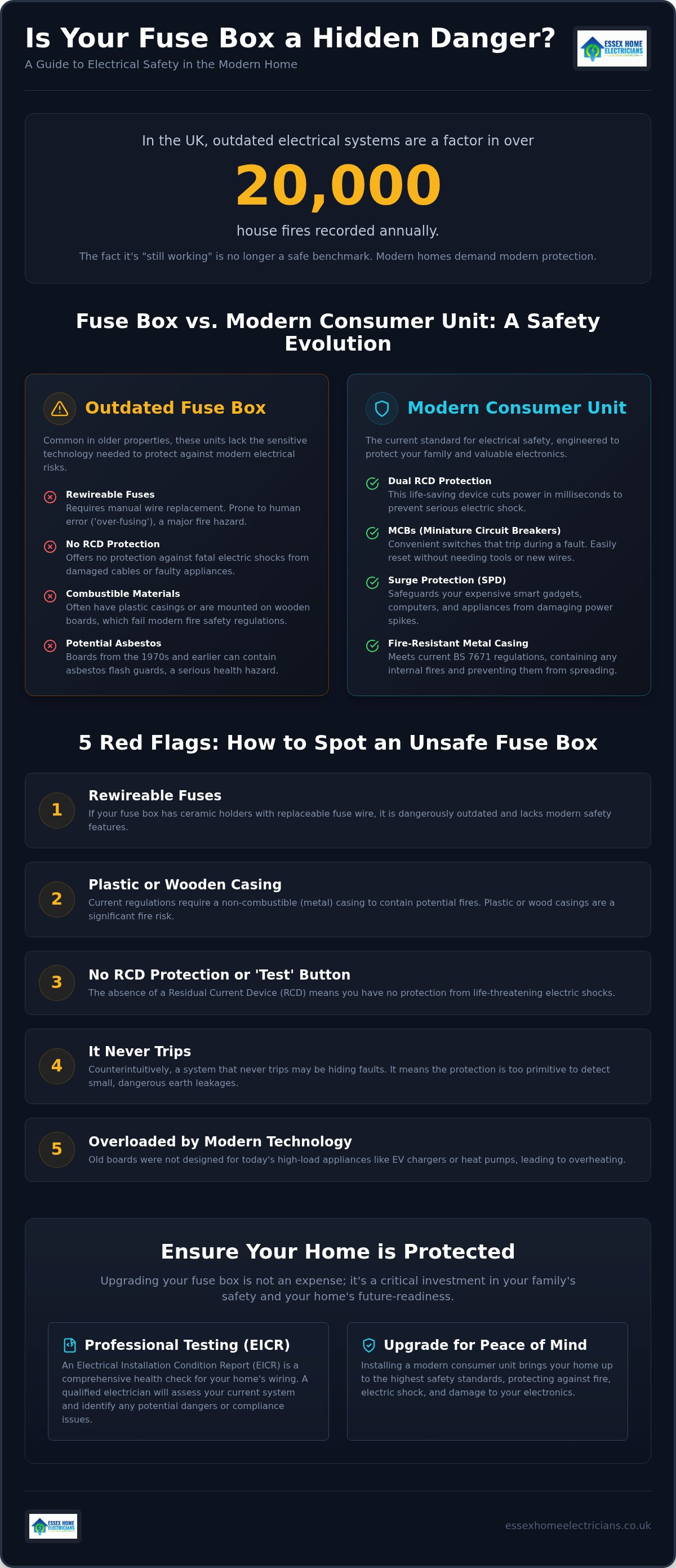
If you open your cabinet and see ceramic holders with thin wire wrapped around them, you have a rewireable fuse box. These were standard decades ago but are now considered a significant risk. When a fuse 'blows', you have to manually replace that wire. This often leads to dangerous mistakes, such as using a wire that's too thick, which allows the cables in your walls to overheat without the fuse ever popping. These units also lack a 'Test' button, meaning you have no way to verify if the safety mechanisms still work. Many 1970s-era boards also contain asbestos flash guards, which are a serious health hazard if they become damaged or disturbed during repairs.
The Modern Standard: The Dual RCD Consumer Unit
Modern standards require a Consumer Unit equipped with Miniature Circuit Breakers (MCBs) and RCDs. MCBs are convenient switches that flip down during a fault, making it easy to see which circuit has a problem. You don't need tools to fix them; you just flick the switch back up once the fault is cleared. The real hero, however, is the Residual Current Device (RCD). This component constantly monitors the flow of electricity for any sign of "leaking" to earth, which happens during an electric shock or if a cable is damaged. An RCD is a life-saving device that cuts power in milliseconds to prevent fatal electric shocks. When we perform a fuse box upgrade, we ensure these modern protections are in place to keep your family safe from invisible electrical threats.
Myth vs. Reality: 'My Electricians Say It Still Works, So It Must Be Safe'
It's a common belief that as long as the power is running, the electrical system is healthy. This logic is flawed. A lack of 'tripping' doesn't necessarily mean your system is robust. It often means the protection is too primitive to detect a fault before it becomes a hazard. Old rewireable fuses are effectively 'blind' to small but lethal earth leakages. Whilst a modern unit would cut power instantly if it detected a tiny current imbalance, an old fuse box will keep the power flowing until something literally melts or catches fire.
According to Electrical Safety First, thousands of domestic fires are caused by electrical faults each year. Many of these occur in homes where the owner believed their setup was perfectly functional. The stress on these old boards has increased significantly in 2026. We now use high-load technology like EV chargers, heat pumps, and induction hobs that the original installers in the 1970s never imagined. If you are asking "is my fuse box safe" while charging your car on a 50-year-old board, the reality is that you are pushing the system beyond its design limits.
The Danger of 'Over-fusing'
One of the biggest risks with old units is human error. When a fuse wire blows, it's tempting for a homeowner to use whatever wire they have to hand. If you use a 30-amp wire on a 5-amp lighting circuit, you've created a ticking time bomb. This 'over-fusing' prevents the fuse from blowing even when the cables inside your walls are overheating. This behaviour is a leading cause of house fires in older Essex properties, as the wiring becomes brittle and eventually ignites the surrounding timber or insulation.
Why 'Grandfather Rights' Don't Protect You From Fire
There is a common myth that old fuse boxes are "grandfathered in" and therefore don't need changing. Whilst it isn't a criminal offence to have an old board, it simply doesn't meet modern safety standards. Current BS 7671 regulations exist because we have better technology to save lives today. Compliance is about following the law, but safety is about protecting your family. If your current setup leaves you feeling uncertain, it might be time to look into fuse box upgrades in Basildon to bring your home up to 2026 standards.
If you've noticed flickering lights or a strange smell near your meter, don't wait for a total failure. You can speak with our local team for a professional assessment of your home's safety.
5 Red Flags: How to Spot an Unsafe Fuse Box in Your Essex Home
Identifying a dangerous electrical setup does not always require a professional degree. Often, the evidence is visible to the naked eye. If you find yourself standing in your hallway wondering "is my fuse box safe", you can perform a quick visual inspection to look for immediate danger signs. These red flags are clear indicators that your home's electrical heart is struggling to cope with modern demands.
Wood Backing: Many older properties in Basildon and surrounding Essex areas still have fuse boxes mounted on wooden plinths. This is a significant fire hazard. If a component fails and generates heat, the wood acts as fuel, allowing a small fault to become a house fire.
No RCD Protection: Look for a button marked 'Test' or 'T'. If your box lacks this, you likely have no RCD protection. This means your system cannot detect small current leakages that cause lethal electric shocks.
Visible Damage or Discolouration: Check for charring, soot marks, or 'smoky' stains around the fuses. This is a sign of previous overheating or internal arcing.
Buzzing Sounds: A healthy electrical board should be silent. If you hear a persistent buzzing or crackling sound, it indicates loose connections that are generating heat and potentially melting the internal plastic.
Flickering Lights: Whilst often blamed on a loose bulb, consistent flickering across multiple rooms suggests the main board is failing to distribute power evenly.
Using a Home Electrical Safety Checklist can help you stay organised during your inspection, but these physical red flags should never be ignored. If you spot any of these signs, your next step should be a professional assessment.
The 'Old Plastic Box' Risk
In 2015, the UK Wiring Regulations underwent a major change. It became mandatory for all new consumer units to be made from non-combustible materials, which usually means a metal enclosure. Older plastic boxes are no longer installed in new Essex builds because they cannot contain a fire if a component fails inside. If you have a plastic unit, it may be time to have it inspected by a qualified electrician. A metal unit provides a vital layer of protection by keeping any potential fire contained within the box itself.
Identifying Asbestos Flash Guards
If your fuse box is more than 40 years old, it might be hiding a hidden health risk. Many old ceramic fuse holders utilised asbestos flash guards to manage heat. These appear as small, fibrous grey or white pads located behind the fuse carriers. Do not attempt DIY repairs or even pull the fuses out if you suspect asbestos is present. Disturbing these fibres can release them into the air, creating a severe health hazard for you and your family. If your board looks like a relic from the 1970s, it is best to leave it to the experts.
The Real Risks of Ignoring an Outdated Electrical Board
Ignoring an old electrical board is a gamble. It is not just about the inconvenience of a blown fuse; it is about the structural integrity of your home. One of the most severe risks is electrical arcing. This happens when wires become loose within old ceramic holders. Over time, the constant heating and cooling causes connections to slacken. This creates a gap where electricity 'jumps' or arcs, generating temperatures high enough to melt plastic and ignite surrounding materials. Many people ask "is my fuse box safe" only after they smell a faint scent of ozone or burning, but by then, the damage is already well underway.
Modern technology in 2026 also faces threats that older boards simply cannot handle. Our homes are now filled with sensitive electronics, from smart hubs to high-end gaming rigs. Outdated fuse boxes lack Surge Protection Devices (SPDs). Without an SPD, a single power spike from the grid can fry your expensive tech in an instant. There is also the hidden danger of inadequate earthing. In older systems, the earth connection can degrade. This potentially makes the metal casing of your toaster or kettle 'live' to the touch, posing a constant risk of electric shock to your family.
Financial protection is another concern. Insurance companies are increasingly rigorous when assessing fire claims. If a fire is traced back to an outdated board that was highlighted as a risk during a previous survey, your payout could be significantly reduced or even rejected entirely. Maintaining a safe system is as much about protecting your investment as it is about physical safety.
Modern Life vs. 1970s Wiring
Our electrical habits have changed beyond recognition since the 1970s. We now rely on high-draw devices that put immense pressure on old circuits. Consider these common modern additions:
High-wattage air fryers and induction hobs.
Electric showers that draw massive amounts of current.
Home offices with multiple monitors, printers, and servers.
Old fuse boxes were designed for a time when a colour television was the most advanced thing in the house. This mismatch leads to 'nuisance' tripping and overheating that eventually causes the system to fail completely. If your board was installed before the turn of the century, it was never meant to handle the load of a 2026 lifestyle.
The Silent Danger: Earth Leakage
Earth leakage is a fault where electricity escapes its intended path. Without an RCD, a small fault to earth often won't draw enough current to blow a fuse. This is why you might feel a slight 'tingle' when touching a metal appliance. This is a major warning sign. It means electricity is looking for a path to the ground, and that path could be you. An RCD is the only reliable way to cut power instantly before a shock becomes fatal. If you're asking "is my fuse box safe" after feeling even a tiny shock, the answer is almost certainly no. You should book a safety inspection with our local experts to get a clear picture of your home's health.
Next Steps: Testing and Upgrading for Peace of Mind
If you have spotted the red flags mentioned earlier, the next step isn't to worry; it's to act. Identifying a potential hazard is the start of the journey, but resolving it requires a professional touch. Receiving a definitive verdict is the only way to truly answer "is my fuse box safe" with 100% certainty. For many Essex homeowners, this process starts with a thorough diagnostic check rather than an immediate teardown.
Booking an EICR Inspection
An Electrical Installation Condition Report (EICR) is essentially the 'MOT' for your home's electrical system. Just as you wouldn't drive a car for twenty years without a safety check, you shouldn't rely on decades-old wiring without a professional review. During an inspection, an expert electrician checks everything from the main intake to the furthest socket in your loft. We look for hidden issues like degraded insulation, poor earthing, and over-fused circuits that aren't visible during a casual glance. If you want to understand the full scope of what we look for, our EICR certificate Chelmsford guide provides a comprehensive breakdown of the 2026 safety standards.
The Upgrade Process
If your EICR reveals that your current board is a fire risk, an upgrade is the logical solution. Many people delay this because they fear their home will be a building site for weeks. In reality, a standard consumer unit change usually takes less than a day. We isolate the power, remove the old unit, and install a modern, metal-clad board equipped with the latest RCD and surge protection technology. Once the new unit is in place, we test every single circuit to ensure it functions perfectly with the new safety devices. The result is a system that is easier to maintain and far more resilient against power spikes and faults.
Certification is a vital part of this process. As NAPIT-accredited experts, we provide a Building Regulations Compliance Certificate once the work is finished. This document is essential if you ever decide to sell or rent your property. It proves that your electrical system meets the rigorous BS 7671 standards required in 2026. Without this paperwork, you may find it difficult to satisfy buyers or insurance providers.
DIY is never an option for fuse box work. Attempting to swap a board yourself is not only dangerous but often illegal under Part P of the Building Regulations. A single loose connection or a misplaced wire can lead to a fire or a fatal shock. Trusting a professional with over 20 years of local experience ensures the job is done right the first time. Contact our expert team to organise a safety inspection or upgrade today and take the first step toward a safer home.
Secure Your Home's Electrical Future Today
Understanding the state of your electrical system is about more than just avoiding a tripped switch; it's about protecting your family from the thousands of electrical fires that occur annually in the UK. We have explored how outdated wood-backed units and the lack of RCD protection create silent hazards that modern appliances only intensify. If you are still questioning is my fuse box safe, remember that a visual inspection is merely the first step. True peace of mind comes from professional verification and ensuring your home meets the rigorous 2026 safety standards.
Don't leave your property's safety to chance. As NAPIT-accredited electricians with over 20 years of local experience, we specialise in bringing Essex homes up to code. Whether you need a routine check or a full consumer unit upgrade, we are here to help. We even provide a 1-hour emergency response in Basildon for those who discover immediate hazards. Book a professional electrical safety check for your Essex home and rest easy knowing your power is in expert hands. Your home deserves the highest level of protection.
Frequently Asked Questions
Is it illegal to have an old fuse box in my UK home?
It is not illegal to have an old fuse box in your home, but it may not meet current safety standards. If you are asking "is my fuse box safe" because you want to sell your property, be aware that surveyors often flag older units as a priority for replacement. Whilst not a criminal offence, an outdated system can lead to insurance complications.
How much does it cost to replace an old fuse box in Essex?
The cost of replacing an old fuse box depends on the number of circuits and the overall condition of your wiring. Every Essex home is different, so we provide personalised quotes based on your specific requirements. This ensures you receive a modern, compliant consumer unit that meets all current regulations without paying for unnecessary extras.
Can I just replace the fuses with circuit breakers myself?
No, you should never attempt to modify your fuse box or replace components yourself. Electrical work of this nature is high-risk and falls under Part P of the Building Regulations. Incorrect installation can lead to fires or fatal shocks. Always hire a NAPIT-accredited professional to ensure the work is certified and safe for your family.
What happens if my fuse box fails an EICR test?
If your fuse box fails an EICR, you will receive a report with 'C1' or 'C2' codes indicating immediate or potential danger. These faults must be rectified to make the installation safe and compliant. We will provide a clear breakdown of the necessary repairs or upgrades needed to bring your home back to a satisfactory safety standard.
How long does it take an electrician to upgrade a consumer unit?
A standard consumer unit upgrade typically takes between four and eight hours to complete. This timeframe includes isolating the power, installing the new metal-clad board, and performing rigorous safety tests on every circuit. We aim to minimise disruption to your day and ensure your home is fully protected by the time we leave.
Do I need a new fuse box if I'm getting an EV charger installed?
You likely will need an upgrade if your current board lacks RCD protection or sufficient spare capacity. EV chargers draw a significant amount of current for long periods. If you are asking "is my fuse box safe" for electric vehicle charging, it must be capable of handling high loads and protecting against DC leakage faults.
My fuse box is plastic—is it an immediate fire risk?
A plastic fuse box is not an immediate fire risk if the internal connections are healthy, but it no longer meets the 2015 non-combustible material requirement. Modern metal units are designed to contain a fire if a component fails inside. If your plastic unit shows signs of heat or damage, it should be replaced with a metal-clad consumer unit immediately.
What is the difference between a fuse box and a consumer unit?
A fuse box is an older style of distribution board that uses rewireable fuses to protect circuits. A consumer unit is the modern equivalent that uses automatic circuit breakers and RCDs. Whilst people often use the terms interchangeably, a consumer unit offers far superior protection against electric shocks and fires compared to the outdated fuse box.