
The charger you choose may be the easiest part of getting ready to charge at home. For a home EV charging point Essex homeowners can use safely and conveniently, start by considering the property’s electrical setup, parking access and practical installation options.
It’s sensible to ask whether your existing electrics can support a charger, where it should go and how installation might affect your home. These details shape the installation, but they’re easier to plan when considered together before work begins.
This guide explains what to consider before arranging installation, including your consumer unit, electrical capacity, charger position, cable route and parking access. It also covers what information to prepare and why permissions may depend on your property and circumstances. Essex Home Electricians is a Basildon-based, NAPIT-accredited electrical contractor with over 20 years of experience. An assessment of your home can help turn questions into a practical installation plan.
Table of Contents
Check Your Essex Home’s Electrical Capacity Before Installation
Will Your Essex Home Need Electrical Upgrades for an EV Charge Point?
Arrange a Home EV Charging Point in Essex with Local Electrical Support
Home EV Charging Point Essex: What Does a Ready Home Need?
A home EV charge point is dedicated equipment installed at a property to charge an electric vehicle, rather than part of the public charging network. A public map can show nearby places to charge, but it can’t tell you whether your home is ready for its own installation.
An electric vehicle charging station is a general term for equipment that supplies power to a vehicle. At home, a dedicated charge point lets you charge where you park. Public charge points, including those shown through Essex Highways resources, are for use away from home, such as during a journey or for a top-up. A home unit can support routine charging around your usual parking habits.
How is a home charge point different from a public charger?
Public infrastructure is shared and located across the road network; a home charge point is installed for use at a specific property. Essex Highways information can help you find public charging options, but it doesn’t assess your home’s electrical installation or identify a suitable charger position. For broader installation information, readers can also explore an Essex EV charger installation guide covering Southend.
Which parts of the property affect readiness?
Readiness depends on how the electrical installation and parking area work together. The consumer unit, the condition of the existing wiring, your usual parking space and the proposed charger position all help shape the installation plan. The likely cable route and practical access around the property matter too.
For example, a charger near the front of a home may be straightforward to position if that’s where the car is parked. A different parking layout could mean the cable route needs closer consideration. The details vary from one property to another, even within the same town. A postcode in Basildon, Rayleigh or Southend can’t determine a home’s electrical capacity or layout.
That’s why a home EV charging point Essex installation starts with the property, not just the choice of charger. Note where the vehicle usually sits and where you’d prefer the unit to go. An electrician can assess the existing installation and consider the route and access when planning the work. Essex Home Electricians installs EV car chargers across Essex and brings over 20 years of experience to the work.
Check Your Essex Home’s Electrical Capacity Before Installation
Plan a home EV charging point Essex installation around the electrical system already in place. An electrician assesses the existing installation and intended charging arrangement before deciding what work, if any, is appropriate. A checklist can help you gather useful information, but it can’t confirm your home’s capacity or the condition of its wiring.
A site assessment determines whether electrical changes are needed. The answer depends on the property, the condition of its electrical installation and the proposed charger setup. Don’t assume every home needs an upgrade or that none will.
What can the consumer unit and existing wiring tell you?
The consumer unit and wider wiring are key parts of an electrical assessment. Their condition and configuration help the electrician understand the existing installation and what to consider before adding a charger. If you know about previous electrical work, repairs or upgrades, share that information. Mention visible concerns too, such as damage or recurring circuit trips. Don’t remove covers or inspect electrical equipment yourself.
If a safety concern or possible consumer unit upgrade is identified, have it assessed as part of the installation plan rather than guessing what work is needed. An electrician can explain what the findings mean for the proposed installation.
When might electrical work need to be considered?
Capacity is one factor, but it isn’t the only one. The existing installation’s condition and the charger’s intended position can also influence the work involved. A professional assessment considers these factors together, rather than relying on the property’s age or a general online checklist.
EV charger work should be planned with relevant electrical safety requirements in view, including BS 7671 and applicable Building Regulations Part P requirements in England. For wider national information, see UK government guidance on EV charging. The electrician can assess the particular installation and explain the work and compliance considerations for your home.
Before an assessment, note any known electrical work and describe how you expect to use the charger. Leave technical checks and electrical work to the electrician. Don’t attempt to test capacity or alter wiring yourself. Essex Home Electricians installs EV car chargers across Essex, with the work planned around the property and proposed setup. To explore the service, see EV charger installation in Essex.
Will Your Essex Home Need Electrical Upgrades for an EV Charge Point?
Not every home needs electrical upgrades before a charger can be installed. The answer depends on the existing installation, its available electrical capacity and the charging arrangement being considered. Assess a home EV charging point Essex installation on its own merits, rather than judging it by the property’s age, location or a general checklist.
In one home, the existing electrical setup may be suitable for the proposed installation, with the work focused on fitting the charge point and planning its connection. In another, the electrician may identify issues that need further investigation or electrical work before installation can proceed as planned. Neither outcome should be assumed before the property has been assessed.
What can affect whether changes are needed?
The electrician considers the condition of the existing installation and whether its capacity is suitable for the intended charging setup. The charger’s position matters too. If the parking space is some distance from the property, or the cable route is complicated, that may affect how the installation is planned and what work is involved.
These factors need to be considered together. A clear route to the parking space doesn’t establish that the electrical installation is suitable. Equally, a concern about one part of the setup doesn’t automatically mean a particular upgrade is required. An assessment helps identify what applies to your home.
How does a site assessment clarify the options?
A site assessment brings the electrical installation and intended charger location into the same plan. The electrician can consider the relevant conditions, discuss your usual parking position and identify whether further electrical work needs to be considered. This gives you a property-specific view of the options, rather than relying on assumptions.
Before the assessment, note where you park, where you’d like the charger and any known electrical concerns or previous work. Stick to observations: don’t open the consumer unit, alter circuits or attempt electrical tests yourself. Leave inspection and electrical changes to a qualified electrician.
Essex Home Electricians installs EV car chargers across Essex. The team can discuss your proposed setup and assess the property as part of planning the work. Find out more about EV charger installation.
Prepare Your Property for a Home EV Charging Point in Essex
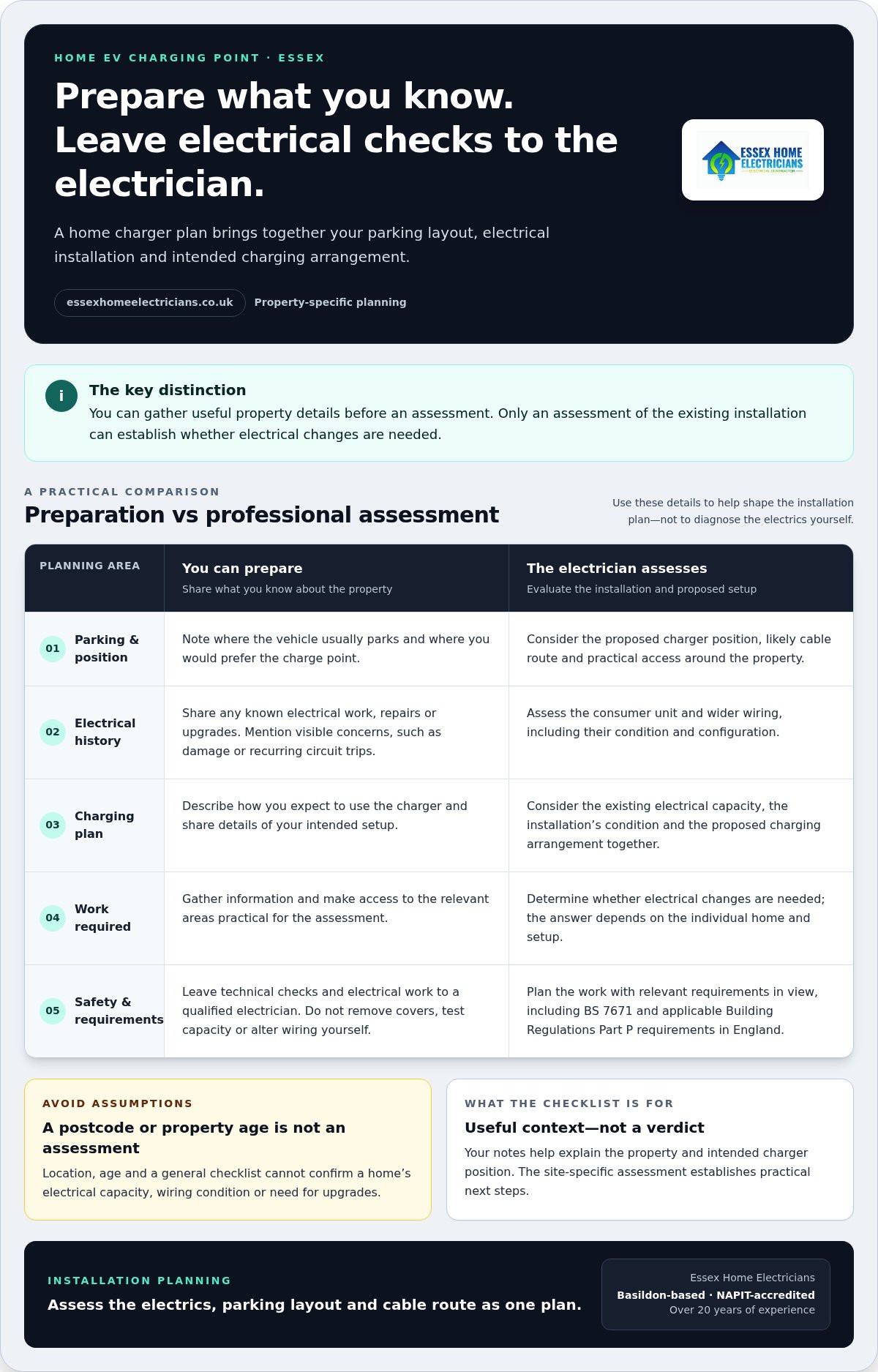
Before the electrician visits, prepare practical details about your parking, preferred charger position, cable route and existing electrical installation. This gives the assessment a useful starting point without asking you to inspect or alter electrical equipment yourself.
What information should you gather beforehand?
Use this homeowner checklist to organise what you know. You don’t need to make technical decisions or select a charger specification in advance.
Note your vehicle and usual parking position. Describe where you normally park and whether that position changes.
Mark your preferred charger location. A note or simple sketch can show where you’d like the unit fitted.
Think through the likely cable route. Point out the route from the electrical supply towards the parking area, including any doors, paths or other practical obstacles.
Gather relevant information. Share known details of previous electrical alterations, repairs or issues. If helpful, take clear photos of the consumer unit from the outside, without removing its cover.
Explain access constraints. Note gates, limited parking access or other details that could affect a visit or the proposed installation. These practical details matter whether your home is in Wickford, Benfleet or elsewhere in Essex.
How should you think about charger position and access?
Consider how the car sits in its usual parking space, whether a charging cable could reach safely and how people move around the area. The distance between the parking position and the property, along with the possible cable route, can influence installation planning. A location that looks convenient on paper may need adjusting once the property layout and electrical supply have been assessed.
Use your preferred position as a starting point, not a final decision. The electrician can consider the home, electrical installation and access before settling on a suitable arrangement. For a wider overview of installation planning, readers can also look for a Southend home installation guide.
Keep preparation separate from electrical work. Don’t open the consumer unit, change a circuit or try to test the installation. Leave inspection and any electrical changes to the electrician. Your notes and photos help explain the property, but they don’t replace a professional assessment for a home EV charging point Essex installation.
Once you’ve gathered these details, arrange an EV charger installation assessment with Essex Home Electricians.
Arrange a Home EV Charging Point in Essex with Local Electrical Support
Once you’ve gathered details about your home and parking, discuss the intended setup with an electrician. Share where the vehicle is usually parked, where you’d like the charge point and any known electrical work or concerns. The property can then be assessed and suitable work planned around its layout and electrical installation.
What should you expect when discussing your home?
The conversation should focus on how you’ll use the charger and the practical details of your property. Ask about the assessment, charger position and any work that may need to be considered. Essex Home Electricians takes a project-specific approach to EV car charger installation. The assessment informs the plan; it doesn’t assume a particular specification or outcome before the home has been considered.
Essex Home Electricians is a Basildon-based, NAPIT-accredited electrical contractor with over 20 years of experience. Its qualified, insured electricians install EV car chargers for homes across Essex. A free, no-obligation quote gives you an opportunity to discuss the proposed work before deciding how to proceed with a home EV charging point Essex project.
Which Essex areas can request local support?
Local installation support is available across Essex, including Basildon, Benfleet, Canvey Island, Rayleigh, Wickford, Billericay, Leigh-on-Sea and Southend. Sharing your location alongside your property and parking details helps start a practical conversation about the installation. No two homes are identical, so the discussion can focus on your intended setup and what the property needs.
Ready to discuss your home EV charging point? Arrange a free, no-obligation quote with Essex Home Electricians.
Take the Next Step Towards Home Charging
Getting ready for a home EV charging point Essex installation starts with the details of your property. Electrical capacity and the condition of the installation need an individual assessment. Your usual parking position, preferred charger location and likely cable route help shape the practical plan.
You don’t need to diagnose the electrics or settle every detail before asking questions. Share what you know about your home and how you intend to charge, then discuss suitable next steps with a local electrician.
Essex Home Electricians is a Basildon-based, NAPIT-accredited electrical contractor with over 20 years of experience. Its qualified, fully insured electricians install EV car chargers across Essex, and the business provides free, no-obligation quotes.
Ready to discuss your property and installation plans? Request a free, no-obligation quote for your home EV charging point. A clear conversation is a practical first step towards charging at home with confidence.
Frequently Asked Questions
Can any home in Essex have an EV charging point?
Do I need to upgrade my consumer unit before installing a home EV charging point?
Not necessarily. Whether an upgrade or other changes are needed depends on the condition and capacity of your existing electrical installation, as well as the proposed charging setup. A qualified electrician can assess the consumer unit and relevant parts of the installation as part of planning the work. Don’t remove covers, modify circuits or attempt electrical tests yourself. Share any known faults or previous electrical work with the electrician.
How do I prepare my home for an EV charging point installation?
Note where your vehicle is usually parked, your preferred charge point position and any access constraints around the property. Gather information about known electrical alterations, repairs or concerns. Clear photos of the parking area and the outside of the consumer unit may help explain the layout, but don’t remove covers. Photos aren’t a substitute for an assessment. Leave electrical checks and installation work to a qualified electrician.
Can I install a home EV charging point if I don’t have a driveway?
Possibly, but the parking arrangement and charging route need careful consideration. Shared parking, pavement access and the position of the property can affect what’s practical and whether permissions need to be addressed. Discuss the layout with an electrician and check the relevant property permissions before planning work. Don’t trail a loose charging cable across a public route, where it could obstruct pedestrians or create a hazard.
Do I need permission to install an EV charging point at home?
It depends on the property, its location, ownership arrangements and the proposed installation. If you rent, own a leasehold property or live in a shared building, you may need permission from a landlord, freeholder or managing body. Planning and building requirements can also depend on the circumstances. Check current official guidance for your situation, and discuss the installation details with an electrician before work is planned.
What happens if my home isn’t ready for an EV charging point?
An assessment can identify what needs attention before installation, whether that relates to the electrical installation, available capacity or a practical cable route. The work required depends on your property, and an assessment doesn’t automatically mean a major upgrade is needed. The electrician can explain the findings, discuss suitable options and outline any necessary work, giving you a clearer picture of the next steps before deciding how to proceed.
Can a home EV charging point be installed in Basildon, Rayleigh or Southend?
Essex Home Electricians installs EV car chargers in Basildon, Rayleigh, Southend and surrounding Essex areas, including Benfleet, Canvey Island, Wickford, Billericay and Leigh-on-Sea. The installation plan depends on your home’s electrical setup, parking arrangement and intended charger location. Share your town and a brief description of the property when discussing the project. Essex Home Electricians is a Basildon-based, NAPIT-accredited electrical contractor serving homes across Essex.