
A home EV charger is only as dependable as the electrical system behind it. If you’re considering EV charger installation Southend, choosing between 7kW and 22kW is only part of the decision. Your consumer unit, existing electrical supply and any steps required by UK Power Networks, your local DNO, matter too.
It’s understandable to want convenient charging without compromising electrical safety or overlooking approval requirements. This guide explains how to choose a charger for your vehicle and property, what an assessment of an older fuse box may involve, and when UK Power Networks needs notification or approval. It also covers smart charging requirements for new chargers in 2026.
Essex Home Electricians are NAPIT-accredited contractors with over 20 years of experience, serving Southend and nearby areas including Basildon, Benfleet, Canvey Island, Rayleigh, Wickford, Billericay and Leigh-on-Sea. They can assess your home’s electrical infrastructure and upgrade the consumer unit alongside a charger installation where needed. Read on for a practical overview of the process, from checking your supply to planning a safe installation.
Table of Contents
The Installation Process: What Southend Homeowners Should Expect
Professional EV Charger Fitting with Essex Home Electricians
Switching to Electric: EV Charger Installation in Southend
For Southend drivers, a home chargepoint can make charging part of an everyday routine: park, plug in and charge while the car is at home. A dedicated chargepoint is designed for this purpose. A standard three-pin socket can charge an EV too, but it typically supplies power more slowly and isn’t equivalent to a purpose-installed unit. The technology behind charging points is often described as electric vehicle supply equipment (EVSE).
Whether you live in Thorpe Bay, Leigh-on-Sea or elsewhere in Southend-on-Sea, start by checking where you can park and whether the car can be charged there. A home with off-street parking has different options from a property where the car is usually left on the street. Public charging can help on journeys, but relying on it means planning around charger availability, location and charging time. Home charging can make daily use simpler; any savings depend on your electricity tariff, driving habits and the cost of public charging.
Why Southend is the Perfect Place for an EV
Public charging provision can change, so check current maps and facilities in Southend and Leigh-on-Sea rather than assuming a charger will be available or convenient when you need it. For commuters heading towards London, overnight home charging can mean starting the morning with a useful charge in the battery. An EV produces no exhaust emissions while driving, which can help reduce pollution at street level. Its overall environmental impact also depends on factors such as electricity generation and vehicle manufacture.
The Problem with 3-Pin “Granny” Chargers
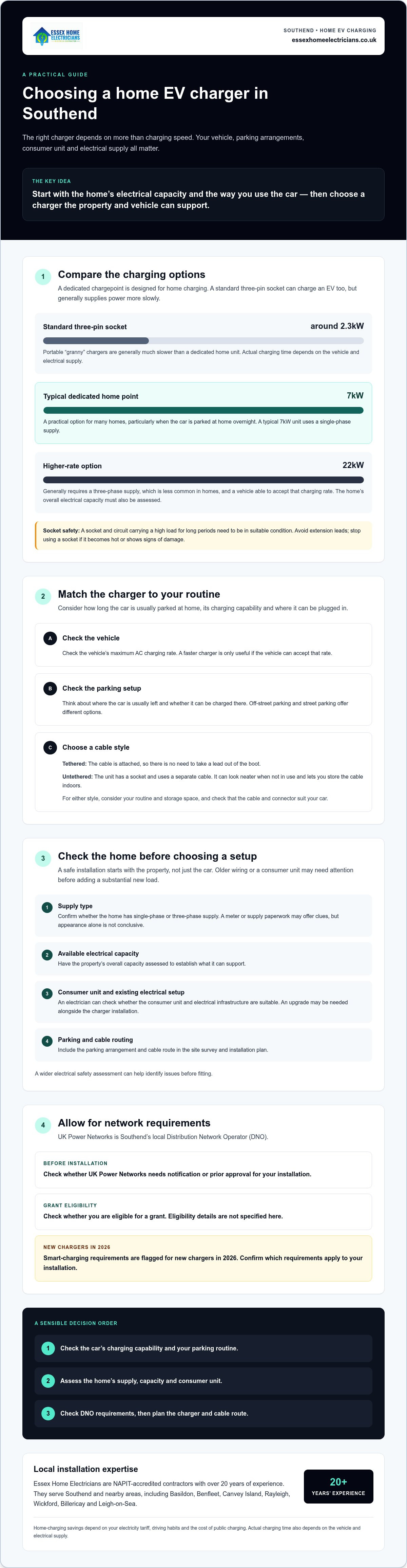
A portable charger using a standard socket is generally much slower than a dedicated home unit: around 2.3kW compared with a typical 7kW point. Actual charging time depends on the vehicle and electrical supply. A socket and circuit carrying a high load for long periods need to be in suitable condition. Avoid extension leads, and stop using a socket if it becomes hot or shows signs of damage. A three-pin charger isn’t automatically prohibited for regular use, but a qualified electrician can assess whether your home setup is suitable.
A proper EV charger installation Southend starts with the property, not just the car. Older wiring or a consumer unit may need attention before adding a substantial new load. Essex Home Electricians are NAPIT-accredited contractors with over 20 years of experience serving Southend and surrounding areas. They can upgrade a consumer unit alongside an EV charger installation where required. This assessment helps match the charging plan to your home’s electrical setup and parking arrangements.
Choosing the Right Home Charging Point for Your Vehicle
The right charger depends on your car, daily mileage and what your home’s electricity supply can support. For many Southend properties, a 7kW unit is a practical option: it can charge overnight without needing the higher-capacity supply associated with faster charging. Your vehicle also affects charging speed, so check its maximum AC charging rate before choosing a unit. The guidance from the Energy Saving Trust offers an independent overview of home and public charging options.
7KW vs 22kW: What Can Your Southend Home Handle?
A typical 7kW home charger uses a single-phase supply. A 22kW charger generally requires a three-phase supply, which is less common in homes, and a vehicle capable of accepting that rate. The property’s overall electrical capacity must also be assessed before installation. Your electricity meter or supply paperwork may offer clues about the incoming supply, but don’t rely on appearance alone. An electrician can confirm the supply type and check whether the consumer unit and available capacity are suitable.
Consider how long the car is usually parked at home. If it stays on the drive overnight, a 7kW charger may meet your needs without pursuing a faster setup that your supply or vehicle can’t use. If you’re considering 22kW, ask for the home supply and vehicle compatibility to be checked first.
Tethered vs Untethered: Which Suits Your Driveway?
A tethered charger has its cable attached, so you can plug in without taking a lead out of the boot. An untethered unit has a socket and uses a separate cable. It can look neater when not in use and lets you store the cable indoors. Either can work well. Consider your routine, storage space and whether you may change vehicles, then check that the cable and connector suit your car.
Parking arrangements matter in Southend. If the car is close to the house, check that the cable can reach without crossing a walking route or creating a trip hazard. Street-side parking brings extra challenges: a cable should not be left trailing across a public pavement. Discuss your parking layout and cable route before selecting a unit.
Smart features can make charging easier to manage. Look for scheduling if you want to set charging times, app controls if you want to monitor or adjust sessions remotely, and solar matching if you have solar panels and the chosen system supports it. New chargers sold in Great Britain must have smart functionality, including scheduled charging and a randomised delay. To discuss EV charger installation in Southend, consider your car, supply and parking setup together.
Navigating UK Regulations, DNO Approvals, and Grants
A compliant EV charger installation Southend involves more than fitting the unit. Your installer must consider the home’s electrical capacity, notify or seek approval from the local Distribution Network Operator (DNO), and make sure the work meets relevant safety requirements. In Southend, the DNO is UK Power Networks. The process depends on the installation and your property’s maximum electrical demand, so don’t assume every home follows the same DNO route or timescale.
The DNO Notification Process Explained
UK Power Networks needs information about new high-load equipment so it can assess the effect on the local electricity network. For a standard 7kW, single-phase installation where the property’s total maximum demand stays at or below 60A, the installer can generally connect the charger and notify the DNO within 28 days. If demand exceeds that level, or the job involves a more complex supply such as three-phase, prior approval is required.
That prior-approval route is often called “Apply to Connect”. Straightforward cases may receive a response in around ten working days, but jobs involving a supply fuse upgrade or network reinforcement can take from a few weeks to a few months. If a Southend substation is near capacity, UK Power Networks may need to assess what the network can support and whether further work is required before connection. The installer should establish the correct route before work begins, rather than treating every notification as automatic.
Installation work must also meet applicable electrical safety requirements, including Building Regulations Part P and the IET Wiring Regulations (BS 7671). Testing and certification provide a record that the circuit and charger have been installed and checked. Ask what documentation you’ll receive, and confirm who is responsible for submitting the DNO notification or application.
OZEV Grants and Incentives in 2026
Grant eligibility depends on your circumstances. From 1 April 2026, renters and people who own and live in a flat may be eligible for an OZEV grant of up to £500 towards a chargepoint, provided they have private off-street parking. The scheme is confirmed for installations completed by 31 March 2027. Homeowners with off-street parking who don’t meet those categories shouldn’t assume they qualify.
Landlords may be eligible for up to £500 per socket, for up to 200 sockets per year across their properties. This is a separate grant, not the Workplace Charging Scheme. A qualifying grant installation must use an OZEV-authorised installer; NAPIT accreditation alone doesn’t confirm that status. Check the current scheme conditions and the installer’s authorisation before committing. Essex Home Electricians are NAPIT-accredited, so ask directly about any grant-specific requirements and relevant credentials.
The Installation Process: What Southend Homeowners Should Expect
A well-planned installation starts with your home’s electrical supply and parking layout, not simply the position of the charger. For EV charger installation Southend, a survey can identify practical issues early, such as an older consumer unit, a long route from the meter or limited driveway access. The work depends on the property, so don’t rely on a standard time estimate before the installer has assessed the site.
Step 1: Site survey and load assessment. The electrician checks the consumer unit, incoming supply, proposed charger location and likely cable route. They’ll consider the home’s existing electrical demand and whether an upgrade may be needed before adding the charger.
Step 2: Cable route planning. You and the installer agree on the route from the consumer unit to the chargepoint. Ask how the cable will be run and discuss any practical compromises between a shorter route, appearance and access.
Step 3: Mounting and connection. The unit is fixed in the agreed position and connected to the electrical installation. Its location should let you reach the vehicle’s charging inlet without creating an avoidable obstruction.
Step 4: Testing and setup. The electrician tests the installation and commissions the charger. If it has app-based controls, setup may include connecting it to your home network and checking that you can use the relevant functions.
Preparing Your Home for the Installer
A little preparation can help the work proceed smoothly. Clear access to the fuse box or consumer unit, the outside wall and the planned cable route. Think about where the charger will be easiest to reach, then discuss a practical mounting position with the installer. If you want app or smart features, check whether your Wi-Fi reaches the driveway; a weak signal may affect connectivity.
Common Challenges in Southend Properties
In a detached Thorpe Bay home, the consumer unit may be some distance from the driveway. A longer cable run can affect the route and installation plan, so point out any preferred paths and landscaping to protect during the survey. If groundwork or lifting paving is required along the route, driveway and landscaping specialists such as Stonebase can help reinstate or adapt the surface. A meter at the opposite end of the property can create a similar challenge.
Flats and maisonettes in Southend centre may have shared areas or parking separate from the home. Don’t assume a cable can be routed through communal spaces. Ask the property owner or managing agent about access and permissions, then have the installer assess whether a safe, practical route is possible. Each layout needs an individual review.
Essex Home Electricians serve Southend and nearby communities across Essex. They can assess the charger and consumer unit as part of the installation plan. Arrange an EV charger installation assessment to discuss your property’s layout and electrical setup.
Professional EV Charger Fitting with Essex Home Electricians
A reliable charger needs a safe electrical installation behind it. Essex Home Electricians are NAPIT-accredited contractors with over 20 years of experience serving Southend and surrounding areas. As a local contractor, they can assess how your consumer unit, existing wiring and proposed charger fit together. That wider view matters, particularly in older homes where the fuse box may need attention before a new high-load circuit is added.
During an installation, the electrician can check the condition and capacity of the existing electrical system and confirm the protective measures required for the charger. The correct RCD protection depends on the charger and installation design, so it should be verified by the qualified installer rather than guessed by the homeowner. The work should be tested and documented in line with applicable electrical requirements.
Beyond the Charger: Upgrading Your Home Infrastructure
A consumer unit that’s old, damaged or unsuitable may need upgrading as part of the project. Essex Home Electricians provide fuse box repairs and upgrades, and can consider this work alongside EV charger installation. If your property also needs wider electrical work, a charger installation may be planned alongside a full house rewiring project.
Ask the electrician to explain any recommended upgrade, why it’s needed and how it affects the installation plan. A clear assessment helps you understand whether the existing consumer unit can safely support the charger or whether electrical work should come first.
Booking Your Southend Installation
When requesting a quote, share practical details that can help the team understand your property: where you park, where the consumer unit is, the likely cable route and whether you’ve noticed issues with the existing electrics. Essex Home Electricians are fully insured and qualified, and their NAPIT accreditation offers an additional point to check when choosing an installer.
The business also provides 24-hour emergency electrician support, with a one-hour emergency response in Southend. This is emergency support, not a charger-installation guarantee or a promise of ongoing charger maintenance.
For a locally assessed EV charger installation Southend, contact Essex Home Electricians to discuss your property and request a quote. Enquire about EV charger installation.
Make Your Southend Home Ready to Charge
A safe, practical home charging setup starts with matching the charger to your vehicle and checking that your electrical supply and consumer unit can support it. The installation plan should also cover cable routing, testing and UK Power Networks requirements, since it is Southend’s local DNO. Smart functionality matters too, helping new chargepoints meet the applicable requirements.
For EV charger installation Southend, an assessment can identify infrastructure issues before fitting begins and help you plan any necessary consumer unit upgrade. Essex Home Electricians are NAPIT-accredited contractors with over 20 years of experience serving Southend and nearby areas, including Basildon, Benfleet, Canvey Island, Rayleigh, Wickford, Billericay and Leigh-on-Sea. They can assess your home’s requirements and explain the installation process.
Ready to take the next step? Book your Southend EV charger survey to discuss your property, parking and electrical setup. Contact Essex Home Electricians to request a quote and plan your installation.
Frequently Asked Questions About EV Charger Installation in Southend
Do I need a new fuse box to install an EV charger in Southend?
Not always. Whether your fuse box, also called a consumer unit, needs upgrading depends on its condition, capacity and protective devices, as well as your home’s existing electrical demand. A qualified electrician should assess it before a charger is added. If it can’t safely support the new circuit, an upgrade may be needed. For EV charger installation Southend homeowners should start with this electrical check, not assume their existing unit is suitable.
How long does a typical home EV charger installation take?
There isn’t one fixed installation time; it depends on the property and the work required. An accessible consumer unit and a straightforward cable route can make the job simpler, while a longer cable run, consumer unit upgrade or other remedial work can add time. If UK Power Networks, Southend’s local DNO, requires prior approval, that process can also affect scheduling. Ask your installer for an estimate after they’ve assessed your home.
Can I install my own electric car charger if I am a DIY enthusiast?
DIY installation isn’t advisable. A home charger needs a suitable electrical circuit, appropriate protection, testing and commissioning. Incorrect work can create serious safety risks and may leave the installation non-compliant. Use a qualified electrician experienced in EV charging installations. Before work starts, check who will provide the relevant electrical documentation and take care of notifying UK Power Networks, Southend’s local DNO, where required.
What happens if my Southend home does not have a driveway?
You may still have a home-charging option, but it depends on where you park and what permissions are needed. Don’t trail a loose cable across a public pavement. Check purpose-designed cross-pavement solutions and local requirements before proceeding. In 2026, households with on-street parking may be eligible for an OZEV grant of up to £500 for a cross-pavement charging solution. The scheme is confirmed until 31 March 2027; check the current conditions first.
Will an EV charger increase my electricity bill significantly?
Charging at home will add electricity use, but the effect on your bill depends on how far you drive, your vehicle’s efficiency and your electricity tariff. To estimate the impact, consider the energy your car needs and the rate your supplier charges. If your tariff offers cheaper off-peak periods, scheduling charging for those times may help manage costs. Compare your tariff details rather than assuming home charging will always be cheaper.
Do I need permission from the council to install a charger in Southend?
Planning permission isn’t automatically required for every installation, but the answer depends on the property, charger position and applicable planning rules. Check with Southend-on-Sea City Council before work, particularly if your home is listed or in a conservation area, or if the proposal involves pavement works. Flats and homes with shared areas may also need separate permission from a landlord or managing agent. Council planning and DNO notification are separate matters.
Is my old consumer unit safe enough for a 7kW charger?
Age alone can’t determine whether a consumer unit is safe or suitable. An electrician needs to inspect its condition, assess the home’s electrical demand and confirm that the charger circuit can have the required protection. A 7kW charger adds a substantial electrical load, so don’t connect one based on appearance or assumptions. If the unit or existing wiring needs attention, repairs or an upgrade may be required before installation.
What is the difference between Type 1 and Type 2 charging cables?
Type 1 and Type 2 describe different connectors used for AC vehicle charging. Type 1 has five pins and is generally associated with single-phase charging; Type 2 has seven pins and can support single- or three-phase AC charging. Check your vehicle’s inlet and the charger’s socket or tethered cable before choosing. The car determines what charging rate it can accept, so a connector alone doesn’t guarantee faster charging.