

What if the best way to avoid an electrical emergency is to deal with risks before they interrupt the working day? A fault can affect staff, customers and essential operations, which is why Essex commercial electrical maintenance should start with planned risk control, not last-minute repairs.
It isn’t always clear which checks a premises needs, what should be included in the work or how to fit it around daily operations. This guide explains how planned maintenance differs from emergency repairs and how to assess electrical needs according to your building, equipment and working patterns.
You’ll also find a practical framework for defining the work, planning access and keeping useful records, so electrical work causes as little avoidable disruption as possible. Essex Home Electricians is a Basildon-based, NAPIT-accredited contractor with more than 20 years’ experience supporting commercial and industrial customers across Essex. Here’s what to consider when arranging electrical work for your premises.
Table of Contents
Why Essex commercial electrical maintenance matters beyond emergency repairs
What commercial electrical maintenance can cover in an Essex premises
How to compare commercial electrical maintenance providers in Essex
How to plan commercial electrical maintenance around your Essex site
Commercial electrical maintenance support from Essex Home Electricians
Why Essex commercial electrical maintenance matters beyond emergency repairs
A lighting fault in a shop can affect customers and staff straight away. In an office, loss of power to essential equipment may slow work; in a workshop, a fault could interrupt a task or make an area unavailable. The choice is between responding after a problem disrupts the day and planning electrical work around how the premises operates.
Commercial electrical maintenance means planned attention to a building’s electrical systems, shaped by how people use the premises and what needs to keep working. Priorities should reflect the likely impact of a fault, not a generic checklist applied to every site. An office, retail unit, workshop and managed commercial building can each have different patterns of occupancy, equipment use and access.
Start by considering the consequences of a fault. Which areas are regularly occupied? Which systems do staff or customers rely on? Could work in one area affect another? A shop may prioritise customer-facing lighting and power for tills; a workshop may need to consider the electrical systems supporting essential equipment. In managed premises, occupant needs and access arrangements also matter.
How electrical faults affect Essex business operations
Electrical problems can interrupt everyday tasks without shutting down an entire building. Failed lighting may make part of a shop or office harder to use. A power fault could disrupt staff work or affect equipment needed for a particular process. The impact depends on the premises, the affected circuit or system, and what the business relies on at that time.
An electrician’s work can include maintaining and repairing electrical infrastructure in buildings, as outlined in this general overview of the Electrician trade. For a business, the useful next step is to connect that work to site priorities: identify the affected areas, the equipment involved and any limits on access or timing.
Planned maintenance versus reactive electrical repairs
Planned maintenance means arranging checks and electrical work in advance, with the scope and site arrangements considered beforehand. Reactive repairs begin after a fault appears and needs attention. Both have a place. Planned work can help bring concerns to light before they cause greater disruption, but it cannot prevent every unexpected fault.
The benefit of planning is control, not a promise of fault-free operation. Businesses can identify higher-impact areas, organise work around occupancy and make decisions before an issue becomes urgent. If a fault does occur, an emergency response addresses the immediate problem. It is distinct from routine maintenance and should not be treated as a substitute for it.
For Essex commercial electrical maintenance, use business impact to guide priorities. Note which systems are essential to daily operations, when different areas are occupied and where work could affect staff or customers. This gives the electrician a clearer basis for scoping inspections and electrical work. It also helps managers explain priorities, coordinate access and keep disruption to a practical minimum.
What commercial electrical maintenance can cover in an Essex premises
Electrical maintenance is not one fixed package. It can include inspections, testing and remedial work, with the scope shaped by the building, its electrical systems and the way the business operates. An office, retail unit and industrial workshop may need attention to different areas, depending on equipment, occupancy and operational priorities.
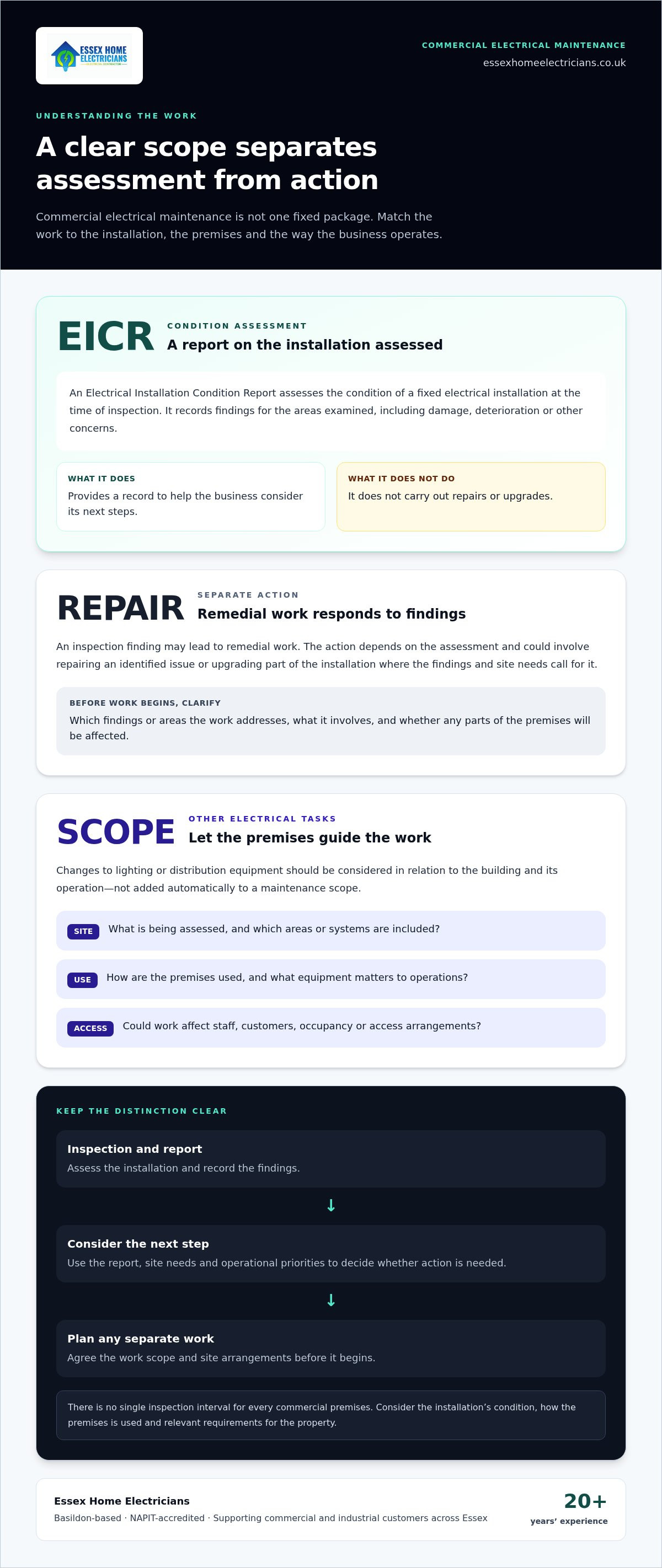
A useful scope makes clear what is being assessed, what work is proposed and what falls outside the assessment. An Electrical Installation Condition Report (EICR) is one part of this picture. It records the condition of the electrical installation assessed; it is not the same as carrying out repairs or upgrades. Keeping these activities distinct helps managers understand what a report says and what action, if any, follows.
Inspections, testing and electrical condition reporting
An EICR assesses the condition of a fixed electrical installation at the time of inspection. It can identify damage, deterioration or other concerns in the areas examined and records the findings in a report. The report helps a business consider its next steps. It does not complete remedial work, and a reported concern may need separate investigation or repair.
There is no single inspection interval that should be applied to every commercial premises without considering the site and current guidance. Consider the installation’s condition, how the premises is used and any relevant requirements for that property. Keep previous reports and records of later electrical work together so a new assessment has useful context.
For more detail on what an EICR involves, use the existing EICR guide alongside this overview. The key point is to treat the report as an assessment and record, not as proof that any recommended work has already been completed.
Repairs, upgrades and planned remedial work
Inspection findings may lead to remedial work, but the action required depends on the assessment. It could involve repairing an identified issue or upgrading part of the installation where the findings and site needs call for it. Other electrical work, such as changes to lighting or distribution equipment, should be considered in relation to the premises and its operation, rather than added automatically to a maintenance scope.
Before work begins, clarify which findings or areas it addresses, what it involves and whether any parts of the premises will be affected. For a shop, that may mean planning access around trading activity. In a workshop, it may mean agreeing when the relevant equipment or area can be accessed. A clear scope helps the business coordinate staff, occupants and site access.
Essex commercial electrical maintenance is most useful when it reflects the actual premises, not a generic task list. Essex Home Electricians carries out electrical inspections and EICRs for commercial and industrial customers. To discuss an inspection or outline electrical work for your site, get in touch about your premises.
How to compare commercial electrical maintenance providers in Essex
A useful comparison goes beyond a headline service list. Consider who will carry out the work, what the proposed scope covers, what information you’ll receive afterwards and how the work will fit your site. These points help you judge whether the support suits your premises, rather than simply whether electrical services are offered.
Compare competence, scope, reporting and communication to find electrical support that fits your premises.
Competence: Look for relevant accreditation, electricians’ qualifications and insurance. These details help you understand who will be working on your site and their professional credentials.
Scope: Make sure the work is described in relation to your premises and request. It should be clear which areas or systems are included, and whether the work involves an inspection, testing, repairs or another task.
Reporting: Check that findings and recommended next steps will be set out clearly. Useful records help managers understand what was assessed and what action remains.
Communication: Agree arrangements that account for access, occupancy and operational constraints. Clear coordination helps staff and site managers prepare for the work.
Check competence, credentials and work scope
Accreditation, qualifications and insurance are important considerations for commercial electrical work. Essex Home Electricians is NAPIT-accredited and provides qualified, fully insured electricians, with more than 20 years of experience. These are relevant credentials for businesses arranging electrical inspections and work across Essex.
Scope matters just as much as credentials. The work should reflect the building and the task required, rather than assume every site needs the same things. An occupied office, for example, may have different access constraints from a workshop. Clear boundaries also help distinguish an EICR from any repairs or upgrades identified separately.
Compare reporting, communication and operational fit
For planned work, agree how access will be arranged and how the work can fit around opening hours, staff use and areas that need to remain accessible. Establish what work is included and how findings will be communicated. This gives the responsible manager a practical basis for planning, keeping records and deciding on next steps.
Routine maintenance scheduling and emergency support are separate considerations. Planned work is arranged in advance around the premises. Emergency call-outs address faults requiring an urgent response. Essex Home Electricians provides a 24-hour emergency electrician service, but emergency response is not a routine maintenance schedule.
When comparing Essex commercial electrical maintenance, consider the planned scope and site arrangements separately from emergency support. Essex Home Electricians serves commercial and industrial customers across Essex. To discuss electrical inspections or work for your premises, get in touch about your site.
How to plan commercial electrical maintenance around your Essex site
A useful maintenance plan starts with the way your premises operates. Before arranging inspections or work, build a clear picture of the site, identify which electrical systems matter most to day-to-day activity, then coordinate access and keep records together. This gives a qualified electrician practical information to scope the work, rather than relying on assumptions about what every business needs.
Create a useful site and asset overview
Bring together the details that explain the building and its electrical needs. Go beyond a list of equipment: note where systems are, how the premises is used and who can provide access or approve work.
Map key areas: List occupied spaces, work areas, shared facilities and any parts of the building with restricted access.
Record operational equipment: Identify electrical systems or equipment important to essential tasks, and note where an interruption could affect staff, customers or site activity.
Gather existing records: Keep previous inspection reports and details of electrical work together, along with known faults that have not been resolved.
Note site arrangements: Record opening hours, busy periods, access procedures and any areas where work may need coordination or a shutdown.
Name the contacts: Identify who manages site access, briefs staff and approves electrical work, so decisions and arrangements have a clear owner.
Keep the overview practical. A shop may need to flag customer areas and trading hours, while a workshop may need to identify the work areas and electrical systems supporting its daily processes. The aim is to give the electrician relevant context, not to make technical assessments yourself.
Prioritise work and coordinate access
Once you have a site overview, use it to organise the next steps. Start with immediate safety concerns, then consider the operational impact of an issue and the professional assessment of the electrical installation. Do not rank work solely by convenience or by how visible a problem is. Technical priorities and inspection intervals should follow competent assessment and current guidance, rather than a universal timetable for every premises.
Before work is arranged, share the site information and agree the scope, access requirements and suitable working windows. Consider which staff or site contacts need advance notice, whether particular areas must stay accessible and how any disruption will be communicated. Afterwards, retain reports and records of completed tasks alongside outstanding actions. This makes it easier to understand what has been assessed and plan follow-up work with the right context.
Good Essex commercial electrical maintenance planning connects technical findings with the way the business runs. For a site-specific scope, discuss your commercial electrical maintenance needs with Essex Home Electricians, a Basildon-based contractor serving commercial and industrial customers across Essex.
Commercial electrical maintenance support from Essex Home Electricians
Commercial premises need electrical support that reflects their use, layout and operating requirements. Essex Home Electricians is a Basildon-based, NAPIT-accredited contractor serving commercial and industrial customers across Essex. With more than 20 years of experience, the team provides qualified, fully insured electricians for electrical inspections and EICRs, helping businesses make informed decisions about their premises.
The right starting point is a clear understanding of the work required. An inspection or EICR assesses electrical condition; any remedial work identified is a separate step that can be scoped to the findings and site. Quotes are free and no-obligation, with the proposed scope shaped around the premises rather than assumed to fit a standard package.
Local commercial electrical support across Essex
Based in Basildon, Essex Home Electricians serves businesses across the county, including Basildon, Benfleet, Canvey Island, Rayleigh, Wickford, Billericay, Leigh-on-Sea and Southend. Local commercial and industrial sites vary, from offices and shops to workshops and managed premises, so useful support begins with understanding the building, access arrangements and work requested.
For planned inspections and routine work, arrangements are made around the agreed scope and the site’s operating needs. Emergency call-outs are a separate service: the one-hour response target applies to emergency call-outs only, not routine maintenance or scheduled inspections.
What to include when requesting a maintenance quote
A few clear details help shape a relevant quote. Include:
The premises type and location.
Opening hours and any access or shutdown constraints.
Known electrical issues and relevant inspection records.
The work you’re seeking, such as an electrical inspection, EICR or remedial work following an assessment.
These details give the team a practical picture of the site and its needs. If the request follows an EICR, sharing the report can help clarify which findings need attention. If you’re still defining the scope, explain what you know about the building and what prompted the enquiry. The work can then be discussed in context, without treating every premises as if it needs the same tasks.
Essex commercial electrical maintenance should be planned around the actual site and work required. For a free, no-obligation quote, request a free commercial electrical quote from Essex Home Electricians. Share your premises details and the electrical work you have in mind to start a clear conversation about next steps.
Make your next maintenance decision a planned one
Electrical needs can change as a business grows, moves into new areas or changes how its premises are used. Revisit the maintenance scope when those changes happen, rather than treating it as a document that stays fixed indefinitely. This gives you an opportunity to flag new priorities and keep future electrical work aligned with the way the site operates.
For Essex commercial electrical maintenance, turn an outstanding concern or upcoming site change into a clear request for a quote. Essex Home Electricians can discuss the work with you and provide a free, no-obligation quote shaped around your premises.
Request a commercial electrical quote and take the next step towards a clear plan for your business. Share your site details and the electrical work you have in mind.
Frequently Asked Questions
Is commercial electrical maintenance a legal requirement in the UK?
UK workplace rules require electrical systems to be maintained so they do not create danger. This does not mean every business must follow an identical maintenance contract or timetable. Appropriate arrangements depend on the installation, how the premises is used and the risks involved. Seek competent advice about your site, and consult current Health and Safety Executive guidance on how the Electricity at Work Regulations apply.
How often should commercial electrical maintenance be carried out?
There is no single suitable interval for every commercial premises. The right approach depends on factors such as the installation’s condition, the working environment, equipment use and findings from previous assessments. Follow recommendations from a competent electrician and relevant current guidance rather than relying on a calendar rule alone. Review the plan if the premises changes, electrical equipment is added or new concerns arise.
Does an EICR replace routine commercial electrical maintenance?
No. An EICR records the condition of the fixed electrical installation assessed at the time of inspection, but it does not provide ongoing oversight or carry out repairs. A new fault or damage that occurs after the assessment needs attention in its own right. Keep the report with records of subsequent electrical work, and arrange a fresh assessment when appropriate to the site and applicable guidance.
Can commercial electrical maintenance be planned around business hours?
Work can be scoped with the premises’ operating pattern and access needs in mind. Share opening times, busy periods and any areas that need to remain available, then discuss suitable arrangements before work is scheduled. For example, a business may prefer work to take place when a particular area is less occupied. Practical timing depends on the agreed scope and site requirements.
What happens if an electrical inspection identifies a fault?
The inspection findings should be recorded, and the electrician can explain what they mean and what further action is recommended. The report itself does not complete repairs. Any remedial work needs to be separately scoped and carried out as appropriate to the findings. If the electrician identifies an immediate safety concern, follow their advice promptly and make sure the issue is not treated as routine paperwork.
What information should I prepare before requesting commercial electrical maintenance?
Share the premises type and location, opening hours, access constraints, known issues and the electrical work you’re seeking. Previous inspection reports or records of relevant work can also provide useful context. Essex Home Electricians supports commercial customers in Basildon, Benfleet, Canvey Island, Rayleigh, Wickford, Billericay, Leigh-on-Sea and Southend. These details help shape a relevant discussion about Essex commercial electrical maintenance for your site.