
Assuming a modern electric oven is a straightforward plug-and-play appliance can quickly damage your kitchen's wiring. If you're upgrading your cooking setup in an older Essex property, it's completely natural to worry whether your existing consumer unit will constantly trip under heavy load, or whether an uncertified connection might void your manufacturer warranty. Arranging a certified electric cooker installation Wickford residents can rely on starts with looking past the appliance's sleek exterior to understand the dedicated electrical supply running behind your cabinets.
In this comprehensive guide, you'll discover how to pinpoint the exact power requirements for your cooker, distinguish between a 13A socket connection and a hardwired 32A radial circuit, and guarantee full compliance with Part P building regulations and current BS 7671 wiring standards. We'll outline everything you need to check at your fuse box and local isolation switch, ensuring your new cooker runs safely and smoothly from day one.
Table of Contents
Understanding Electric Cooker Power Requirements in Wickford Homes
Selecting the Right Electric Cooker Style for Your Wickford Property
The Certified Electric Cooker Installation Process Explained
Choosing an Accredited Electrician in Wickford for Your Installation
Understanding Electric Cooker Power Requirements in Wickford Homes
Modern cooking appliances draw far more continuous electrical current than standard domestic devices. In Wickford's established housing stock, particularly post-war builds and bungalows around areas like Runwell or Shotgate, existing kitchen wiring was rarely designed for the massive electrical load of high-performance culinary equipment. When planning an electric cooker installation Wickford homeowners must first confirm their appliance's total power rating in kilowatts (kW) to prevent overloaded cabling and nuisance tripping.
Every cooking appliance falls into one of two power categories:
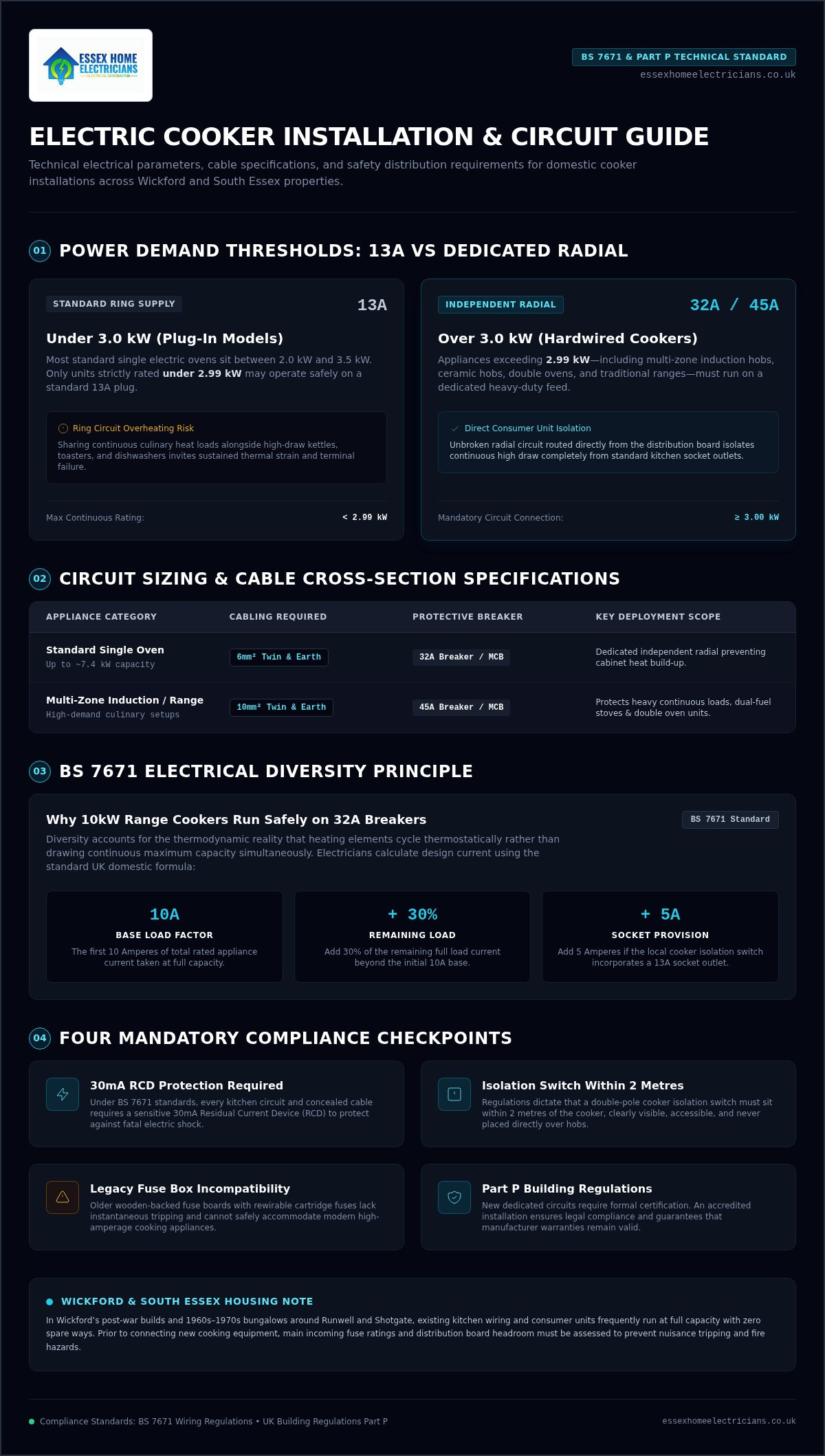
Under 3kW (Plug-in Models): Most single electric ovens have a power rating between 2.0 kW and 3.5 kW. Appliances rated under 2.99kW can operate on a standard 13A plug.
Over 3kW (Hardwired Cookers): Any cooking appliance with a power rating exceeding 2.99kW must connect directly to an independent, heavy-duty radial circuit.
Plug-in 13A Models vs Dedicated Hardwired Circuits
A compact single oven drawing under 13 amps can theoretically plug into a standard kitchen socket. However, standard ring circuits also feed kettles, toasters, and dishwashers. Plugging a continuous heat load into an already busy ring invites overheated connections. Conversely, comprehensive appliances like modern ceramic hobs, double ovens, and traditional range setups demand dedicated 32A or 45A feeds protected by independent circuit breakers.
Modern design configurations, from modular induction hobs to a traditional freestanding electric stove, rely on dedicated 6mm² or 10mm² twin and earth cable routed directly from the distribution board. This physical separation shields surrounding kitchen outlets from sustained thermal strain.
The Role of Electrical Diversity in Cooker Calculations
You might wonder how a 10kW range cooker functions on a 32A breaker without immediately tripping the supply. Qualified electricians apply standard UK diversity calculations set out in BS 7671. Diversity acknowledges that cooking elements cycle thermostatically rather than operating continuously at full capacity.
The standard domestic diversity formula calculates design current by taking the first 10 amps of the rated cooker load, adding 30% of the remaining full load current, and adding an extra 5 amps if the cooker control unit features an integrated socket outlet. While diversity allows practical circuit sizing, older properties in South Essex require a thorough load assessment. Establishing total demand ensures an electric cooker installation Wickford project runs within safe thermal limits without overloading your consumer unit.
Assessing Kitchen Circuits and Consumer Unit Capacity
Every hardwired cooking appliance relies on an unbroken, dedicated circuit running straight back to your distribution board. In Wickford properties, particularly mid-century homes built throughout the 1960s and 1970s, consumer units often run at full capacity with zero spare ways available. Adding a substantial culinary load without checking your board's physical space and main incoming fuse creates an immediate fire hazard.
Safety organisations such as Electrical Safety First emphasise that high-powered kitchen circuits require robust residual current protection. Under BS 7671 standards, every concealed cable and kitchen circuit must feature a sensitive 30mA RCD to protect against fatal electric shocks.
Cable Sizing and Isolation Switch Placement
Selecting suitable cable cross-sections prevents dangerous heat build-up behind your kitchen cabinetry. A standard single oven typically demands a 6mm² twin-and-earth cable protected by a 32A breaker, whilst high-output dual fuel ranges or multi-zone induction hobs often mandate a 10mm² run backed by a 45A device.
Regulations dictate that your double-pole cooker isolation switch must sit within two metres of the appliance. It needs to remain clearly visible and fully accessible, allowing you to cut power instantly in an emergency without reaching across burning hotplates or active pans.
Managing Consumer Unit Upgrades for High-Demand Appliances
Older wooden-backed fuse boards with rewirable cartridge fuses cannot safely manage modern cooking technology. These legacy setups lack the instantaneous trip mechanisms required by current standards. Before proceeding with an electric cooker installation Wickford residents frequently discover their boards cannot accommodate new high-amperage breakers.
To prepare your home safely, consider these crucial distribution checks:
Spare Usable Ways: Check whether your consumer unit has an unassigned slot to accept a dedicated 32A or 45A MCB or RCBO.
RCD Protection: Verify that modern 30mA residual current devices shield the proposed circuit path.
Main Incoming Cut-out Fuse: Ensure your property's main service head provides sufficient headroom alongside existing domestic demand.
Replacing an obsolete board with a modern fuse box upgrade resolves capacity bottlenecks, brings your setup into full Part P compliance, and delivers vital surge protection. If your property still relies on aged vulcanised rubber or degraded cabling, investing in full house rewiring creates a dependable electrical foundation for decades to come. If you're unsure about your board's capacity, you can contact our local team for an expert circuit inspection.
Selecting the Right Electric Cooker Style for Your Wickford Property
Cabinetry layouts and available wall cavities heavily shape your cooker's electrical infrastructure. Whether you are planning a complete remodel with bespoke design specialists like Bowkirk Kitchens & Bedrooms or updating an existing setup in a traditional family home, selecting between an all-in-one appliance and split built-in units completely alters the installation scope. Proper planning guarantees both electrical safety and adequate ventilation around your kitchen units.
Freestanding Cookers vs Built-in Ovens and Hobs
Freestanding cookers integrate the oven, grill, and hob into one continuous chassis, offering an efficient single-point electrical termination. A high-temperature cooker connection plate sits low on the wall behind the appliance, allowing the unit to slide back flush against the wall.
Built-in configurations divide these cooking zones, which changes electrical requirements entirely:
Eye-Level Double Ovens: These tall units sit within dedicated column furniture. They draw substantial load and demand precise heat ventilation gaps to protect surrounding timber.
Separate Countertop Hobs: Positioning an independent hob across the room requires a separate, dedicated radial feed. Connecting both an oven and a hob to one under-sized circuit creates an immediate fire hazard.
Terminal Box Placement: Electrical connection units must sit in accessible cabinetry recesses rather than trapped directly behind high-heat oven backs.
Induction Cooker Power Needs vs Traditional Ceramic Hobs
Induction cooking uses powerful copper coils beneath the glass surface to generate high-frequency magnetic fields. This creates rapid heat directly inside ferromagnetic cookware. Consequently, induction units draw sharp, instantaneous bursts of electrical power when activating boost functions. If your incoming supply or cooker circuit is marginal, simultaneous ring usage will cause circuit breakers to trip.
Standard ceramic hobs rely on traditional coiled metal elements that heat through electrical resistance. These elements operate on smoother, moderate cycling patterns, producing steady continuous loads rather than sudden spikes. Before finalising an electric cooker installation Wickford homeowners must check both their existing cookware and their circuit breaker sizes to ensure their property can handle induction technology without unneeded electrical strain.
Adequate clearance matters just as much as electrical capacity. Built-in induction and ceramic units generate intense downward heat, requiring a minimum 50mm airflow gap underneath the chassis. Without proper airflow, cooling fans fail, causing the hob's internal electronics to overheat and fail prematurely.
The Certified Electric Cooker Installation Process Explained
Professional cooker fitting involves far more than simply tightening screw terminals into a wall plate. Handling substantial continuous current requires systematic safety procedures to prevent electrical fires and electric shock. A qualified electrician approaches an electric cooker installation Wickford project using precise diagnostic testing, ensuring the entire installation satisfies UK safety legislation.
Pre-Installation Survey and Circuit Isolation
Work begins by proving dead. The electrician isolates the cooker supply at your consumer unit, locking the miniature circuit breaker off to prevent accidental re-energisation. Using an approved two-pole voltage indicator and proving unit, they verify zero voltage across all conductors.
Next comes a thorough physical inspection:
Terminal Integrity: Checking the cooker connection unit for signs of thermal damage, heat stress, or loose terminals.
Cable Specification: Verifying heat-resistant butyl flexible cord connects the wall outlet to the cooker's internal connection block.
Rating Alignment: Confirming the consumer unit protective device matches the manufacturer's exact specifications.
Hardwiring, Testing, and Commissioning
After securely clamping conductors into the appliance block, rigorous electrical testing begins. These measurements happen before switching on the power. Using calibrated multi-function testers, the electrician checks continuity of protective conductors to confirm a solid path to earth.
Insulation resistance testing applies high test voltages between live conductors and earth, ensuring cable sheathing has not degraded. Once the circuit passes these checks, live testing confirms safe earth fault loop impedance. The engineer then powers up the appliance, systematically cycling through every heating ring, grill element, and fan setting to verify steady operational current under load.
Part P Building Regulations and Safety Certification
All electrical work in kitchens falls under Part P of the Building Regulations in England. While connecting a replacement appliance to an existing circuit requires an official Minor Electrical Installation Works Certificate (MEIWC), running an entirely new radial circuit from the consumer unit is fully notifiable to local authority building control.
This certification documents exact test readings, proving your installation complies with BS 7671:2018+A4:2026. Without this paperwork, uncertified domestic electrical work can invalidate home buildings insurance policies and create severe complications during property sales. If you are preparing for a new appliance, book your certified cooker installation with our accredited team today.
Choosing an Accredited Electrician in Wickford for Your Installation
High-power kitchen connections carry zero margin for error. Entrusting a major cooking circuit to an uncertified handyman leaves your home vulnerable to overheated terminations, dangerous short circuits, and voided appliance warranties. Securing a professional electric cooker installation Wickford homeowners can trust means choosing fully insured, accredited professionals who take absolute accountability for their craftsmanship.
Why Accreditation Matters: NAPIT and Part P Compliance
Competent person scheme registration provides vital legal and technical safeguards. An installer accredited by bodies like NAPIT undergoes regular technical assessments, proving they work strictly to BS 7671 standards.
Hiring an accredited contractor delivers three immediate advantages:
Direct Self-Certification: Registered electricians certify their own work, notifying the local authority directly and bypassing costly council inspection charges.
Legally Valid Paperwork: You receive an official certificate verifying your cooker wiring complies fully with UK Building Regulations.
Guaranteed Technical Competency: All work is backed by comprehensive public liability and professional indemnity insurance.
Retaining this documentation is essential. When you sell your home, solicitors routinely request Part P compliance certificates for all kitchen circuit alterations carried out under your ownership.
The Benefits of Using a Local Wickford Contractor
National callout platforms often dispatch distant sub-contractors who possess little understanding of local housing layouts. Working with a community-rooted Essex business ensures your engineer understands the distinct electrical characteristics of properties across Wickford, from original wiring layouts in Castledon to extended family homes near Brock Hill.
Local accountability means faster project turnaround and transparent communication from initial survey to final testing. If unexpected faults or tripped circuits occur elsewhere in your home, having access to an experienced emergency electrician provides round-the-clock peace of mind.
With over 20 years of domestic electrical experience across Essex, our NAPIT-accredited team guarantees complete safety, meticulous workmanship, and seamless certification. For dependable advice or to arrange your installation, get in touch with Essex Home Electricians today.
Power Your Kitchen Safely with Professional Installation
Upgrading your kitchen appliances shouldn't mean compromising on electrical safety. Ensuring your new setup features correct cable sizing, adequate consumer unit capacity, and 30mA RCD protection keeps your home running smoothly. Whether you're connecting a high-draw induction range or fitting a sleek eye-level double oven, certified installation prevents costly circuit damage, protects your manufacturer warranty, and keeps your family safe.
When you're ready to arrange an electric cooker installation Wickford homeowners can rely on, trust local professionals who understand your property. Essex Home Electricians brings over 20 years of domestic electrical experience to every project across Essex. As a NAPIT-accredited contractor, we carry out comprehensive circuit testing, guarantee full compliance with BS 7671 standards, and provide official Part P certification right upon completion.
Take the stress out of your kitchen upgrade. Book your certified electric cooker installation with Essex Home Electricians today and enjoy dependable, certified cooking power in your home.
Frequently Asked Questions
Can I install an electric cooker myself in the UK?
You shouldn't attempt a DIY installation for high-powered cookers. While plugging an appliance rated under 3kW into a socket isn't restricted, connecting a hardwired cooker to a dedicated circuit is notifiable under Part P of the Building Regulations. Uncertified domestic work risks dangerous electrical fires, invalidates home insurance policies, and voids manufacturer warranties. An accredited installer guarantees compliance and safety.
Does an electric cooker require a dedicated circuit from the fuse box?
Yes, all cookers drawing over 2.99kW demand an independent radial circuit running directly from your consumer unit. Connecting high-load appliances to standard kitchen sockets overloads the ring final circuit, causing persistent tripping and heat damage to cabling. A dedicated 32A or 45A radial supply ensures the cooker operates reliably without compromising other kitchen appliances.
How do I know if my new cooker needs a 13A plug or hardwiring?
Check the appliance rating plate or manual for the total power load in kilowatts. If the cooker is rated at 2.99kW or lower, it can operate using a standard 13A plug. Any unit rated at 3kW or higher requires a hardwired connection to a heavy-duty circuit. For a safe electric cooker installation Wickford homeowners should verify this rating before delivery.
What is the purpose of the big red cooker switch on the kitchen wall?
The red wall switch acts as a local double-pole isolation control. It completely disconnects both the live and neutral feeds to the appliance in a single action. BS 7671 regulations require this switch within two metres of the appliance so you can isolate power instantly during an emergency, cleaning, or maintenance without reaching over hot surfaces.
Can an induction hob run on an existing electric cooker circuit?
It depends on the hob's maximum power rating and your existing cable size. Standard 32A radial circuits with 6mm² wiring support many induction models. However, advanced induction hobs featuring rapid boost settings on multiple rings often require a 45A circuit with 10mm² cabling. A qualified electrician must inspect existing cable runs before connecting high-output induction units.
Do I receive an electrical certificate after my cooker installation?
Yes, your electrician should issue a Minor Electrical Installation Works Certificate (MEIWC) upon completing the safety tests. If the job involves installing an entirely new dedicated circuit back to the fuse box, you will also receive an Electrical Installation Certificate (EIC) along with a Building Regulations Compliance Certificate, which protects future property transactions.
What should I do if my consumer unit does not have room for a cooker circuit?
You will need a consumer unit upgrade before installing your appliance. If your board has no spare ways or lacks modern 30mA RCD protection, adding high-draw culinary circuits is unsafe. When planning an electric cooker installation Wickford residents with outdated boards can have their distribution board replaced to create compliant capacity for new appliances.