

A landlord EICR is a compliance process, not a certificate to file and forget. An EICR certificate for landlords Canvey Island properties need involves more than booking an inspection: in England, the fixed electrical installation must be checked at least every five years, and the findings may require follow-up work.
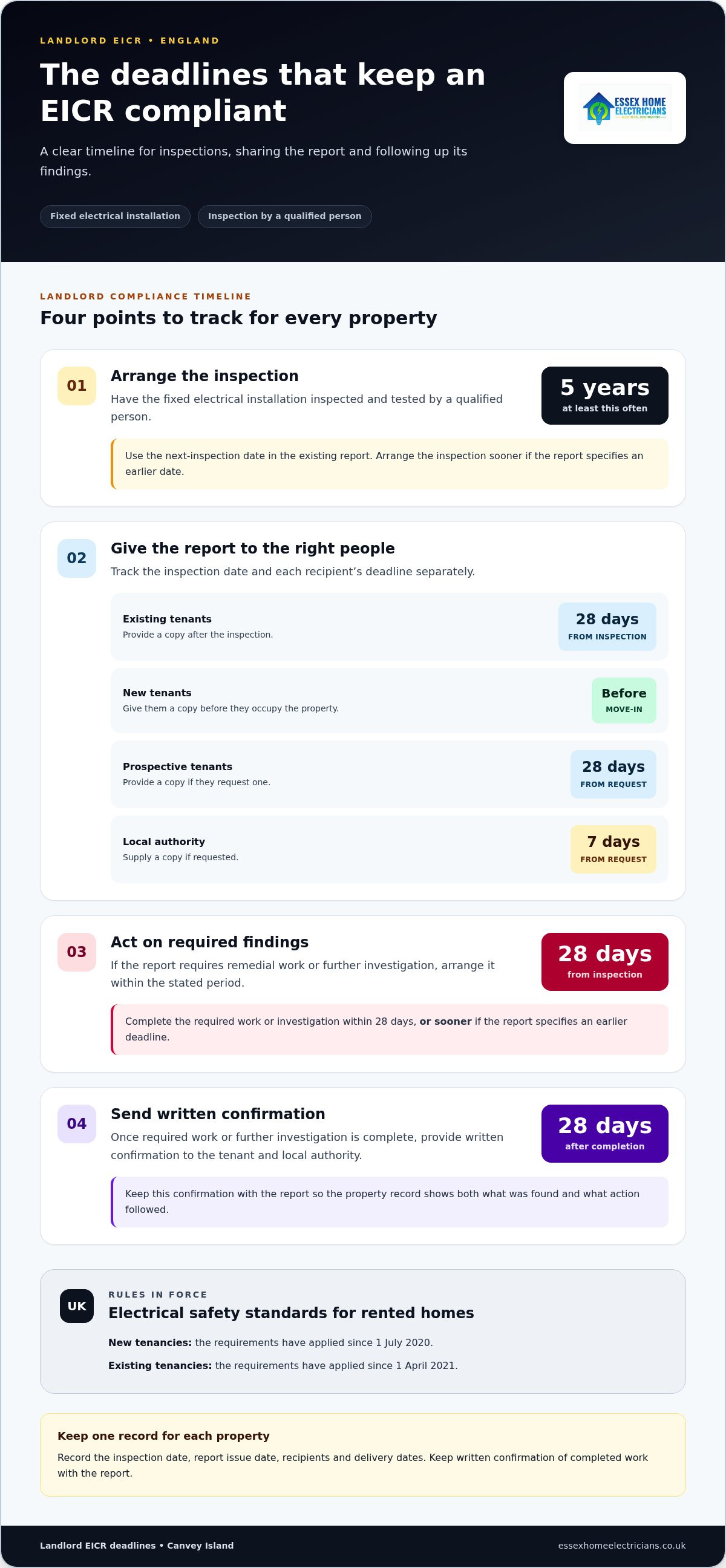
Deadlines, tenant paperwork and an unsatisfactory report can all raise questions. You must give existing tenants a copy within 28 days of the inspection and provide it to new tenants before they move in. Any required remedial work or further investigation must also be completed within 28 days, or sooner if the report says so.
This 2026 guide explains landlord duties, what an electrician checks and how to read report codes such as C1, C2, C3 and FI. You’ll also learn what to do if the report is unsatisfactory, so you can plan the next steps. Essex Home Electricians carries out EICR inspections and provides reports for landlords in Canvey Island, with clear guidance on the findings.
Table of Contents
What does an EICR certificate mean for a Canvey Island landlord?
How should landlords understand EICR codes and report outcomes?
Book a landlord EICR in Canvey Island with a local electrical contractor
What does an EICR certificate mean for a Canvey Island landlord?
An Electrical Installation Condition Report (EICR) is a formal assessment of a property’s fixed electrical installation. An electrician inspects and tests relevant parts of the system, then records the condition and any observations in a written report. Although people commonly say “EICR certificate”, the report is the useful record: it describes what was found during the inspection, rather than simply confirming that a general electrical check took place.
In brief: an EICR records the observed condition of a property’s fixed wiring and electrical installation at the time of inspection. It helps a landlord understand the findings and plan any necessary action. It isn’t a guarantee that faults won’t arise later. Electrical components can wear, become damaged or be affected by later changes, so the report relates to the inspection date and the accessible installation examined.
This record supports practical property management. It gives landlords information about the installation’s condition and helps them decide what follow-up is needed. For tenants, a properly maintained electrical installation is an important part of a safe home. Landlords should act on the findings rather than relying on assumptions about a property’s age or appearance.
What does an EICR inspect in a rented property?
The inspection concerns fixed electrical components, which may include wiring, the consumer unit (fuse box), sockets, switches and visible electrical fittings. The electrician carries out visual checks and appropriate tests to assess the installation. The inspection and testing depend on the property’s electrical system and what can be accessed safely. The report should relate to the installation examined and not make claims about parts that couldn’t be assessed.
This is different from portable appliance testing (PAT). An EICR assesses the fixed installation, while PAT concerns portable electrical appliances such as plug-in equipment. One does not replace the other. For a general overview of the term and its UK context, see this Electrical Installation Condition Report (EICR) reference.
Why is a landlord EICR relevant in Canvey Island?
The report must relate to the specific rental property being inspected. Two homes nearby can have different electrical layouts, equipment, alterations and maintenance histories, so a report from another address won’t describe your installation. Keep each report with the details for the property it covers, particularly if you manage more than one let.
An EICR certificate for landlords Canvey Island properties therefore provides a practical record of the installation’s assessed condition, not a generic statement about local homes. Essex Home Electricians carries out EICR inspections and provides reports for landlords in Canvey Island, Basildon, Benfleet, Rayleigh, Wickford, Billericay, Leigh-on-Sea and Southend. The report’s observations help you understand the condition recorded and identify the next steps for that property.
What are the landlord EICR rules and deadlines in England?
For landlords in England, the Electrical Safety Standards in the Private Rented Sector (England) Regulations 2020 set out key duties for the fixed electrical installation in a privately rented property. In general, it must be inspected and tested by a qualified person at least every five years, or sooner if the report specifies an earlier date. This summary reflects the current Government guidance on electrical safety standards for landlords.
Arranging the inspection is only one part of compliance. Landlords must also share the report with the right people, keep a copy and act on required remedial work or further investigation. The rules have applied to new tenancies since 1 July 2020 and existing tenancies since 1 April 2021. Requirements can depend on the property and tenancy circumstances, so use the regulations and official guidance for the relevant situation.
When must a landlord arrange an EICR?
Plan the next inspection around the date stated in the existing report, rather than assuming every rental has the same renewal date. The usual maximum interval is five years, but an electrician may recommend an earlier inspection. Record the next-inspection date and arrange the assessment in time. Booking the inspection and distributing the resulting report are separate duties, each with its own deadline.
Read the findings promptly after the inspection. If the report requires remedial work or further investigation, the landlord must arrange it within 28 days of the inspection, or sooner if the report specifies. After the work or investigation is completed, written confirmation must be provided to the tenant and local authority within 28 days.
Who must receive the report, and when?
Keep the report accessible and track each sharing deadline. The required recipients and timeframes include:
Existing tenants: provide a copy within 28 days of the inspection.
New tenants: give them a copy before they occupy the property.
Prospective tenants: provide a copy within 28 days of a request.
Local authority: supply a copy within seven days of a request.
These are statutory duties, not suggested targets. Record the inspection date, report issue date, recipients and delivery dates to help demonstrate that you shared the document on time. Keep written confirmation of completed work with the report, so the property’s safety records show what was found and what action followed.
Essex Home Electricians carries out EICR inspections and provides reports for Canvey Island rentals. You can request a free, no-obligation quote when planning an inspection.
How should landlords understand EICR codes and report outcomes?
An EICR doesn’t treat every observation as equally serious. It records what the electrician found, assigns codes to observations where appropriate and gives an overall outcome. Start with that outcome, then read the codes and notes to understand what action is needed. A recommendation isn’t automatically an urgent fault, but don’t overlook a serious code or a request for further investigation.
An EICR is generally classed as satisfactory only if it contains no C1, C2 or FI observations. C3 observations may still appear on a satisfactory report because they recommend improvement rather than identify a condition that makes the report unsatisfactory. Read the explanation alongside each code, and don’t assume that the same code always points to the same repair.
What do C1, C2, C3 and FI mean?
C1, danger present: An immediate danger has been identified. The report calls for immediate action to make the situation safe.
C2, potentially dangerous: A potentially dangerous condition needs urgent remedial action.
C3, improvement recommended: The installation could be improved, but a C3 alone doesn’t make the report unsatisfactory.
FI, further investigation required: More investigation is needed to establish the condition. Treat this seriously: the report is unsatisfactory until the investigation is complete and the outcome is clear.
These codes indicate the concern and urgency, not a ready-made repair specification. For example, a C3 may flag an improvement to consider, while a C2 points to a potentially dangerous issue requiring urgent attention. Check the observation’s location and description, then follow the report’s recommendations and timescales. If anything is unclear, have the finding explained before deciding what work to arrange.
What happens when an EICR is unsatisfactory?
An unsatisfactory outcome means the report includes a C1, C2 or FI finding. Arrange the remedial work or further investigation specified in the report, using a qualified person to carry it out. The legal deadline is generally within 28 days of the inspection, or sooner if the report requires it. The action needed depends on the individual findings, so follow the report rather than guessing at a solution.
Once work or investigation is complete, retain written evidence, such as the relevant installation certificate or confirmation of the work, with the EICR. Landlords must provide written confirmation of completed remedial work or investigation to tenants and the local authority within 28 days of completion. Keep the original observations and follow-up records together, rather than treating a later repair note as a replacement for the inspection report.
For an EICR certificate for landlords Canvey Island properties, work through each coded observation, record the action taken and track the applicable deadline. A clear record makes it easier to manage the property and explain the report’s outcome.
How can Canvey Island landlords prepare for an EICR?
A little preparation can make an EICR visit more straightforward. The electrician needs safe access to relevant parts of the fixed installation, and tenants need to know what to expect. Before the appointment, arrange access to the property and explain that the inspection involves checks around electrical fittings. Testing may also mean a temporary interruption to the electricity supply, so agree a suitable time with occupants and plan around essential equipment or work-from-home needs.
What should landlords do before the inspection?
Use this checklist to get the property ready:
Arrange access: Make sure the electrician can enter all rooms and reach areas with fixed electrical fittings. Tell tenants the appointment details in advance.
Clear the consumer unit: Move stored items away from the fuse box so it can be inspected safely and accessed without delay.
Make fittings reachable: Keep sockets, switches and visible electrical fittings clear of furniture or belongings where practical. Don’t remove covers or attempt electrical work yourself.
Gather relevant records: Have previous EICRs and records of electrical alterations or repairs available, if you have them. These can provide useful background on the installation.
Plan for testing: Let occupants know that some checks may require a temporary power interruption. Discuss practical concerns ahead of the visit.
Older installations or significant remedial findings may raise questions about broader work. If the report points to substantial changes, house rewiring guidance for Essex homes can help you understand the options. Let the inspection findings guide any decision; don’t assume that an older property automatically needs rewiring.
What should landlords do after receiving the report?
Start with the overall outcome, then read each observation and its explanation. Note the location, code and recommended action for every finding. This helps separate improvements to consider from issues that call for remedial work or further investigation. If the wording is unclear, have the findings explained before arranging work, so the next step responds to the specific observation.
Where the report requires action, organise the appropriate work or investigation and keep evidence of what was completed. File the EICR, follow-up documentation and tenant communications together, with dates recorded. This creates a clear property record and makes it easier to track outstanding actions and report-sharing duties.
Essex Home Electricians provides EICR inspections and reports for landlords in Canvey Island. You can request a free, no-obligation EICR quote to plan an inspection.
Book a landlord EICR in Canvey Island with a local electrical contractor
When arranging an inspection, it helps to know what the service covers and what you’ll receive. Essex Home Electricians serves Canvey Island from its Basildon base, carrying out EICR inspections and providing written reports. The business is NAPIT-accredited and has over 20 years’ experience, providing local landlords with an assessment of their rental property’s fixed electrical installation.
What can landlords expect from the inspection service?
An EICR inspection involves examining and testing the property’s fixed electrical installation. The report documents the findings and observations, so you can see what was assessed and whether follow-up is needed. The inspection doesn’t guarantee that the installation will remain fault-free, and its outcome depends on the condition of the individual property. Any recommended remedial work or further investigation will be guided by the report.
Clear explanations matter as much as the written record. If the report includes technical terms or coded observations, have the findings explained in plain language. That helps you understand what needs attention, what is recommended and what action to plan, without treating every observation as equally urgent. Keep the inspection report with your property records and use its findings to guide the next steps.
How to arrange an EICR for a Canvey Island rental
To begin an enquiry, share the Canvey Island property location and your inspection requirements. Explain whether you’re arranging a routine assessment, preparing for a tenancy or responding to an earlier report. If you have previous EICRs or details of electrical alterations, mention these too. They provide useful context for planning the inspection, although the assessment must address the installation at the property being inspected.
Essex Home Electricians provides free, no-obligation quotes for landlord EICRs. The electrician inspects the installation and records observations, and the report sets out any findings that need attention. If further work or investigation is required, follow the report and the applicable deadlines.
For landlords seeking an EICR certificate for landlords Canvey Island, share the property details and inspection requirements, then use the report to understand the condition recorded and plan any necessary follow-up. Arrange a landlord EICR enquiry.
Make your next electrical safety step clear
Build the inspection into your property management routine rather than leaving it until a tenancy change or report deadline is close. Keep a clear record for each rental, including the inspection date, actions completed and when the next assessment is due. This makes future planning more straightforward and helps you respond if questions arise about the property’s electrical safety.
If you’re ready to arrange an EICR certificate for landlords Canvey Island, share the property location and your requirements to get the process moving. Essex Home Electricians provides free, no-obligation quotes, with NAPIT accreditation and over 20 years’ experience serving the area. Arrange a landlord EICR enquiry and take a practical next step towards managing your rental with confidence.
Frequently Asked Questions
How often does a landlord need an EICR in England?
Landlords in England generally need to have the fixed electrical installation inspected at least every five years, or sooner if the report specifies an earlier date. Record both the inspection date and the report’s recommended next inspection date. If the electrician advises an earlier return than the five-year point, plan around that recommendation rather than relying on the usual maximum interval.
Is an EICR certificate a legal requirement for landlords in Canvey Island?
For most privately rented homes in England, landlords must arrange inspection and testing of the fixed electrical installation under the Electrical Safety Standards in the Private Rented Sector (England) Regulations 2020. Canvey Island follows the England requirements. The regulations require a report of the inspection, commonly called an EICR. Some circumstances, such as a newly built or completely rewired property with a valid Electrical Installation Certificate, may affect when the first EICR is needed.
What happens if a landlord EICR is unsatisfactory?
An unsatisfactory result means the report identifies a C1, C2 or FI observation. Follow the report’s instructions and arrange the required remedial work or further investigation within 28 days of the inspection, or sooner if specified. Keep written evidence of completed action. If the report calls for further investigation rather than a defined repair, arrange that investigation and retain its outcome with the original report.
How long does an EICR inspection take in a rented property?
There isn’t one fixed inspection duration for every rental. The time depends on the property, its electrical installation, the number of circuits and whether the electrician can safely access the areas and equipment needed for testing. A larger or more complex installation may take longer than a straightforward one. Arrange tenant access for a suitable period, and allow for possible temporary interruptions to the electricity supply during testing.
Can a tenant refuse access for an EICR inspection?
A tenant may decline a proposed appointment, so landlords should communicate clearly and try to agree a suitable time rather than entering without permission. Give reasonable notice, explain that the inspection is needed to meet electrical safety duties, and keep a record of contact attempts and responses. If access remains unresolved, seek advice on the appropriate legal steps. Don’t assume the landlord’s inspection duty permits forced entry.
What does a C2 code mean on a landlord EICR?
A C2 means the electrician has identified a potentially dangerous condition requiring urgent remedial action. Read the observation details to understand where the issue is and what action the report recommends. Don’t treat a C2 as a general improvement note or wait until the next routine inspection. Arrange the required work within the report’s stated period and keep the completion records with the EICR.
Do landlords have to give tenants a copy of the EICR?
Yes. Give existing tenants a copy within 28 days of the inspection, and provide the report to a new tenant before they move in. A prospective tenant who requests a copy must receive it within 28 days. Keep a record of when and how you shared it. If the local authority requests the report, provide it within seven days.