

Could two “unsatisfactory” EICRs lead to very different repair quotes? Absolutely. The cost of EICR remedial work depends on the faults recorded, how much of the installation is affected and what is needed to address them. The overall result alone doesn’t define the job.
An unsatisfactory report can leave you unsure what needs attention first, what each recommendation means and whether a quote covers the right work. C1 and C2 findings indicate danger or potential danger, while C3 recommendations identify improvements and FI means further investigation is needed.
This guide explains how EICR codes relate to remedial work, what can affect your quote and how to compare itemised scopes rather than focusing on price alone. You’ll also learn how to prioritise safety work and plan repairs for your property. Essex Home Electricians is a NAPIT-accredited electrical contractor with over 20 years of experience serving Essex, including Basildon and nearby areas. The aim is to help you understand the findings and decide on practical next steps.
Table of Contents
What does the cost of EICR remedial work cover?
An unsatisfactory report can leave you with a list of findings and no clear idea what happens next. Start by separating the inspection from the repairs. An EICR records the condition of the fixed electrical installation and highlights defects or areas for attention. The term Electrical Installation Condition Report (EICR) describes this inspection and its written findings. Remedial work is the repair or improvement proposed in response to those findings.
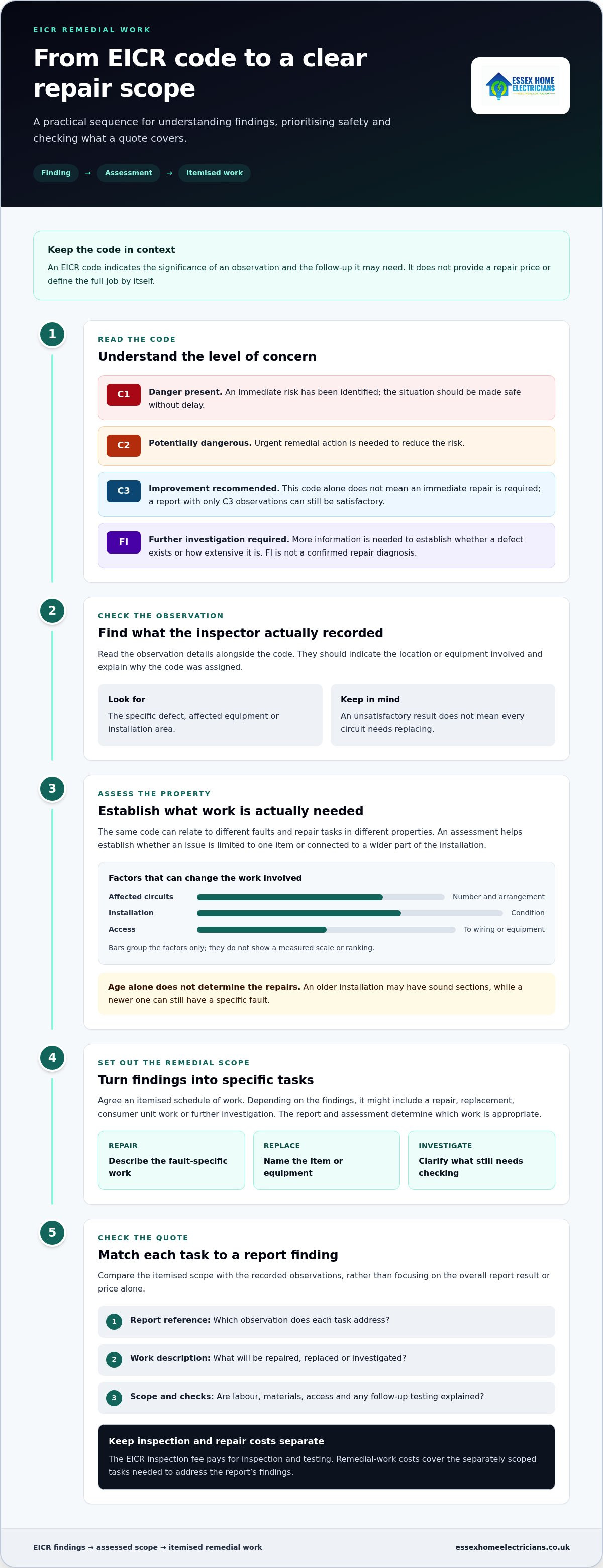
The EICR inspection fee pays for inspection and testing; the cost of EICR remedial work covers the separately scoped tasks needed to address the report’s findings. A quote should refer to the observations recorded and the condition of your property, rather than use a generic allowance for an “unsatisfactory” result.
What is included in an EICR remedial-work quote?
A clear quote translates report observations into specific tasks. If the report identifies a damaged socket, for example, the proposed work should describe that repair rather than simply say “electrical works”. Depending on the findings, the scope might include a repair, replacement, consumer unit work or further investigation. The report and assessment determine which work is appropriate.
Check whether the quote explains the labour, materials and access involved, and whether any follow-up testing is included. These details make it easier to see what you’re paying for and identify tasks that haven’t been clearly linked to a finding.
Report reference: Which observation or finding does each task address?
Work description: What will be repaired, replaced or investigated?
Scope and checks: Are access, materials and any required follow-up testing explained?
Some defects are visible and clearly defined. Others may be concealed or connected to a wider issue. An assessment can establish whether the problem is limited to one item or needs further investigation, and whether the proposed scope should be refined before work begins.
Why can two properties need different work?
Two homes can have similar report findings but need different repairs. The number and arrangement of affected circuits, the condition of the installation and access to wiring or equipment all influence the work involved. Repairing a clearly identified fault in an accessible location is different from tracing a fault that may affect connected parts of the installation.
Age alone doesn’t determine which repairs a property needs. An older installation may have sound sections, while a newer one can still have a specific fault. The recorded findings and a qualified electrician’s assessment should guide the scope. For more context about the inspection and report, see this EICR certificate guide for Chelmsford.
When comparing quotes, look for each task to be set against the relevant finding. This gives you a clearer basis for understanding the work, discussing priorities and deciding what to do next.
How EICR codes turn inspection findings into remedial work
An EICR code indicates the significance of an observation and the kind of follow-up it may need. It doesn’t provide a repair price or define the full job by itself. The recorded finding and the installation need to be assessed before an appropriate scope can be set out. The same code can relate to different faults and repair tasks in different properties.
EICR codes help prioritise electrical safety actions by distinguishing immediate danger, potential danger, recommended improvements and findings that need further investigation. Use the code as a guide to urgency, then read the observation and agreed work details to understand what needs to happen.
Which EICR codes usually call for remedial action?
C1, Danger present: The inspector has identified an immediate risk. The situation should be made safe without delay. This may involve isolating affected equipment or carrying out an appropriate repair.
C2, Potentially dangerous: The issue could become dangerous, so urgent remedial action is needed to reduce the risk.
C3, Improvement recommended: The installation could be improved, but this code alone doesn’t mean an immediate repair is required. A report with only C3 observations can still be satisfactory.
FI, Further investigation required: More information is needed to determine whether a defect exists or how extensive it is. FI is not a confirmed repair diagnosis, but it does need follow-up investigation.
For landlords in England, the GOV.UK Electrical Safety Standards guidance explains the requirements for electrical safety checks and remedial work in the private rented sector. The actions needed depend on the report’s findings and the rules that apply to the property.
What happens after an unsatisfactory EICR?
An unsatisfactory result means the report has identified findings that affect its overall outcome, such as C1, C2 or FI observations. It doesn’t mean every circuit needs replacing. Start with the observation details, which should indicate the location or equipment involved and why the inspector assigned that code.
Next, assess the observations and agree an itemised schedule of work. Each task should refer to a report finding, describe the proposed repair or investigation, and make clear what is included. A specific fault may need a localised electrical repair, for example, while wider work should only be included if the assessment supports it.
Further testing or investigation may clarify whether a concern is isolated or linked to another part of the installation. That can change the scope, so a report code shouldn’t be treated as an instruction to replace a whole circuit or consumer unit. The cost of EICR remedial work reflects the work found to be necessary, not the code alone.
If you have a report and want a clear, property-specific scope, request a remedial-work quote based on its recorded findings.
What factors affect the cost of EICR remedial work?
The cost of EICR remedial work is shaped by the tasks needed to address the recorded faults, not simply by the size or age of the property. Keep the inspection and repair quote separate. Inspection costs cover the examination and testing; remedial costs cover the labour, materials and any further work needed after the findings are assessed.
One report might identify a clear fault that can be repaired directly. Another may record several observations across different circuits or flag an issue that needs investigation before the repair can be defined. These are different scopes, even if the reports have the same overall outcome.
How do the findings and work scope affect a quote?
The type and number of findings influence the work involved. A discrete repair to one accessible component may be a more contained task than addressing several issues across multiple circuits. Replacing a known faulty component also differs from diagnosing an intermittent fault where the cause isn’t immediately apparent.
Each recommended task should link clearly to an observation in the report or to the results of further assessment. If investigation reveals a wider problem, contractors such as redlecelectrical.com.au highlight that the scope should always be explained and updated before additional work is agreed. A recommendation alone isn’t a reason to replace a whole circuit or installation.
How do access, materials and further testing matter?
Physical access can affect the time and method required. A cable route that is straightforward to reach differs from wiring concealed behind finished surfaces or within a restricted space. The work may need to allow for careful access, tracing or additional checks. Materials also depend on the existing installation, as replacement components need to be suitable for the equipment and the repair.
Further testing may help clarify an unclear or intermittent issue, or check the installation after a repair. These steps add work beyond fitting a replacement part and can affect the scope. A property-specific assessment establishes what is necessary and helps shape a quote that reflects it.
Property size, circuit count and access can also affect the original inspection, but they don’t automatically determine the repair scope. Compare the specific tasks included, the findings each task addresses and any testing or investigation described. An assessment of the property and its report is needed to establish the work required and provide a tailored quote.
How to assess an EICR remedial-work quote and prioritise repairs
A useful quote makes clear what work is proposed, why it’s needed and how it relates to your EICR. Don’t compare headline totals alone. A lower figure may cover fewer tasks, exclude testing or assume straightforward access. Compare like-for-like scopes to understand what each quote includes.
Use this checklist to review the quote
1. Match each task to the report. Look for the relevant observation or finding alongside every proposed repair. If a task has no clear link, ask for the reason to be explained.
2. Check the scope. Make sure the description says what will be repaired, replaced or investigated. Note which circuits or areas are affected, and look for assumptions about access or the condition of existing wiring.
3. Review what’s included. Check how labour and materials are described, and whether testing after the work is included where required. Look for exclusions, possible follow-up work and any limits to the quoted scope.
4. Clarify records and changes. Establish what information or documentation will be provided when the work is complete. If further faults are found or the scope needs to change, agree how this will be explained before additional work proceeds.
5. Prioritise by safety. Use the report’s codes and observations, alongside the qualified electrician’s assessment, to decide what needs attention first. Don’t treat an improvement recommendation as equivalent to immediate danger, and don’t delay discussing urgent findings.
Clear answers help you understand the cost of EICR remedial work and avoid comparing a complete repair scope with a quote that covers only some findings. As residential and commercial contractors such as Aether Electrical note, an itemised proposal also lets you track which report observations each task addresses.
When might remedial work involve a consumer unit or rewiring?
Depending on the report and assessment, the appropriate work might be a component repair, consumer unit work or repairs to wiring. Partial or wider rewiring may be appropriate if the findings show that more extensive wiring work is needed. Don’t assume either option is necessary based on the property’s age alone. The recorded condition and assessment should guide the recommendation.
A finding confined to one item may call for a local repair, while several related observations could prompt a closer assessment of the relevant circuit or equipment. The quote should explain why the proposed work fits the findings rather than treat a larger replacement as automatic.
If you’re unsure how the report translates into a clear, itemised scope, discuss your EICR remedial work with Essex Home Electricians. A free, no-obligation quote can help you understand the work proposed for your property.
Arrange EICR remedial work with a local Essex electrician
Once you understand the report, turn its findings into a clear work scope. Identify which observations need attention, discuss the proposed repairs with a qualified electrician, then arrange work that fits your property. This keeps decisions grounded in the report rather than assumptions about what an unsatisfactory result means.
What information helps prepare a project-specific quote?
Share the EICR report so the electrician can review its observations and relevant codes. Include the property’s location and practical details that could affect assessment or access. This context helps make the discussion more focused from the outset.
The report: Provide the full EICR, including observation descriptions and relevant test results.
Property location: Note the town or area, such as Basildon, Benfleet, Canvey Island, Rayleigh, Wickford, Billericay, Leigh-on-Sea or Southend.
Access arrangements: Mention any access restrictions or areas that may be difficult to reach.
Previous work: Share relevant information about earlier electrical repairs or changes, if you have it.
This information helps an electrician understand the context, identify what needs further assessment and define a clear, property-specific scope. It doesn’t replace an assessment of the installation, but it can keep the conversation focused on the findings that matter.
How Essex Home Electricians can help after an EICR
Essex Home Electricians is a Basildon-based, NAPIT-accredited electrical contractor with over 20 years’ experience serving Essex. The team carries out EICR remedial work, from domestic electrical repairs to wider project work where the report and assessment support it. Depending on the findings, this may involve electrical repairs, consumer unit work or rewiring.
The cost of EICR remedial work depends on the property, the recorded findings and the agreed scope. A tailored quote sets out the work proposed for your installation rather than applying one fixed price to every property. Essex Home Electricians provides free, no-obligation quotes, so you can understand the proposed work before deciding how to proceed.
Have the report, property details and access information ready, then request a free, no-obligation quote for your EICR remedial work in Essex.
Take the next step with confidence
An EICR finding can feel like a large problem until it’s turned into a clear decision about what happens next. Keep your report and any details of previous electrical work to hand, then focus on agreeing a scope that addresses the findings and suits your property. If you’re weighing up the cost of EICR remedial work, a conversation about the proposed tasks can make the decision more manageable.
You don’t need to settle every detail before starting that conversation. Share what the report says and explain any concerns. You can then discuss the work, understand what the quote covers and decide how to proceed.
Essex Home Electricians provides electrical support across Basildon and surrounding Essex towns, including Benfleet, Canvey Island, Rayleigh, Wickford, Billericay, Leigh-on-Sea and Southend. Request a free, no-obligation quote for your EICR remedial work to agree a clear scope for your property.
Frequently Asked Questions
Does an unsatisfactory EICR mean I need to rewire the whole property?
No. An unsatisfactory result doesn’t automatically mean the whole property needs rewiring. The report may identify a localised fault, a problem affecting one circuit or an issue that needs more investigation. A damaged accessory, for example, may need a targeted repair. Rewiring is appropriate only if the findings and electrician’s assessment show that wider wiring work is necessary. Ask for the reasons behind any recommendation for extensive work.
Are C3 observations included in EICR remedial work?
They can be included, but a C3 code is an improvement recommendation, not a category that automatically requires urgent repair. You can discuss whether to address the improvement alongside other work or leave it for a later planned upgrade. An electrician can explain what the work involves and whether doing it during existing work is practical. Base the decision on the report and your priorities.
Can I choose which EICR remedial work is carried out first?
You can discuss the order of work, but safety findings should guide the priority. A C1 observation indicates danger, and a C2 indicates potential danger, so speak with the electrician about making these issues safe and arranging appropriate repairs promptly. Other tasks may be scheduled around access or practical constraints. If the property is rented, check the requirements and timescales that apply to your situation before deciding to defer any work.
How long does EICR remedial work usually take?
There isn’t one reliable timescale for every job. Replacing an accessible item differs from tracing a fault, working around restricted access or carrying out repairs across several circuits. The electrician can estimate the duration once the report and property have been assessed. Parts, further investigation or follow-up testing may affect the schedule. Ask how the work will be phased and whether electricity will need to be isolated during any part.
Will I receive updated paperwork after remedial electrical work?
Ask what records will be provided for the specific work, as paperwork depends on the repair and any testing completed. Keep the original EICR with the quote, invoices and records describing the work carried out. This creates a useful history for future inspections or electrical repairs. Don’t assume that completing remedial work automatically means a new EICR has been issued; clarify whether a further inspection or report is part of the agreed scope.
Can EICR remedial work be arranged in Basildon or elsewhere in Essex?
Yes. Essex Home Electricians carries out domestic electrical work in Basildon and surrounding Essex towns, including Benfleet, Canvey Island, Rayleigh, Wickford, Billericay, Leigh-on-Sea and Southend. Share your EICR and property location so the findings can be considered in context. A clear description of the work needed helps establish the next step, whether the report points to a specific repair or calls for a wider assessment.
Can remedial work uncover additional electrical problems?
Yes, further faults can become apparent when an electrician accesses equipment or investigates a finding in more detail. Removing an accessory, for instance, may reveal damage that wasn’t visible during the initial inspection. If this happens, ask for the new issue to be explained and linked to the proposed additional work. The electrician should discuss any change to the scope before proceeding, so you can understand what has been found and decide how to continue.