

A safe consumer unit upgrade starts with checking your existing wiring, not simply swapping the box. If you’re unsure whether an older fuse board needs replacing, the condition of the wiring and the protection your home needs matter as much as the unit’s age. If you’re searching for “consumer unit installation rochford”, start with a professional assessment so the work can be matched to your home’s electrical installation.
This guide explains the warning signs that warrant an electrician’s assessment, what to expect during installation and how the completed work is checked. It also explains protective devices in plain English. Essex Home Electricians is a NAPIT-accredited electrical contractor with over 20 years of experience. Its qualified, fully insured electricians help Rochford homeowners understand their options, from assessing existing wiring to explaining a new consumer unit. The aim is a considered upgrade that suits your home’s electrical system.
Table of Contents
Consumer unit installation in Rochford: what it does and when to consider it
How modern consumer units protect circuits, and what an upgrade changes
Consumer unit options in Rochford: matching protection to your home
What to expect during a consumer unit installation: the steps
Book a consumer unit installation in Rochford with Essex Home Electricians
Consumer unit installation in Rochford: what it does and when to consider it
A consumer unit is the central point in a home’s electrical installation. It distributes electricity to individual circuits and contains devices designed to respond to certain electrical faults. Before deciding to replace a unit, an electrician should assess its condition, the circuits and the wider installation. That way, any recommendation reflects the home rather than the age of the fuse board alone.
What does a consumer unit do in a Rochford home?
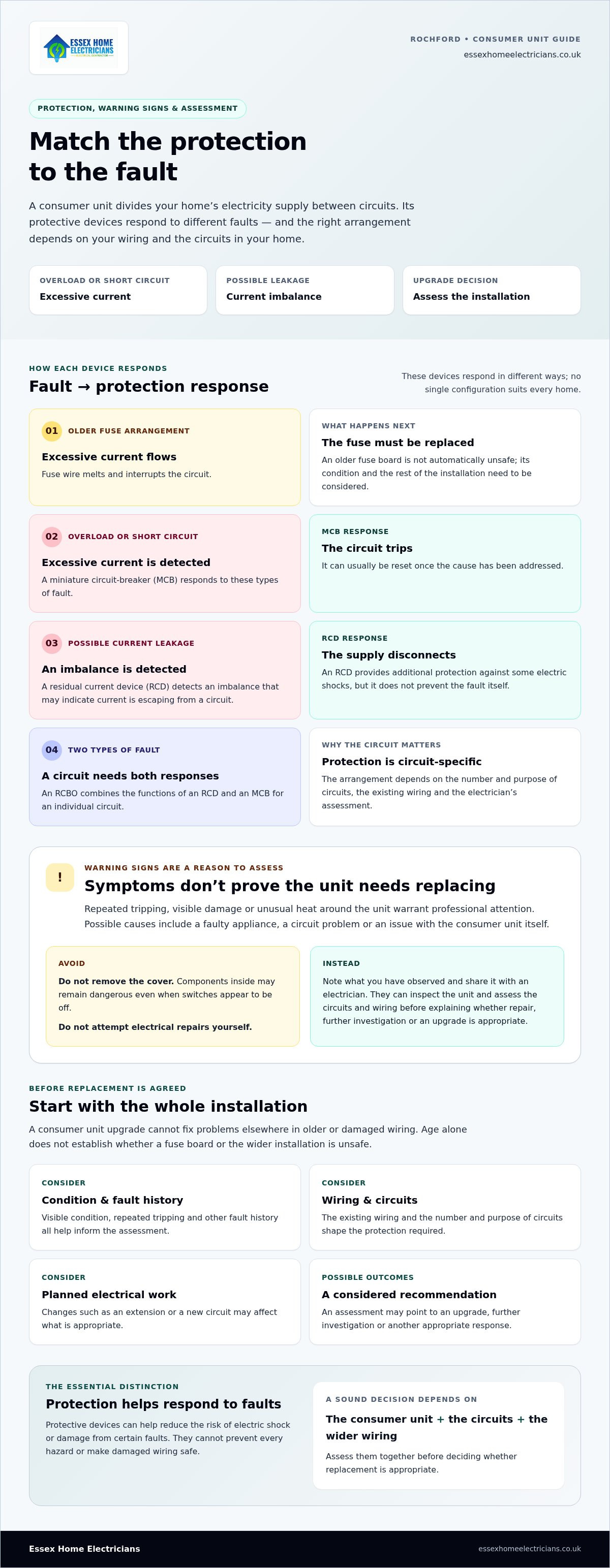
The consumer unit divides the incoming electricity supply between circuits serving different parts of your home, such as lighting, sockets and fixed appliances. Each circuit has protective devices. A circuit breaker switches off a circuit if it detects an overload or short circuit. A residual current device (RCD) monitors the flow of electricity and can disconnect the supply if it detects an imbalance that may indicate current is leaking from a circuit.
These devices can help reduce the risk of electric shock or damage from certain faults, but they can’t prevent every hazard or fix problems in the wiring. For a technical overview of what a consumer unit is, see this explanation of distribution boards and their components.
Older fuse boxes commonly use fuse wire that melts when excessive current flows. Modern consumer units use switches that trip and can usually be reset once the cause has been addressed. That difference alone doesn’t mean an older fuse box is unsafe. Its condition and the rest of the electrical installation need to be considered together.
Which signs mean your consumer unit needs professional attention?
Repeated tripping, visible damage or unusual heat around the unit are reasons to arrange a professional assessment. These symptoms can have different causes, including a faulty appliance, a circuit problem or an issue with the consumer unit itself. They don’t prove that the unit must be replaced.
Don’t remove the cover. Components inside may remain dangerous even when switches appear to be off.
Don’t attempt electrical repairs yourself. Note what you’ve observed and share it with the electrician.
A careful assessment gives Rochford homeowners a clearer understanding of what their installation needs. The decision to replace a fuse box should be based on the condition of the existing system, not an assumption that every older unit needs replacing.
How modern consumer units protect circuits, and what an upgrade changes
An upgrade can replace older fuse protection with switches that respond to particular electrical faults. The benefit depends on the protective devices selected and the condition of the circuits they serve. No consumer unit can prevent every fault or make damaged wiring safe, so the right setup starts with an assessment of the existing installation.
RCDs, RCBOs and circuit breakers: what is the difference?
Think of a kitchen socket circuit. An MCB responds to excessive current from an overload or short circuit. An RCD responds to a current imbalance that may indicate leakage. An RCBO can respond to both types of problem on its own circuit. The precise arrangement depends on the number and purpose of the circuits, the existing wiring and the electrician’s assessment.
Separate protection for circuits can affect how widely a fault interrupts power, but no single configuration suits every home. During installation, your electrician should explain why the proposed devices suit your property and any planned electrical work.
Does every older fuse board need replacing?
No. Age alone doesn’t establish whether a fuse board or the wider installation is unsafe. An electrician considers its visible condition, any history of tripping or other faults, the wiring and whether you’re planning changes such as an extension or a new circuit. An assessment may identify a need for an upgrade, further investigation or another appropriate response.
Work should follow the current applicable electrical safety requirements. GOV.UK’s Approved Document P guidance for electrical safety in dwellings provides information on Building Regulations guidance. The requirements depend on the work and property.
If you’re weighing up an upgrade for your Rochford home, discuss your consumer unit concerns with Essex Home Electricians. An assessment helps establish what needs attention before replacement work is agreed.
Consumer unit options in Rochford: matching protection to your home
There isn’t one consumer unit arrangement that suits every property. The right specification depends on the circuits already in place, their condition and what you may add to your home. A house with a planned extension or new electrical circuit, for example, may have different requirements from a home where the existing circuits are staying unchanged.
An electrician assesses the existing installation before specifying a consumer unit, because the right equipment depends on the circuits it needs to protect.
What factors shape the consumer unit specification?
The assessment considers how many circuits the unit serves, what each circuit supplies and the condition of the wiring and connections. The electrician also needs to understand planned work, such as adding an EV charger, extending the property or changing how a room is used. These details help determine an appropriate unit and protective-device arrangement in line with the applicable requirements.
Circuit protection: Different arrangements can use RCD protection shared across groups of circuits, individual RCBO protection, or a combination. The choice affects how circuits are protected and how a fault may affect other parts of the home.
Installation needs: The existing cables, connections and available space can influence the work required to fit a replacement safely.
Future plans: Discuss planned additions before equipment is specified, so the electrician can consider them as part of the overall design.
For a consumer unit installation, the recommendation should follow the assessment rather than assume a standard setup. Electrical Safety First’s best practice guidance for electrical work offers further context on good practice around consumer unit replacement.
Could other electrical work be needed at the same time?
A consumer unit replacement changes the central point of circuit protection. It doesn’t automatically renew every cable or bring every circuit up to a different condition. Inspection and testing may reveal a separate issue, such as a circuit that needs repair or further investigation. The electrician can explain what’s been identified and whether it affects the proposed work.
A new unit doesn’t automatically require a full rewire. Some homes may need only the consumer unit work, while others may need additional remedial work or a wider rewiring discussion. The extent depends on the condition of the existing installation and the agreed scope. Essex Home Electricians carries out full and partial house rewiring where the installation needs wider work. If wiring condition is a concern, read this house rewiring guide for Essex homes for more context.
What to expect during a consumer unit installation: the steps
A consumer unit replacement should follow a clear sequence: assess the existing installation, agree the scope of work, carry out the installation, test the results and explain the handover. The electrician considers the consumer unit, circuits and relevant wiring conditions before confirming what the job involves. This helps identify any limitations or additional work that may affect the plan.
Before work begins: assessment and preparation
The electrician reviews the existing unit and the circuits it serves, including any concerns such as repeated tripping or visible damage. Inspection and testing may be needed to understand the condition of the wiring. An Electrical Installation Condition Report (EICR) is one type of report used to assess an electrical installation. Essex Home Electricians carries out EICRs and electrical safety checks.
Once the assessment is complete, the electrician should explain the proposed work, any issues found and what falls within the agreed scope. If the condition of a circuit affects the installation, that should be discussed before work proceeds. To help the visit run smoothly, keep clear access to the consumer unit and the surrounding area. Move furniture or stored items away where you can, and keep pets and children clear of the work area.
Installation, inspection, testing and handover
During the installation, a qualified electrician isolates the supply, removes the existing unit and fits the replacement as appropriate to the agreed work. The power will need to be switched off during relevant parts of the job, so plan for a temporary interruption to electricity. The time required varies with the property, the condition of the installation and any additional work identified. There isn’t a reliable fixed duration for every home.
After fitting, the electrician carries out checks and testing on the completed work and relevant circuits. These checks help establish whether the installation is operating as intended. They don’t mean that every unrelated issue elsewhere in the home has been resolved. If testing identifies a concern, the electrician should explain what it means and what action may be needed.
At handover, expect an explanation of the new unit and its protective devices, along with the applicable installation documentation. Ask about anything that’s unclear, including which switch relates to each circuit and what to do if a protective device trips. For a planned installation in Rochford, discuss your Rochford installation with Essex Home Electricians and outline your property, concerns and any planned electrical work.
Book a consumer unit installation in Rochford with Essex Home Electricians
If you’re considering an upgrade, start with a conversation about your home and what prompted the enquiry. Tell the team you’re in Rochford, describe any concerns with the existing consumer unit or electrical system, and mention planned work such as an extension or new circuit. This gives the team useful context for discussing the work and the options that may suit your property.
Why use a qualified, NAPIT-accredited electrical contractor?
Consumer unit work involves electrical connections and protective devices that need to be installed and tested correctly. Qualified electricians can assess the existing installation, explain the proposed work in plain language and carry out appropriate checks afterwards. Essex Home Electricians is NAPIT-accredited, and its electricians are qualified and fully insured. With over 20 years of experience, the team can provide clear explanations and practical support. Accreditation is a useful trust signal, but it doesn’t replace applicable legal and safety requirements.
How to request a consumer unit installation quote
To request a free, no-obligation quote, share your Rochford location, what you’ve noticed and any electrical work you’re planning. You might mention repeated tripping, visible damage or plans to add a circuit. You don’t need to diagnose the problem yourself. A clear description helps the team discuss your home and the next steps without pressure to proceed.
Contact Essex Home Electricians to discuss your property and request a quote: Contact Essex Home Electricians about your installation.
Take the next step towards a safer, well-planned upgrade
A consumer unit upgrade should be based on the condition of your home’s electrical installation, not age alone. An assessment helps clarify whether replacement is needed, which protective arrangement suits your circuits and whether any separate wiring work should be considered.
Essex Home Electricians carries out consumer unit upgrades and electrical work for homeowners, with qualified, fully insured electricians, NAPIT accreditation and over 20 years of experience. You can request a free, no-obligation quote and get clear guidance on the proposed work before deciding how to proceed.
Share your Rochford location, what concerns you about the current unit and any planned electrical work. Contact Essex Home Electricians to discuss your Rochford consumer unit installation and take a practical first step towards greater confidence in your home’s electrical system. The team is based in Basildon and serves homeowners in Benfleet, Canvey Island, Rayleigh, Wickford, Billericay, Leigh-on-Sea and Southend as well as Rochford.
Frequently Asked Questions
When should I consider a consumer unit installation in Rochford?
Consider a professional assessment if your unit is damaged, unusually warm or repeatedly trips, or if you’re planning electrical changes at home. These signs don’t automatically mean the consumer unit needs replacing, as faults can have several causes. An electrician can assess the unit, circuits and wiring condition before recommending what work, if any, is appropriate.
Does an old fuse box always need replacing?
No. Age alone doesn’t show whether a fuse box or the wider electrical installation is in poor condition. An electrician considers its visible state, any history of faults, the condition of the circuits and planned work. An older unit may still be suitable, or an assessment may identify a need for repairs, further investigation or replacement. Avoid removing the cover to inspect it yourself.
How long does consumer unit installation take?
There isn’t a fixed duration for every installation. The time required depends on the property, the existing wiring and circuits, access to the unit, and whether the assessment identifies additional work. A straightforward replacement may involve a different scope from one where a circuit needs attention. Your electrician should explain the expected work and likely disruption once the home and installation have been assessed.
Can I replace a consumer unit myself?
Will a new consumer unit fix faults in my home’s wiring?
Not necessarily. A new consumer unit replaces the central equipment that distributes electricity and houses protective devices, but it doesn’t renew every cable or repair faults elsewhere in the property. Inspection and testing may reveal issues with individual circuits or wiring that need separate attention. Ask the electrician to explain any findings and what they mean for the agreed installation work.
Will the electricity be switched off during installation?
Yes, expect the electricity supply to be interrupted during relevant parts of the installation so the electrician can carry out the work safely. The length of the interruption depends on the property and the work required, so plan for a temporary loss of power rather than assume a set duration. Your electrician can discuss practical arrangements as part of agreeing the work.
Does consumer unit replacement include an electrical safety certificate?
Consumer unit replacement should be followed by appropriate inspection, testing and installation documentation. For replacement work, this is generally an Electrical Installation Certificate, which records the completed work and test results. The electrician should explain the documents provided at handover. Essex Home Electricians is based in Basildon and supports local homeowners in Rochford, Benfleet, Canvey Island, Rayleigh, Wickford, Billericay, Leigh-on-Sea and Southend.